The world premiere of the Mercedes-Benz eActros
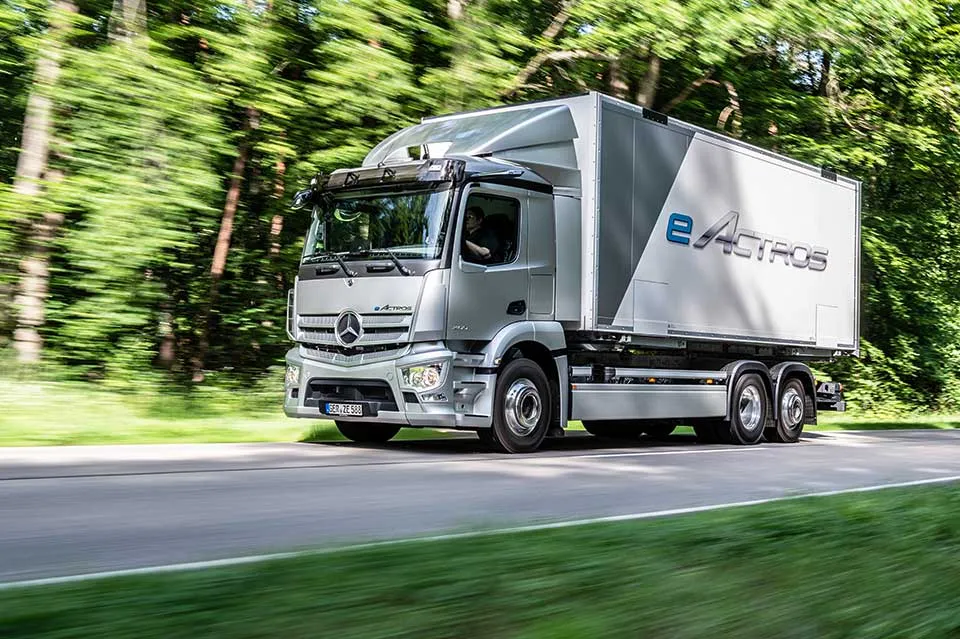
The eActros sets benchmarks in CO2-neutral goods transport.
- Mercedes-Benz Trucks is committed to offering only electrically powered trucks in Europe by 2039.
- With the eActros, the manufacturer is taking an important step towards achieving the goals of the Paris Climate Agreement.
- The eActros is now “Charged & Ready” and forms an integral part of a business-focused ecosystem.
- Findings from the “eActros innovation fleet”, together with extensive customer feedback, have been incorporated into the development of the series-production model.
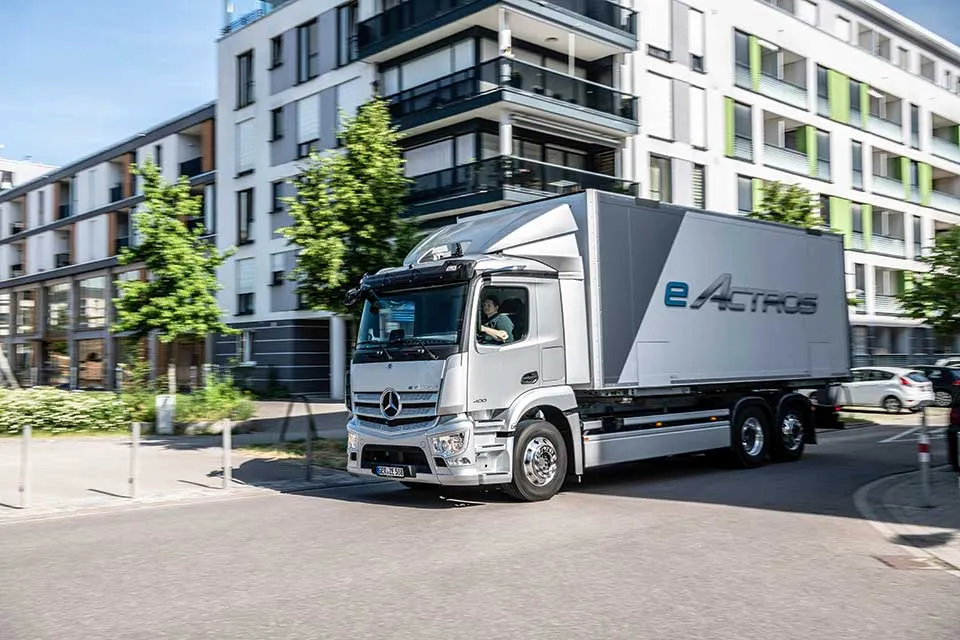
The logistics sector faces enormous challenges: environmental regulations are becoming ever stricter, while global transport volumes continue to rise. This vast quantity of goods must be transported as sustainably and efficiently as possible.
In recognition of its social responsibility to protect the climate, Mercedes-Benz Trucks is doing everything it can to achieve its goal of CO2-neutral goods transport using electric vehicles powered by batteries or hydrogen fuel cells. The company supports the climate goals of the Paris Agreement, which aim to reduce carbon emissions from the sector, and intends to switch its European models to fully electric drive by 2039.
The Mercedes-Benz Trucks eActros is the first all-electric series-production vehicle to bear the three-pointed star, marking a major milestone in the drive towards locally CO2-neutral goods transport. There is more good news for electric long-haul transport: series production of the low-floor Mercedes-Benz eEconic is expected to start in 2022. The battery-powered eActros LongHaul is also expected to reach the market in 2024, while the hydrogen fuel-cell GenH2 Truck is due in the second half of this decade.
An innovative response to radical change in the transport sector
The eActros was specially developed for heavy-duty distribution over short distances. Its sustainable, environmentally friendly credentials can also enhance the image of transport companies, not to mention making a career as a lorry driver far more attractive. The eActros also offers an opportunity to rethink regional and local short-distance distribution. The electric truck brings many other benefits for customers, including the ability to make night-time deliveries and enter city centres where diesel vehicles are no longer permitted.
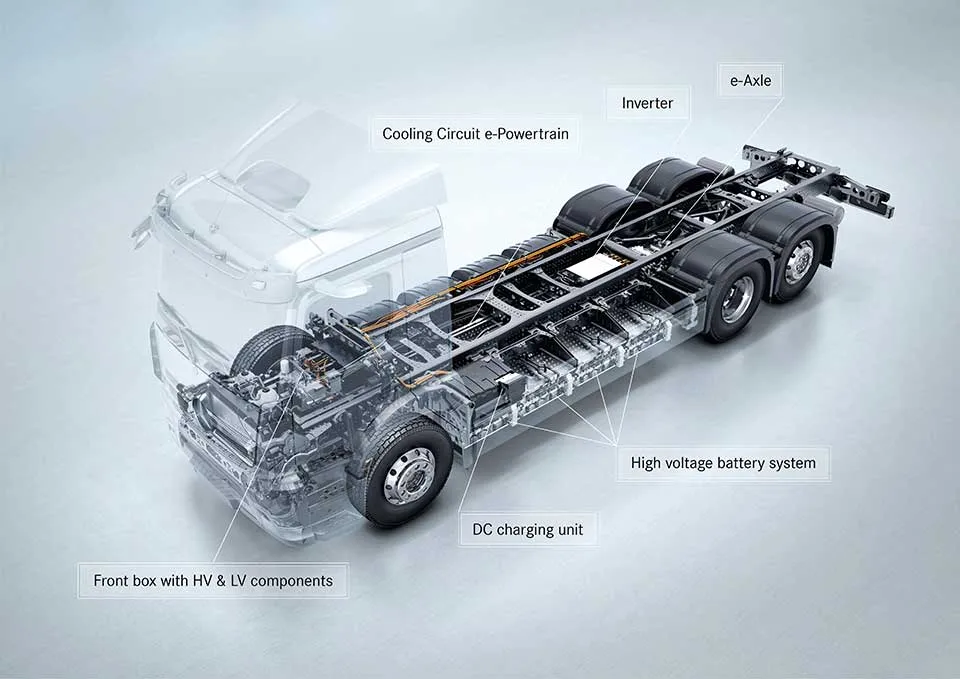
Mercedes-Benz Trucks offers fleet operators an integrated, end-to-end solution
Of course, purchasing an electric truck must also make financial sense for transport companies’ day-to-day operations. Operators are also likely to have a number of questions: which routes can an electric truck operate on? What about charging infrastructure? What building work and investment will be needed at the depot?
It is therefore becoming even more important to offer customers more than just an electric truck, and to support them throughout the transition to an electrified fleet. Electric mobility, or eMobility, is about more than a new drive system. That is precisely why Mercedes-Benz Trucks has integrated the eActros into a business-focused ecosystem under the slogan “Charged & Ready”. The ecosystem offers advice through eConsulting, as well as digital eMobility solutions and tools to optimise total cost of ownership (TCO). The integrated eActros is a “full service” offering that makes Mercedes-Benz Trucks a reliable partner for customers seeking sustainable mobility for the future.
Successful customer field trials as part of the “eActros innovation fleet”
After Mercedes-Benz Trucks unveiled a concept vehicle for heavy-duty short-distance distribution at the IAA Commercial Vehicles show in Hannover in 2016, the first eActros prototypes were loaned to various customers in Germany and elsewhere in Europe for field trials in 2018. The main aim of the “eActros innovation fleet” was to create a market and an electric series-production truck for heavy-duty short-distance distribution by 2021. Various aspects were examined, including energy requirements in different operating scenarios and the efficiency of the eActros prototypes. Development and testing of the innovation fleet prototypes received tiered funding as part of the “Concept ELV²” project, run by the German Federal Ministry for the Environment, Nature Conservation and Nuclear Safety (BMU) and the German Federal Ministry for Economic Affairs and Energy (BMWi).
After more than two years, the main finding of the pilot project was that the prototypes delivered impressive performance. Drivers were particularly impressed by the torque, which is continuously available throughout the entire rev range. They also highlighted the quiet operation and comfortable, smooth driving experience. Findings from the innovation fleet, along with extensive customer feedback, have been fully incorporated into development of the series-production model. Compared with the prototype, the production model has been significantly improved in several key areas, including range, performance and safety. In short, this is co-creation with customers in its purest form. Initially, the eActros series-production model will be available in Germany, Austria, Switzerland, Italy, Spain, France, the Netherlands, Belgium, Great Britain, Denmark, Norway and Sweden. Other markets will follow later.
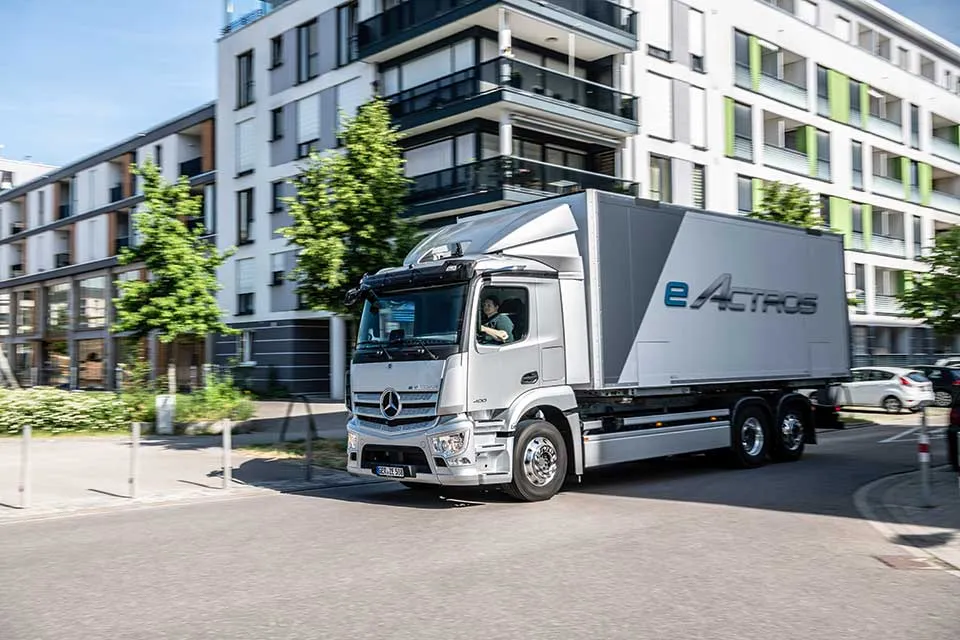
High-tech equipment ensures sustainable performance
The eActros delivers abundant power and an impressive driving experience
- The compact electric axle in the electric drive system, with two electric motors, delivers outstanding performance and up to 400 kW of power.
- The eActros is available with three or four battery packs of approximately 105 kWh[1] each, giving it a total battery capacity of 315 or 420 kWh.[2]
- Its range is an impressive 400 kilometres.[3]
- The eActros offers a high level of driving comfort, thanks in part to its powerful acceleration and low noise levels.
When choosing an electric truck, transport companies consider factors such as range, power delivery, rapid charging, everyday usability and a wide range of applications, not to mention low noise levels and locally CO2-free operation. The eActros is available as a two- or three-axle truck with a maximum permitted mass of 19 or 27 tonnes. The new truck is based on the frame of the Mercedes-Benz Actros. Its quiet powertrain also makes night-time deliveries possible, easing pressure on the road network during peak periods.
Continuous power transmission to the electric axle
Mercedes-Benz Trucks uses a global platform architecture for the eActros: the ePowertrain. Its technological heart is the drive unit, a rigid electric axle with two integrated electric motors and a two-speed transmission. Compared with designs using a central motor, this configuration offers several advantages. Its more compact construction leaves more installation space for greater battery capacity, which in turn has a positive effect on range. Direct power transmission, made possible by this design, also offers efficiency benefits compared with a central motor.
The two motors are mounted centrally on the rear axle and deliver 330 kW of continuous power and a maximum output of 400 kW. The instant torque of the electric motors, which are connected to a two-speed transmission, ensures powerful acceleration, impressive driving comfort and a responsive performance that makes for a more relaxed, less stressful driving style than in a conventional diesel truck. At full load, drivers also benefit from quiet operation: cabin noise is reduced by as much as 10 dB, roughly equivalent to halving the perceived volume. There are also significantly fewer vibrations than in a diesel truck.
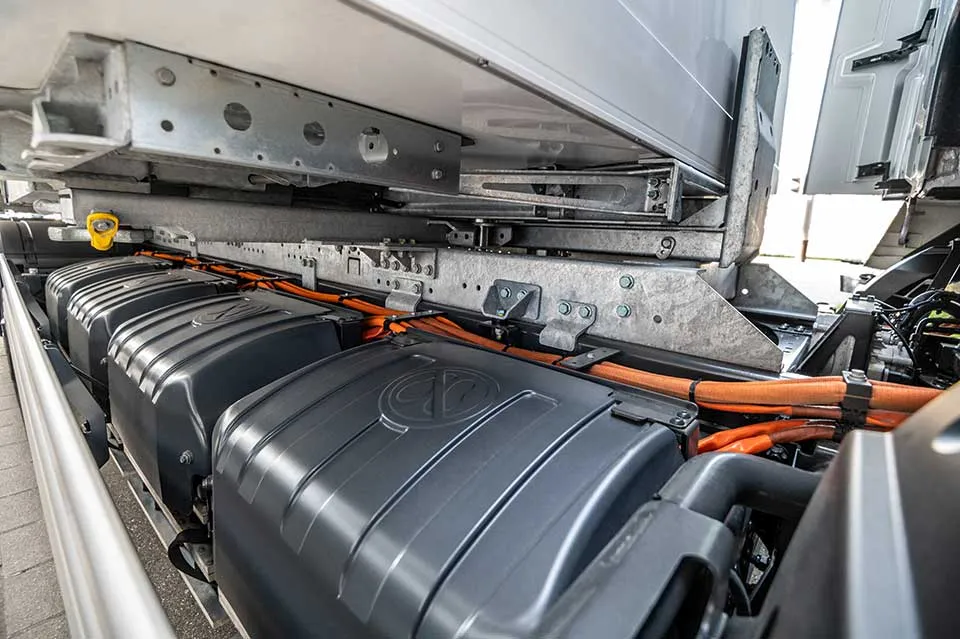
Mercedes-Benz Trucks battery technology
Depending on the equipment version, it draws its energy from three or four battery packs, each with a capacity of 105 kWh4. Installed in compartments beneath the frame, they provide a total capacity of 315 or 420 kWh[4]. The maximum capacity of 420 kWh gives the truck a range of up to 400 kilometres[5].
In this context, combining large battery packs with powerful electric motors has a positive side effect: significant recuperation potential. Whenever the brakes are applied, the electric motor can recover kinetic energy and convert it into electrical energy. This recovered energy is fed back into the eActros batteries, where it is stored to increase range. Depending on the situation, the driver can choose from five different braking levels.
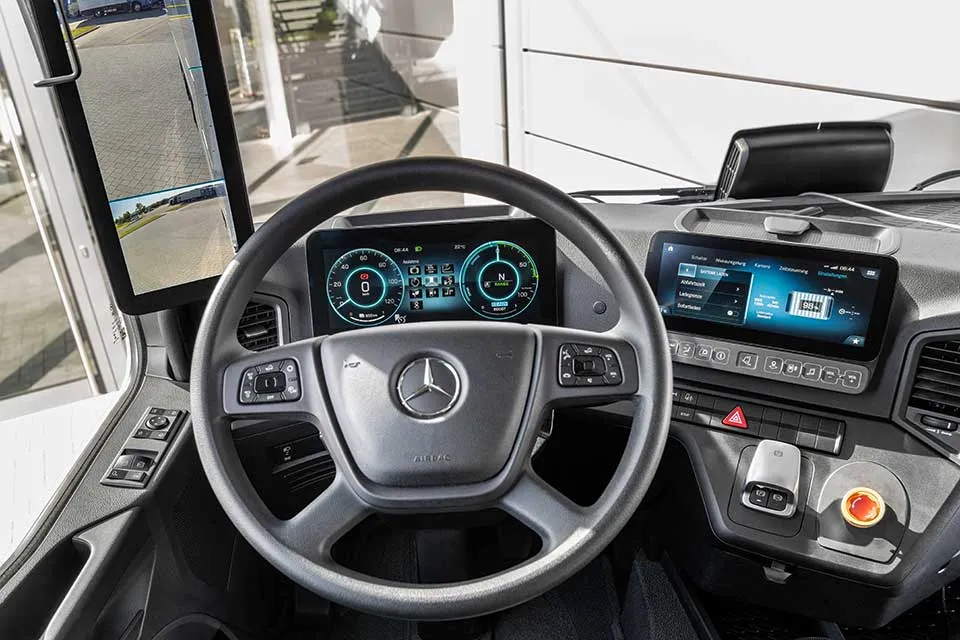
A screen in the eActros’s standard Multimedia Cockpit Interactive keeps the driver informed of the battery charge level, remaining range, and current and average energy consumption in kWh per 100 kilometres.
The batteries supply electricity not only to the powertrain but also to the rest of the vehicle. This means auxiliary systems such as the air compressor for the brakes, the cab air-conditioning compressor and, where fitted, a refrigerated body are also electrically powered. If required, the battery packs can be replaced easily.
Smart charging and component-packaging concept
The charging standard used is the Combined Charging System (CCS). When connected to a standard 400 A DC charger at an ambient temperature of 20 °C, the three battery packs take just over 1 hour to charge from 20 to 80 per cent. Charging the eActros requires a CCS Combo 2 connector and a charging station that supports DC charging.
The onboard low-voltage system, with two standard 12 V batteries, is charged by the high-voltage batteries via a DC/DC converter. This keeps all relevant vehicle functions, including lights, indicators, brakes, air suspension and cab functions, operational even if the high-voltage electrical system fails or is switched off.
Many of the eActros’s high- and low-voltage components have been installed in a particularly space-efficient way in the front compartment, previously occupied by the combustion engine. These include the heat exchanger, water pumps, electric cab circuits, DC/DC converter, valves and the two low-voltage batteries. The components in this compartment are easily accessible for repairs and maintenance. The compact layout also helps to distribute weight more evenly across the axles.
Business-focused ecosystem
Mercedes-Benz Trucks offers customers comprehensive eConsulting services and intelligent digital solutions for the eActros
- The advice provided by the Mercedes-Benz Trucks eConsulting team includes route analyses, checks for any available subsidies, support with operational fleet integration and optimisation of total operating costs.
- If required, our partners, Siemens Smart Infrastructure, ENGIE and EVBox Group, are also available to help customers analyse their depots and create suitable infrastructure, as well as intelligent hardware and software solutions for charging.
- Digital solutions and apps help make the eActros even more efficient to operate within fleets.
- Comprehensive protection with the Mercedes-Benz Complete service contract, including Mercedes-Benz Uptime.
In the coming years, more than ever, truck customers will face the challenge of choosing the best powertrain for their specific sector, segment and application. eMobility will play a central role in this. Mercedes-Benz Trucks aims to meet the associated challenges, which go far beyond the vehicle itself, with a range of tailored offerings. The manufacturer also wants to help transport companies switch to electric mobility and ensure that electric trucks can be operated as effectively as possible.
To this end, Mercedes-Benz Trucks has developed an ecosystem called eConsulting, which provides customers with advice and infrastructure options: this is the integrated eActros solution. The ‘full service’ offering starts with the customer’s existing route plans and uses them to create a highly realistic and useful operating profile for electric trucks. Mercedes-Benz Trucks’ eConsulting also includes comprehensive advice on operating the vehicle efficiently and optimising total cost of ownership. Other services include support with integrating electric trucks into existing fleets and checking whether companies are eligible for government subsidies for infrastructure and vehicles.
If customers wish, Mercedes-Benz Trucks is on hand to answer questions about planning, application and implementation processes, helping customers obtain a turnkey charging infrastructure tailored to their needs, along with a connection to the electricity grid. For this purpose, Mercedes-Benz Trucks has entered into a strategic partnership with Siemens Smart Infrastructure, ENGIE and EVBox Group. If customers wish to use their services, the partners will analyse their depots and install suitable infrastructure or energy supply systems. They will also maintain the charging infrastructure. Siemens Smart Infrastructure, ENGIE and EVBox Group work closely with Mercedes-Benz Trucks at every stage of the process.
One of the first and most important steps in switching to eMobility is charging vehicles at the customer’s depots. The necessary infrastructure can be tailored specifically to the requirements and processes of each logistics operation. Depot charging is ideally suited to applications in which electric trucks operate in urban areas on planned routes and can be charged overnight or during normal periods when they are not in use. In most of these cases, business processes change little or not at all. It also avoids the need for complex billing or vehicle authentication.
Intelligent digital solutions for even greater efficiency
To get the most out of the eActros, Mercedes-Benz Trucks offers its customers a wide range of digital solutions and apps. With the Multimedia Cockpit Interactive, which is standard in the eActros, the driver is always kept up to date on battery charge level and remaining range, as well as current and average energy consumption. Fleet managers can also use the digital solutions in the FleetBoard portal to manage their fleet efficiently. These include a bespoke charge management system for creating charging profiles and a logbook containing detailed information on driving times, downtime and charging breaks. A map view also shows the vehicle’s current location in real time, as well as whether it is moving, parked or charging, and the battery’s charging speed.
Mercedes-Benz Complete and Uptime: digital protection, now also for the eActros
The eActros is also available with Mercedes-Benz Complete, a service contract that includes the All-round Carefree Package. This comprehensive service package covers workshop work to maintain and repair the entire vehicle and powertrain, including wear parts. It covers everything from coordinating appointments through to billing. This gives customers comprehensive cover and helps keep their vehicle operating as planned.
The service contract also always includes intensive customer support through Mercedes-Benz Uptime. Fleet operators want any problems that arise during day-to-day operation to be identified and resolved as quickly as possible. The intelligent system monitors all relevant vehicle data, from tyre pressure to the engine and now also battery status. To this end, Mercedes-Benz Uptime has been expanded with more than 100 e-specific rules that continuously monitor charging processes, the high-voltage battery’s voltage history and more. The information is also available via the new cloud-based customer portal. Thanks to the networked connection between Mercedes-Benz Service and transport companies, workshop visits can be planned and unexpected downtime due to faults avoided.
High levels of safety for the driver and all other road users
Numerous driver assistance systems and technical features give the eActros a high level of safety
- Special crash elements with an aluminium profile can protect the batteries in a side impact, while sensors in the profiles can automatically disconnect the high-voltage battery.
- As the eActros is usually almost silent, it comes as standard with the Acoustic Vehicle Alerting System, an audible warning that helps pedestrians and cyclists, among others, hear the electric truck more easily.
- To enhance safety when the eActros is switched off and travelling in the longitudinal direction, it comes as standard with Sideguard Assist S1R and the fifth-generation Active Brake Assist system.
With the latest generation of the Actros with conventional diesel power, Mercedes-Benz Trucks has already demonstrated impressively the level of safety we can bring to the roads today and how the manufacturer is making its vision of accident-free driving a reality. For the eActros, Mercedes-Benz Trucks focused not only on active safety, but also on the additional challenges posed by electric vehicles and high-voltage systems.
Automatic or manual deactivation of the high-voltage system
In general, the eActros’s batteries, high-voltage cables and other high-voltage components are designed and protected so that, in the event of an accident, they meet not only Mercedes-Benz Trucks’ stringent safety requirements but also statutory and regulatory requirements. The electric truck’s battery temperature warning continuously monitors the temperature of the high-voltage batteries. If the temperature becomes too high, the alarm system in the cab issues an audible warning. The alarm also works when the vehicle is switched off. In terms of design, the batteries are protected in a side impact by special crash elements on the frame. The aluminium profile of these elements is designed to absorb as much energy as possible. They also contain integrated sensors that can detect an accident. In such a case, the HV battery would be automatically isolated from the rest of the vehicle. To assist the emergency services, additional isolation points have been provided beneath the seats to deactivate the high-voltage system.
When the system is deactivated, it ensures within a few seconds that no residual voltage remains in the high-voltage system, other than in the battery, to prevent injury. In addition to automatic deactivation, the driver can also manually switch off the high voltage in the cab if they detect a hazard. When the high-voltage system is deactivated, the drive system and continuous braking function no longer operate. As long as the low-voltage system (24V) remains active, the service brakes, lighting, hazard warning lights and steering continue to work.
Acoustic warning system improves the eActros’s detectability
Like all electric vehicles, the eActros is usually almost silent. In some situations, this can lead to dangerous circumstances, for example if pedestrians or cyclists notice the electric truck too late. To prevent such situations, the eActros comes as standard with an external Acoustic Vehicle Alerting System (AVAS).
The acoustic warning system comprises two speakers, one at the front and one at the rear. They are connected to each other and to the eActros. Depending on the driving conditions, sounds are emitted for forward and reverse movement. When the vehicle moves forwards, it sounds like a quiet fan. In reverse, a two-tone intermittent sound can be heard.
The AVAS system comfortably exceeds the minimum sound levels specified in UNECE Regulation 138.01: at least 10 dB when moving forwards and at least 15 dB in reverse. This ensures that the eActros is easily detectable. However, the legally permitted maximum level is not exceeded, and drivers or passers-by do not subjectively find the sounds disturbing. An additional safety feature has also been implemented that goes beyond the requirements of UNECE Regulation 138.01: the forward-motion sound plays as soon as the driver selects ‘D’ and releases the parking brake. This helps other road users better judge the vehicle’s presence. As soon as the driver selects reverse, the reversing sound is emitted.
Greater safety when turning
Improving the detectability of an electric truck is crucial when it turns right. Accidents involving trucks turning right are among the most serious incidents that can occur in urban areas, not only for vulnerable road users such as cyclists and pedestrians but also for the drivers themselves. To prevent such accidents wherever possible, or at least limit their consequences, the eActros comes as standard with Sideguard Assist S1R. If there is a risk that a truck driver might fail to see a cyclist or pedestrian in their blind spot when turning right, the system can assist the driver with a multi-stage warning process. For its visual warnings, the S1R uses the MirrorCam display, which is also installed in the eActros in place of conventional main and wide-angle mirrors.
Sideguard Assist comprises two short-range radar sensors mounted on the frame on the passenger side, ahead of the truck’s rear axle. The system is designed to monitor the entire length of the vehicle combination, plus 2 metres at the front, 1 metre at the rear and up to 3.75 metres to the side. However, Sideguard Assist S1R does not actively intervene in the braking system. The driver must therefore respond to the system’s warnings and brake the vehicle themselves.
Active Brake Assist 5 with pedestrian detection
For years, a large proportion of accidents involving heavy trucks have been longitudinal collisions: accidents in which a truck hits the vehicle in front or a stationary vehicle because the driver is distracted, fails to keep a sufficient distance or drives at an inappropriate speed. The eActros can avoid many of these accidents thanks to its standard-fit fifth-generation Active Brake Assist (ABA) system. ABA 5 uses a combined radar and camera system. If it detects an imminent collision with a vehicle in front, a stationary obstacle or a person, it first warns the driver visually and audibly, whether the person is crossing the road in front of the truck, walking towards it, walking in its lane or suddenly stopping out of fear. If the driver does not respond sufficiently, the system partially applies the brakes in a second stage, decelerating at up to three metres per second squared. This corresponds to around 50 per cent of the maximum braking performance. If the risk of a collision remains, ABA 5 applies the full braking force. For pedestrians in motion, this applies at vehicle speeds of up to 50 km/h. Finally, the vehicle activates the new electronic parking brake to bring it to a halt.
With all its driver assistance systems, Mercedes-Benz Trucks aims to support the driver as much as possible, within the respective limitations of each system. However, as required by law, the driver remains fully responsible for driving the vehicle safely at all times.
Sustainable and flexible production
The production model of the eActros will be built in Wörth.
- The electric truck models will be built at the Wörth plant on a flexible production line that also manufactures trucks with conventional drivetrains.
- Production of the eActros is fully integrated into Mercedes-Benz Trucks’ drivetrain and vehicle production network.
- The network also handles the processing and assembly of key electric drivetrain components at the plants in Gaggenau (electric axle components), Kassel (electric axle assembly and testing) and Mannheim (high-voltage battery assembly), as well as vehicle production at the Wörth plant.
The heart of eActros series production is the production hall in Building 75 at the Wörth plant. Intensive preparations for the new production processes have been under way there over the past few months. A new assembly line has been built, primarily for installing high-voltage components, including battery packs from the plant’s Competence Centre for Zero-Emission Mobility (KEM) in Mannheim, and commissioning finished vehicles. The vehicles are then returned to the finishing area and final inspection, which form part of the normal production process.
Mercedes-Benz Trucks has established a dedicated organisational structure for high-voltage technology at the Wörth plant. High-voltage specialists must also complete special training at the site’s in-house training centre before they are permitted to work on the eActros. The training comprises a number of modules covering the specialist components and work on high-voltage parts and electric trucks.
In the assembly hall, the electric truck models are built flexibly alongside trucks with conventional drivetrains. The aim is to integrate production of different vehicle types as fully as possible and to build the vehicle’s basic structure on a single production line, regardless of whether it is fitted with a conventional internal combustion engine or an electric drivetrain.
One example is the electric axle used in the vehicle, which comes from the Mercedes-Benz plant in Kassel. There, the electric axles and complete electric drivetrain, comprising the electric motor and engageable transmission elements, are assembled. Final checks focus on correct operation, high-voltage system safety and noise characteristics. Since the electric axle is essentially based on the same design as the conventional models, it can be pre-assembled on the existing production line alongside the axles for the regular model range.
Mercedes-Benz Trucks therefore makes use of the existing infrastructure in the assembly hall while increasing the flexibility of production units for the individual model ranges. With this in mind, the transition from conventional to electric models can be implemented proactively.
Statements from management and selected customers/drivers
Karin Rådström, member of the Board of Management at Daimler Truck AG and responsible for Mercedes-Benz Trucks:
“When it comes to climate change, we have to acknowledge that transport is part of the problem. At the same time, we can and will be part of the solution, starting with our eActros. We developed and tested this truck together with our customers. In total, it covered more than half a million kilometres on public roads. The eActros and its dedicated services represent an important step towards CO2-neutral transport for Mercedes-Benz Trucks and our customers.”
Andreas von Wallfeld, Head of Sales & Marketing at Mercedes-Benz Trucks: “With a range of up to 400 kilometres[6], a gross combination weight of up to 40 tonnes and two powerful electric motors with a maximum output of 400 kW, the eActros is ideally equipped to handle our customers’ day-to-day work. Alongside the truck itself, our digital services and new eConsulting teams help customers make the transition to eMobility as simple and seamless as possible, for example by answering questions about charging infrastructure, fleet integration and route planning.”
Prof. Uwe Baake, Head of Development at Mercedes-Benz Trucks: “The eActros comes as standard with proven innovations such as MirrorCam and Multimedia Cockpit Interactive, not to mention our safety systems, including emergency braking assistance with pedestrian detection and Sideguard Assist. What’s more, our customers don’t have to compromise on the driving experience. The eActros offers a high level of driving comfort thanks to its powerful acceleration and low noise levels. With the compact drivetrain featuring two electric motors on the electric axle, we can deliver up to 400 kW of power.”
Rainer Schmitt, Managing Director of Logistik Schmitt GmbH in Bietigheim (Germany): “I feel that I’m part of a generation in transition: I grew up with the smell of diesel in our workshop, and now we’re making the move to eMobility. We’re naturally proud to be part of that. The vehicle is in use around the clock and has been integrated seamlessly into the fleet.”
Wim Roks, fleet manager at Simon Loos bv in Wognum (the Netherlands): “Our first experiences with the eActros have been very positive. People look at it, and some give you an unexpected thumbs-up in the middle of the city. With this truck, Mercedes-Benz has drawn on its expertise and usual service to make sure the vehicle works with the charging infrastructure.”
Torsten Schuhmann, driver for EDEKA: “Driving the eActros is a real pleasure. The power of the electric motors is amazing, and the truck is also extremely quiet. Mercedes-Benz has certainly produced a fully-fledged electric truck.”
Guillaume Fortanier, driver for Simon Loos bv in Zaandam (the Netherlands): “The first thing you think is: the engine isn’t running. Other truck drivers and car drivers are impressed, though, by how well it keeps up with the flow of traffic. What I mean is that it accelerates just as well as a conventional vehicle. I’m particularly proud to have had the opportunity to drive the eActros.”
Question about this story? Ask your question
Keep following this
Get an email when a new story is published. No account needed.
- ThemeTowards low-emission equipment and transport
- SubjectTransport & off-road