On-site recycling to cut transport and costs
Text Philippe Selke Beeld Fisse sprl
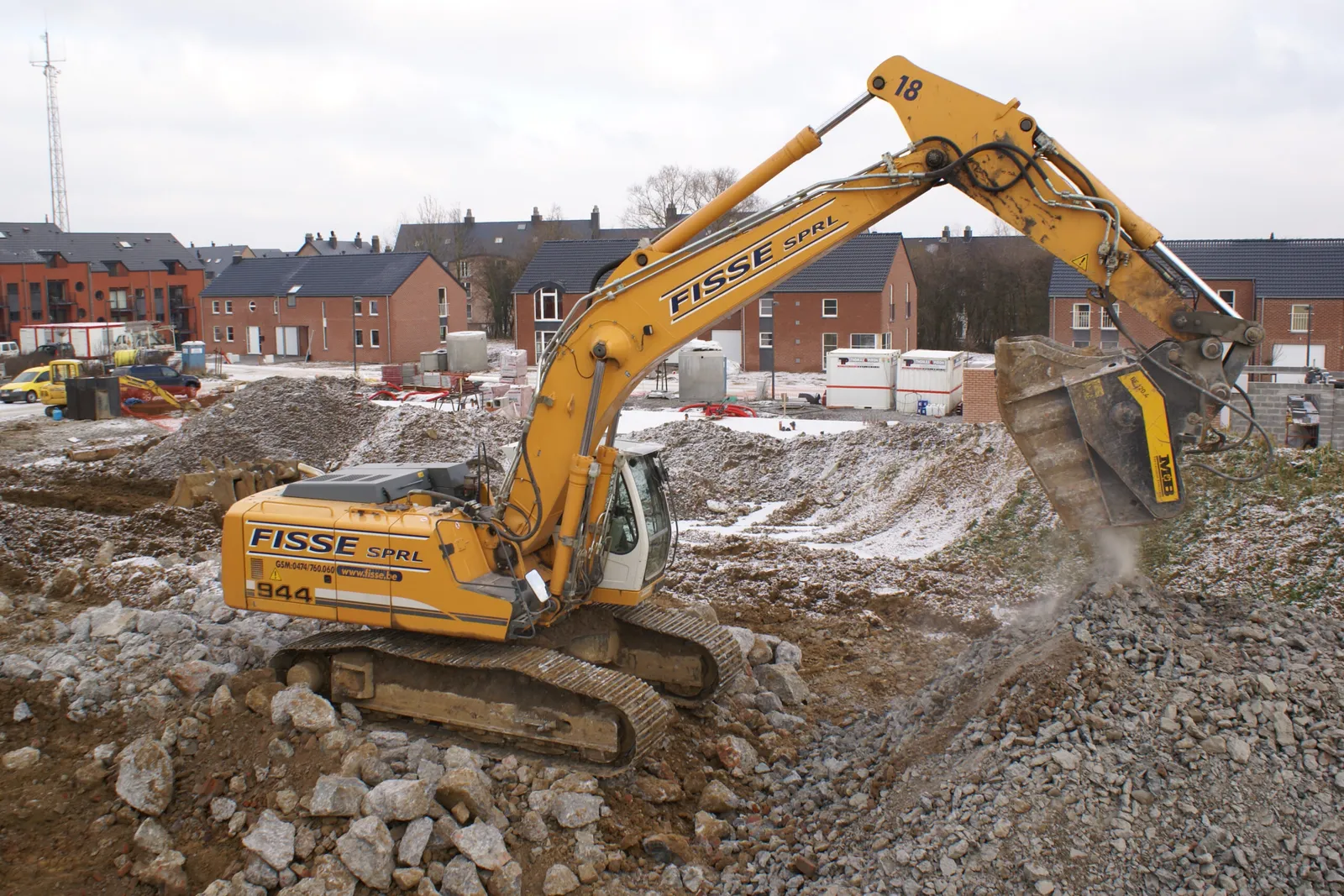
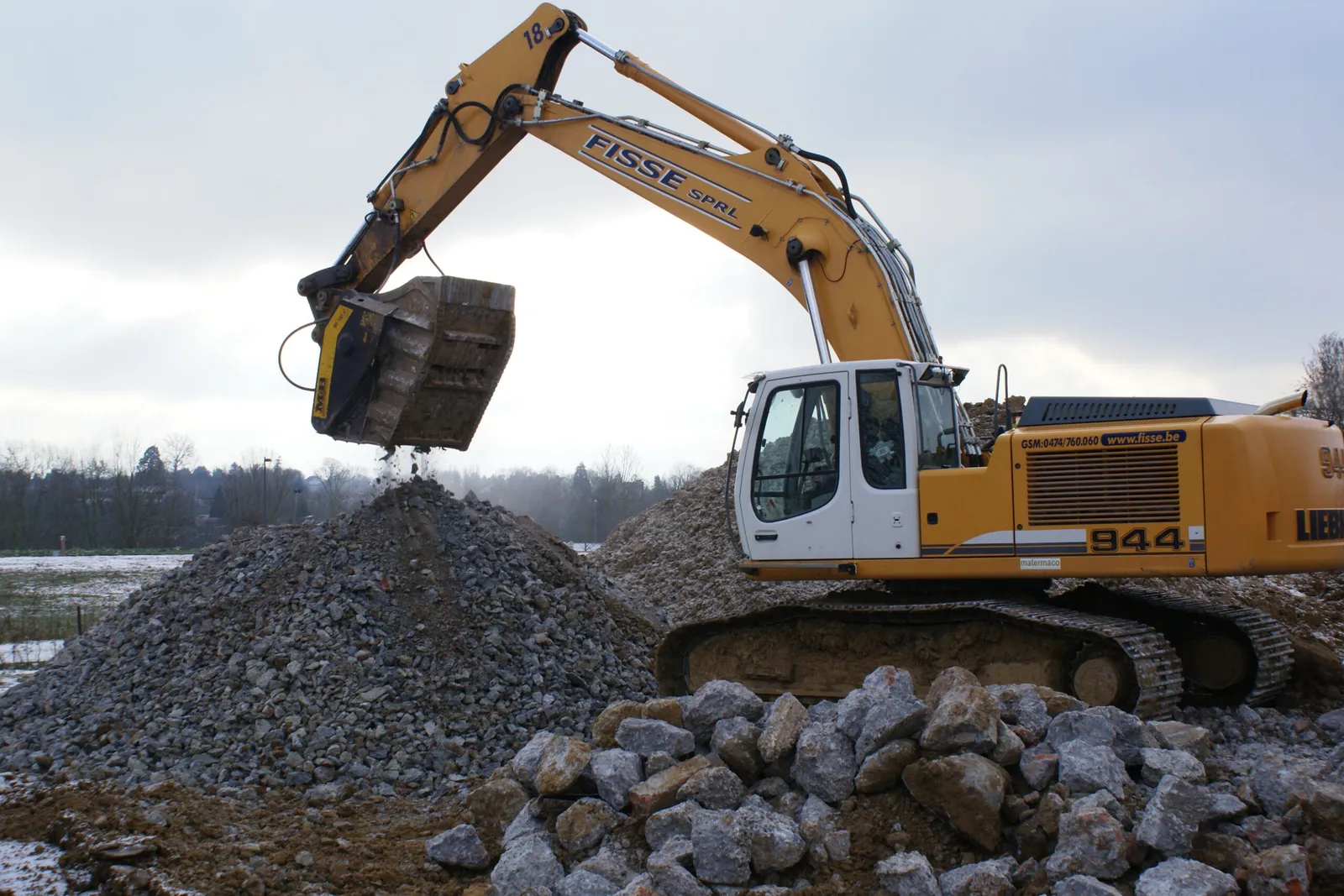
Fisse has been active in earthworks, demolition, construction and remediation since 2000, carrying out a range of projects in Wallonia. Its work covers the entire preparatory phase of construction projects, from demolishing existing buildings to landscaping and installing external infrastructure. As part of its integrated approach to materials management, the company has been using the MB BF120.4 crusher bucket for around 15 years. This excavator attachment is designed to process demolition waste directly on site.
According to Sébastien Fisse, CEO of the eponymous company based in Bossière (Gembloux), this equipment meets a practical need. On renovation or reconstruction projects, demolition waste traditionally had to be transported to a recycling centre before being replaced with new materials for road and car park sub-bases. “We realised that, for small demolition jobs, it was not cost-effective to work this way or to bring a large crusher to site for a few hundred tonnes,” he explains.
The BF120.4 crusher bucket can process bricks, concrete and other inert demolition materials directly on site. The resulting aggregate can then be reused on the site for various applications, such as paving or a foundation layer.
Cutting transport and promoting recycling
The main advantage of this approach is the reduction in logistical movements. By avoiding return trips to processing centres, companies cut both transport costs and the cost of off-site recycling. This approach is becoming increasingly common on construction and demolition sites. It also helps limit the purchase of new materials while making use of resources already available on site.
Simple, proven technology
The MB BF120.4 is based on the jaw crusher principle, widely used in quarries and primary crushing plants. The unit has been adapted into a bucket mounted on a hydraulic excavator, drawing directly on the carrier machine’s hydraulic capacity. “It is essentially a primary crusher in miniature,” the director sums up.
The attachment is compatible with various excavators with sufficient hydraulic power and has been used by Fisse for around 15 years. Routine maintenance is carried out in-house, while the manufacturer supplies spare parts.
Choosing the right solution for each site
According to Sébastien Fisse, the crusher bucket is particularly well suited to modest volumes. For up to around 500 tonnes of material, it remains an economical option and offers considerable flexibility on site.
But the crusher bucket is not restricted to small sites: it is neither a stationary crusher nor a self-propelled mobile crusher. It is precisely because this is a machine-mounted attachment, compact and easy to move, and ready to operate within minutes, that it is an effective addition even on high-volume sites. It can be deployed at an early stage to reduce the largest blocks, work in hard-to-reach areas or process residual material that larger-capacity equipment would not handle.
Beyond a certain threshold, other machines naturally take over. Compact mobile crushing plants are preferred for medium volumes, while large sites call for larger crushing plants. Even in these situations, however, the crusher bucket continues to play a valuable supporting role: it is manoeuvrable in areas other machines cannot reach, and cost-effective for scattered or one-off volumes.
The goal remains the same: to reuse as much material as possible, as close as possible to where it was produced. Although certain legal, noise or planning restrictions can sometimes make off-site processing necessary, on-site crushing, where conditions allow, remains an effective way to strengthen the circular economy in the construction sector.
Question about this story? Ask your question
Keep following this
Get an email when a new story is published. No account needed.
- ThemeOn-site demolition and recycling
- SubjectEarthmoving