Safe on the road under high voltage: Crash tests confirm the Mercedes-Benz eActros 600’s high level of passive safety
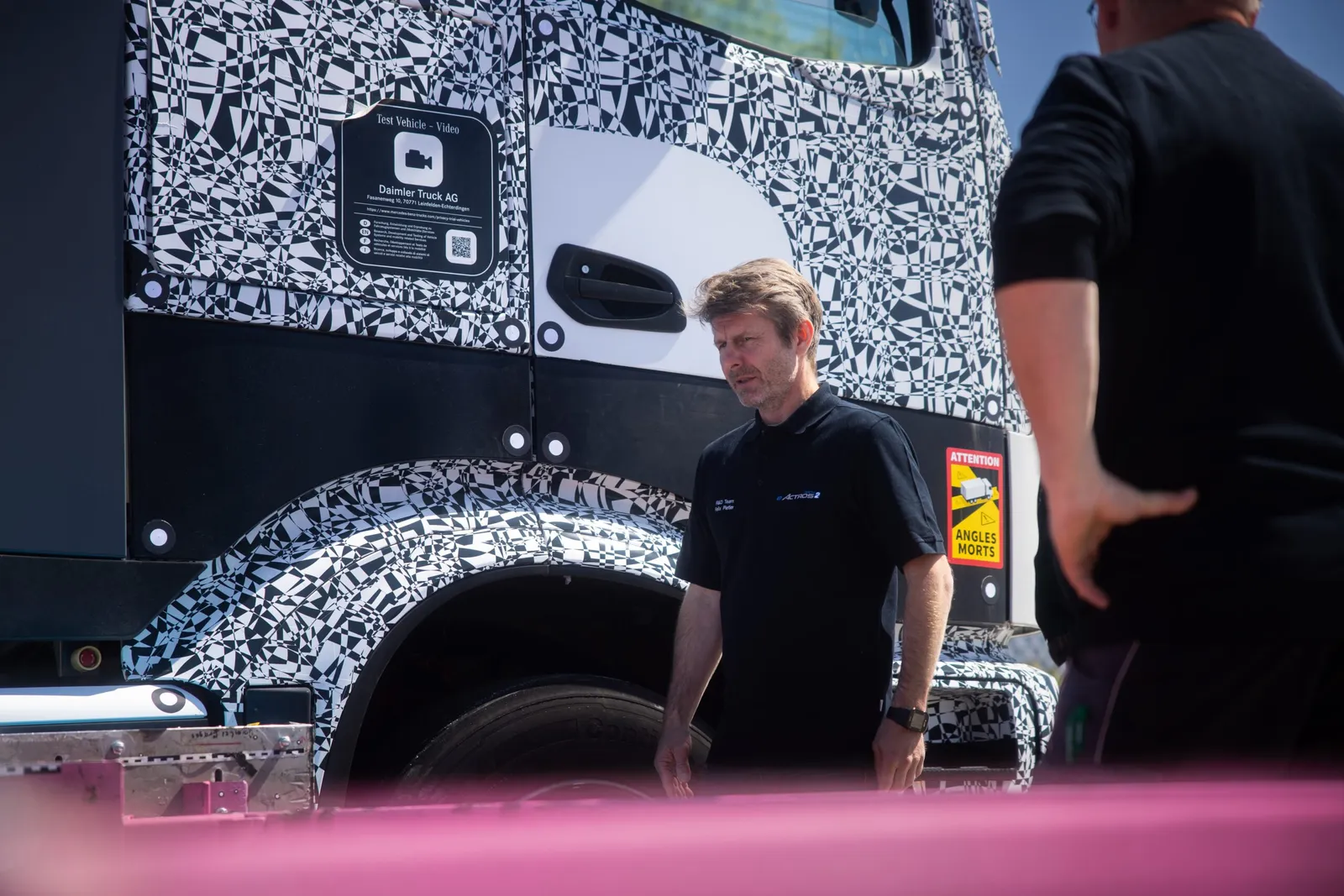
The fully electric Mercedes-Benz eActros 600 for long-haul transport combines efficiency and sustainability with the highest standards of active and passive safety. At an early stage of development, Mercedes-Benz Trucks’ in-house Accident Research team analysed real-world accident data. The vehicle’s protective measures were then tailored to typical severe accident scenarios.
- Comprehensive safety concept offers extra protection for the driver, other road users and emergency services
- Realistic crash test confirms structural stability and battery integrity
- Accident research integrated into development from the outset
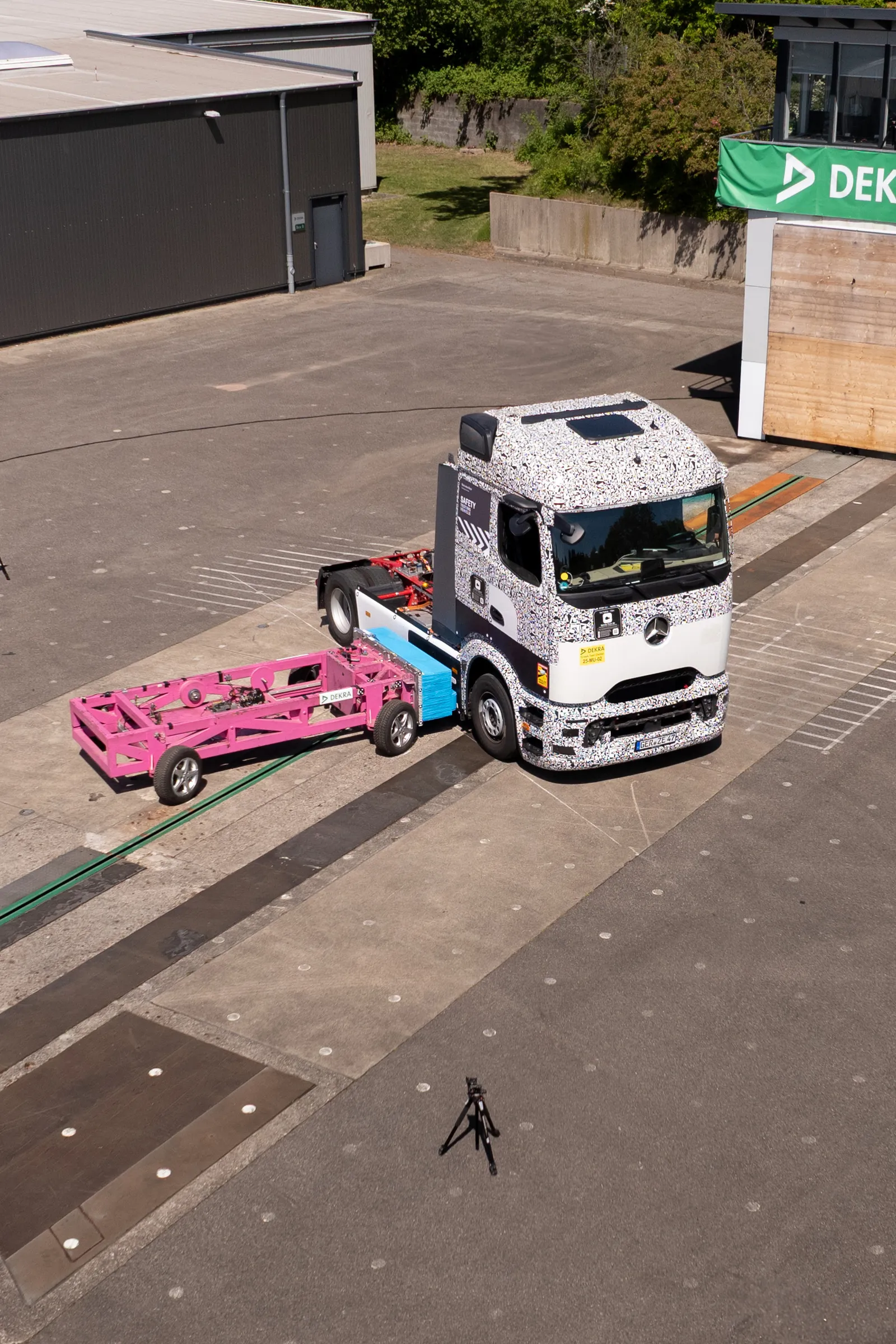
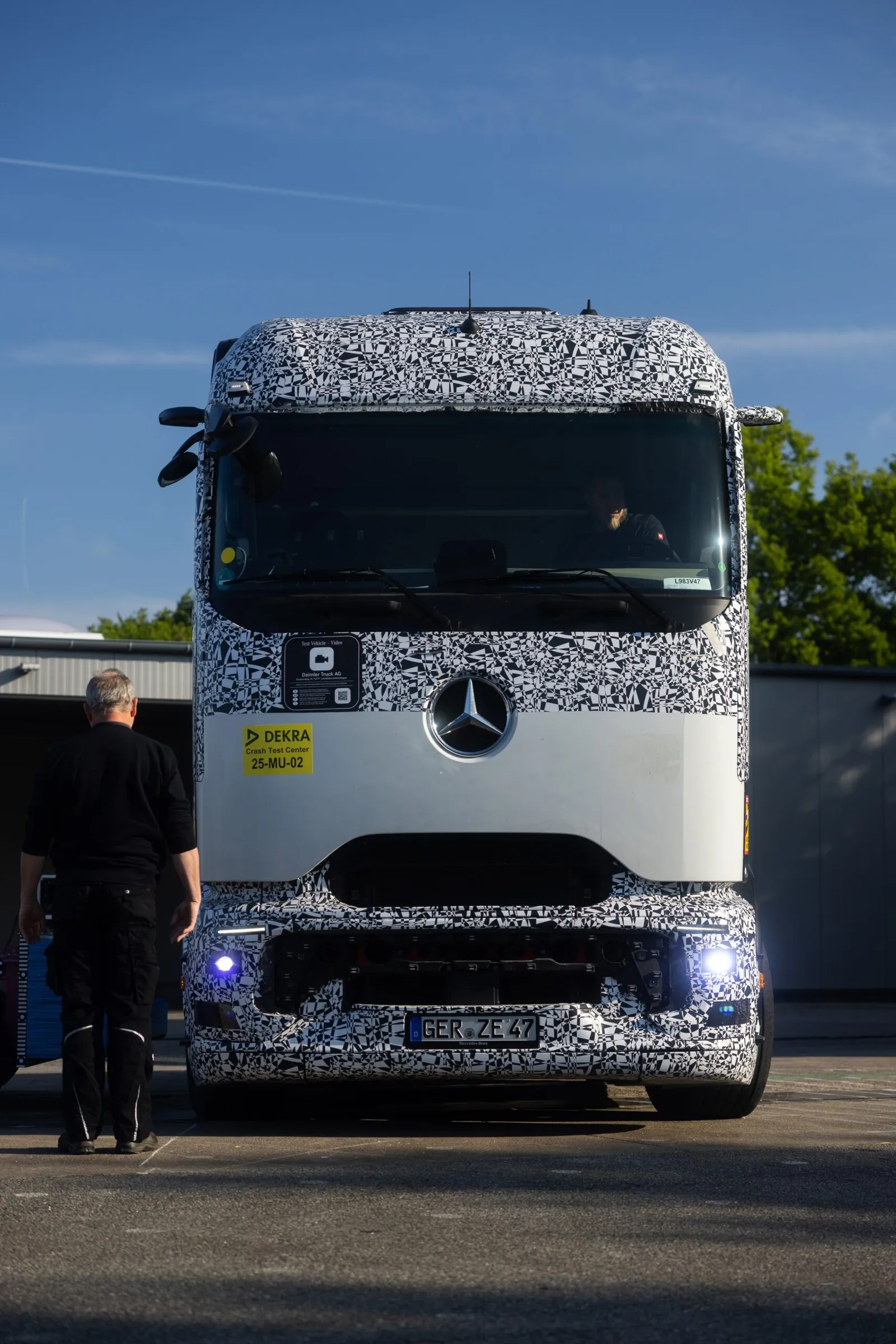
In one of the realistic crash tests carried out in Neumünster (Schleswig-Holstein), the eActros 600 was subjected to a side impact of the kind seen in serious road accidents. The result speaks for itself: despite the considerable force, the entire high-voltage battery system, including all electrical components, remained completely intact.
“From the outset, our guiding principle was that there could be no compromise on safety,” says Felix Pietler, Passive Safety Developer at Mercedes-Benz Trucks. “With electric drivetrains in particular, it is important not only to protect occupants, but also to ensure the safety of people and property around the vehicle.”
A robust safety concept that withstands extreme conditions
The reinforced cab and purpose-designed energy-absorbing zones at the front of the vehicle channel forces in a controlled manner through crash-optimised structures in the event of a frontal collision. In the side-impact test, the high-voltage battery modules remained intact and the housing showed no critical deformation, thanks to a frame structure developed specifically for severe collisions.
Airbag systems and seatbelt tensioners also enhance occupant protection across all vehicle variants. Frank Müller, Head of Accident Research & Passive Safety at Mercedes-Benz Trucks, adds: “The forces involved in the test were enormous, but our concept worked flawlessly.”
Behind the scenes of a special test
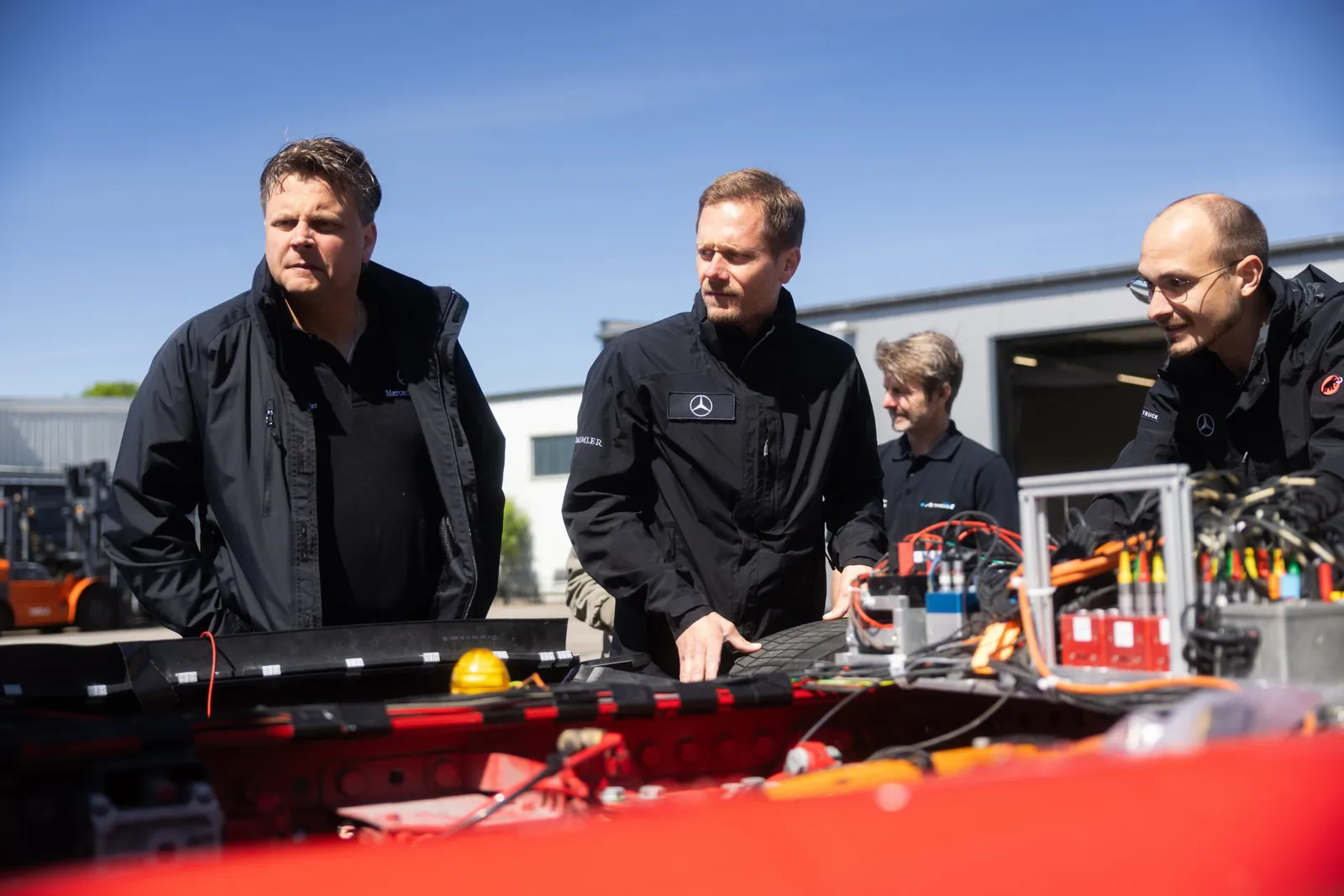
Extensive simulations were carried out ahead of the test, and sensors were installed and carefully calibrated. Every element was precisely matched to the test scenario. “For me personally, the last two to three minutes before the impact are the most fascinating,” says Christoph Berger of the Passive Safety Team. “Everything gets quieter, and the tension builds. Then, a crash. More than a tonne of mass hits the side of the truck at over 50 km/h.”
High-voltage system designed with safety as a priority
The high-voltage system, including the batteries, meets stringent in-house requirements for insulation, mechanical protection and fire safety, to minimise risks following severe damage. Production vehicles therefore meet not only all statutory standards, but also brand-specific test criteria that go well beyond legal requirements.
After each physical test, specialist emergency response teams first carry out a safety inspection. The main components are then dismantled and analysed, and the results are compared with simulation data.
Müller concludes: “The results confirm our expectations: in a real-world situation, there would have been no danger.”
Why testing continues after series production begins
Mercedes-Benz Trucks also carries out regular physical tests during series production. This means new insights from real-world use can be translated directly into product improvements.
This approach enables technological innovations to be introduced more quickly, ensures compliance with changing legislation and allows new customer requirements to be addressed immediately.
In this way, Mercedes-Benz Trucks remains true to its Vision Zero goal: maximum road safety for both conventional and battery-electric trucks in Europe.
Advanced active driver assistance systems
The Mercedes-Benz eActros 600 is not only a milestone in CO₂-free long-haul transport, but also impresses with its modern safety and driver assistance systems.
These include:
- Active Brake Assist 6 with 270° surround detection, which can identify dangerous situations and bring the vehicle to a complete stop autonomously if necessary.
- Active Sideguard Assist 2, which provides effective support to the driver when turning or changing lanes.
- Front Guard Assist, which monitors the area directly in front of the truck, providing extra protection for pedestrians and cyclists.
- Active Drive Assist 3, which enables semi-automated driving on motorways.
- Attention Assist 2, which warns the driver if they are tired or lose concentration.
As the eActros 600 runs very quietly, which is pleasant for both the driver and those nearby, it is equipped with an Acoustic Vehicle Alerting System (AVAS) so that vulnerable road users can hear it approaching in good time. Different sounds are played when driving forwards or in reverse, depending on the driving situation. The pitch varies with speed and accelerator input, making the vehicle clearly audible in urban traffic. The AVAS’s futuristic sound profile reflects the powerful character of a heavy vehicle.
About the eActros 600
At the end of November last year, Mercedes-Benz Trucks celebrated the start of series production of the eActros 600 at its Wörth plant. The first customer deliveries followed in December 2024. Since then, the pioneer in electric long-haul transport has proved its capabilities on several occasions, including during the “eActros 600 European Testing Tour 2024” (15,000 km through 22 countries) and the “European Testing Tour Winter 2025” (6,500 km through Northern Europe), each with a gross combination weight of 40 tonnes.
The e-truck was also named “International Truck of the Year 2025”, the industry’s most prestigious accolade, awarded by an international jury of 24 European commercial vehicle journalists.
With a battery capacity of more than 600 kWh, hence the name eActros 600, and an in-house-developed, highly efficient electric drive axle, the truck has a range of up to 500 km without intermediate charging. Depending on driving style and route, this range can be exceeded. By charging during mandatory rest breaks, the eActros 600 can cover more than 1,000 km per day, provided charging facilities are available.
The eActros 600 has three battery packs, each with a capacity of 207 kWh, giving it a total installed capacity of 621 kWh. Lithium iron phosphate (LFP) cell technology ensures a long service life and usable capacity of more than 95% of the total. The vehicle is designed for a gross combination weight of up to 44 tonnes and offers a payload of around 22 tonnes with a standard semi-trailer, depending on national regulations.
To better meet customer needs, Mercedes-Benz Trucks has recently expanded the eActros 600 range with additional variants. Customers can choose from two cabs, two or three battery packs, different wheelbases and new axle configurations, giving a total of more than 40 vehicle variants. All versions share the key features: LFP battery technology and the specially developed electric rear axle.
Question about this story? Ask your question
Keep following this
Get an email when a new story is published. No account needed.
- ThemeTowards low-emission equipment and transport
- SubjectTransport & off-road