Mercedes-Benz Trucks takes further steps to accelerate electrification: eActros LongHaul to hit the market in 2022
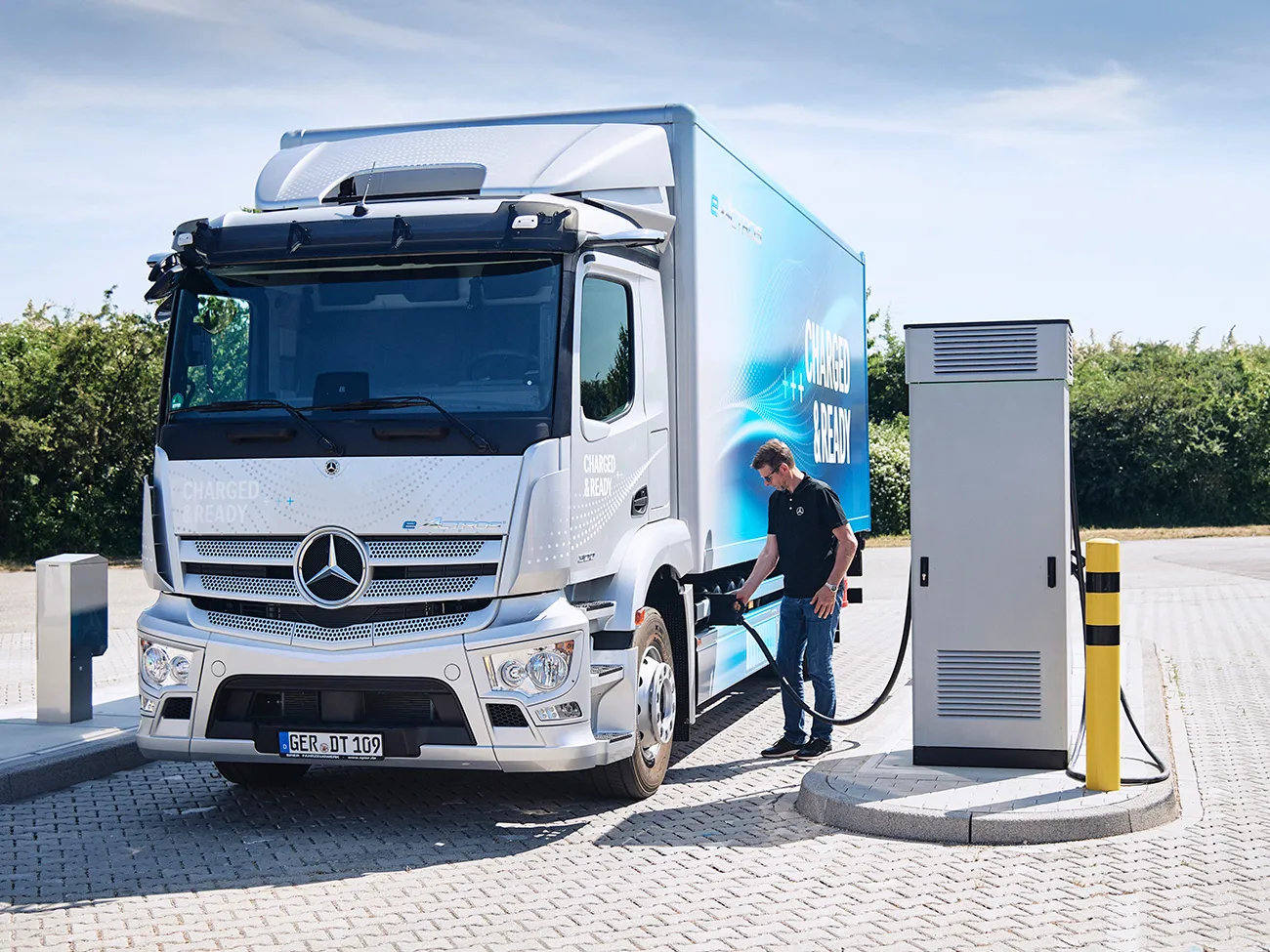
Following the market launch of the eActros for heavy-duty distribution transport in 2021, Mercedes-Benz Trucks is building systematically on this momentum this year and in the years ahead, introducing further battery-electric models. The eActros LongHaul, aimed at the important long-haul segment and expected to cover around 500 kilometres on a single battery charge, is expected to be ready for series production in 2024. The first prototypes of the 40-tonne truck are already undergoing internal testing, and Mercedes-Benz Trucks engineers plan to begin testing the electric truck on public roads later this year. The eActros LongHaul will enable extremely high-power charging, known as ‘megawatt charging’. Mercedes-Benz Trucks is also preparing other variants of the eActros, namely the eActros 300 and eActros 400, and from the beginning of July the eEconic for municipal use will roll off the production line at the Wörth plant as the company’s second fully electric series-production truck. Mercedes-Benz Trucks aims to increase the share of locally CO₂-neutral new vehicles in Europe to more than 50 per cent by 2030.
- Launch of various new battery-electric trucks in 2022 and the years ahead
- First eActros LongHaul prototypes built for testing
- Additional variants of the eActros 300 and eActros 400 in development
- Series production of the eEconic for municipal applications to start in July 2022
- Customer event on e-mobility for around 1,000 participants from across Europe to take place in Wörth in June
- Karin Rådström, CEO of Mercedes-Benz Trucks: “The huge interest in our eActros driving event in Wörth once again shows that e-mobility is already gaining popularity with customers. Customers are sending a strong signal to all stakeholders to join forces and quickly put more electric trucks on the road, expand charging infrastructure and achieve cost parity.”
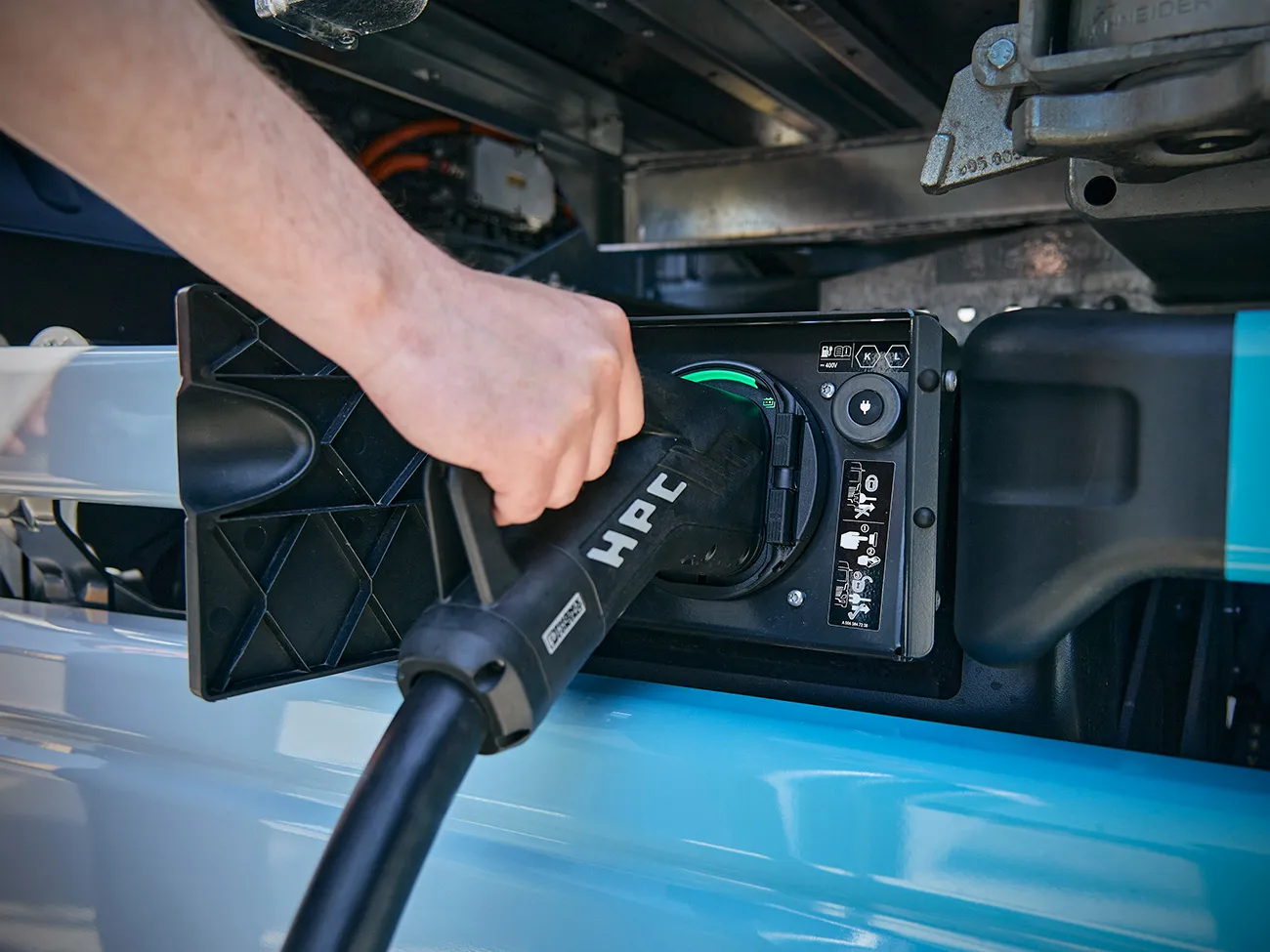
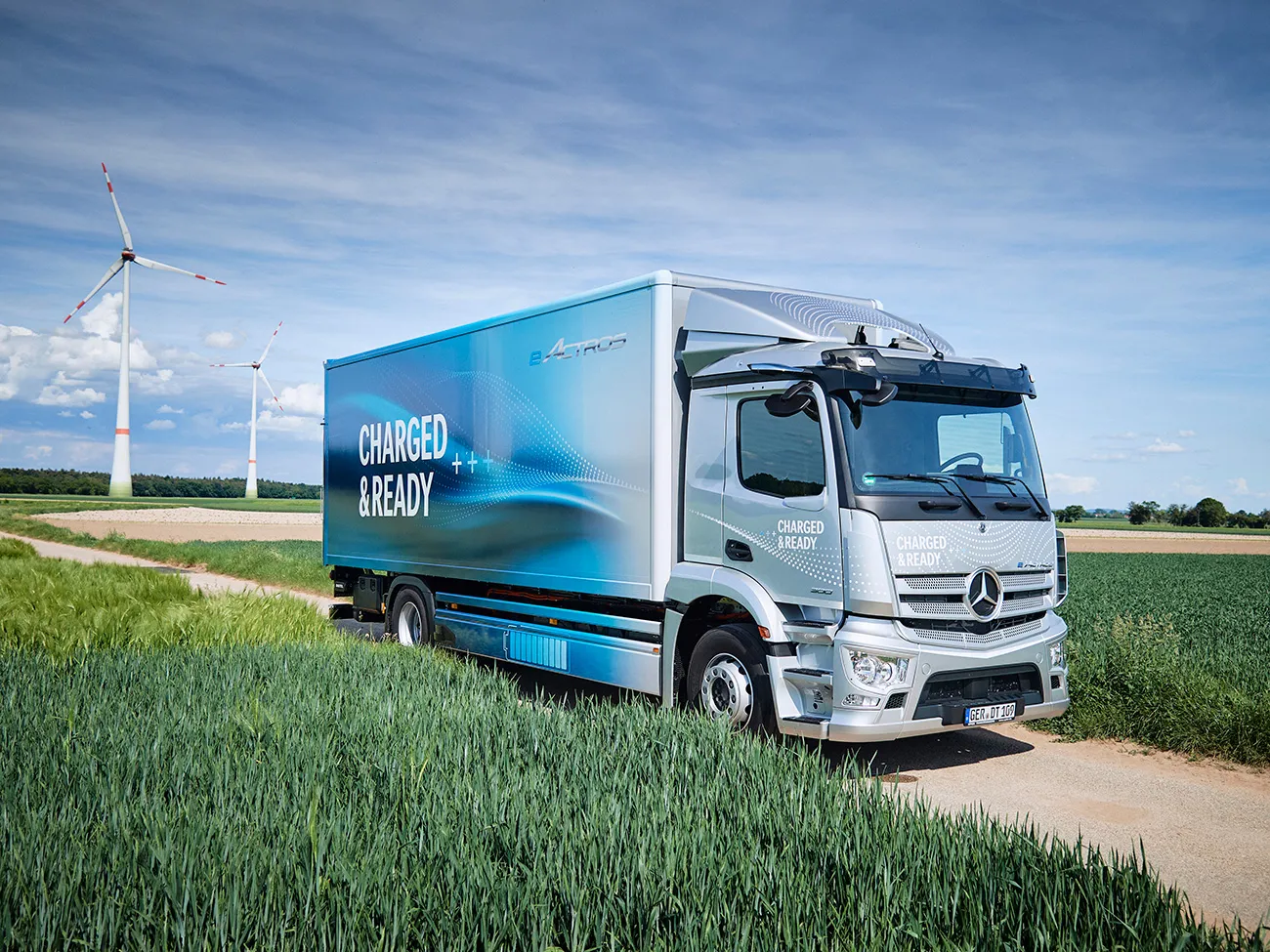
To give truck customers from across Europe a better introduction to electric mobility, the manufacturer is organising an event at its Wörth site from early June, running for several weeks. Mercedes-Benz Trucks experts will brief around 1,000 participants in total on the key aspects of electric mobility, from infrastructure and services to electric models. Customers will also have the opportunity to test the eActros 300 on demanding routes with realistic payloads.
Karin Rådström, CEO of Mercedes-Benz Trucks: “The huge interest in our eActros driving event in Wörth once again shows that e-mobility is already gaining popularity with customers. Customers are sending a strong signal to all stakeholders to join forces and quickly put more electric trucks on the road, expand charging infrastructure and achieve cost parity.”
Working with partners on charging infrastructure
For depot charging technology, Mercedes-Benz Trucks is working with Siemens Smart Infrastructure, ENGIE and EVBox Group. For public charging for long-haul transport, Daimler Truck, Traton Group and Volvo Group have signed a binding agreement to establish a joint venture. It will develop and operate a high-power public charging network for battery-electric long-haul trucks and coaches in Europe. The charging network operated by the three parties will be available to fleet operators across Europe, regardless of vehicle make.
The HoLa project (‘High-Performance Charging in Long-Haul Truck Transport’), in which Daimler Truck is participating and which is being conducted under the auspices of the German Association of the Automotive Industry (VDA), aims to plan, establish and operate dedicated charging infrastructure for battery-electric long-haul trucks. Two high-power charging points equipped with the Megawatt Charging System (MCS) will be installed at each of four locations in Germany for real-world testing. The project also involves several other consortium partners from industry and research.
The Mercedes-Benz eEconic at IFAT
On 30 May, the battery-electric eEconic will make its trade fair debut at IFAT, the world’s leading trade fair for water, sewage, waste and raw materials management, held in Munich. The eEconic is particularly well suited to urban applications in the early morning hours thanks to its lower noise emissions. The eEconic’s vehicle architecture benefits from Daimler Truck’s global platform strategy. The powertrain of the low-floor truck is based on that of the Mercedes-Benz eActros, which has been in series production at the Wörth plant since October 2021. Since May 2022, waste management company FES GmbH (Frankfurter Entsorgung- und Service) in Frankfurt am Main has been operating a near-production-ready eEconic for municipal waste collection.
Second-generation MirrorCam for the eActros
Since April this year, Mercedes-Benz Trucks has been equipping the eActros with the improved second-generation MirrorCam. It brings improvements particularly in terms of visibility and safety. Externally, the camera arms on both sides have been shortened by ten centimetres. Among other benefits, the new dimensions make the MirrorCam’s perspective even more like that of the familiar interior mirror. This makes reversing immediately easier for drivers than with the first-generation MirrorCam.
Ultimate goal: CO₂-neutral road transport by 2050
Daimler Truck aims to offer only new vehicles that are CO₂-neutral in operation (‘tank-to-wheel’) in Europe, Japan and North America by 2039. The two battery-electric models, the Mercedes-Benz eCitaro and Mercedes-Benz eActros, have been rolling off the production line since 2018 and 2021 respectively. The Mercedes-Benz eEconic, FUSO eCanter and Freightliner eCascadia will follow later this year, with further carbon-neutral vehicles in the pipeline. In the second half of this decade, the manufacturer plans to expand its vehicle range with series-produced hydrogen fuel-cell vehicles. The ultimate goal is to achieve CO₂-neutral road transport by 2050.
Question about this story? Ask your question
Keep following this
Get an email when a new story is published. No account needed.
- ThemeConstruction transport on road and site
- SubjectTransport & off-road