Mercedes-Benz Trucks presents the new eActros 400 based on the eActros 600
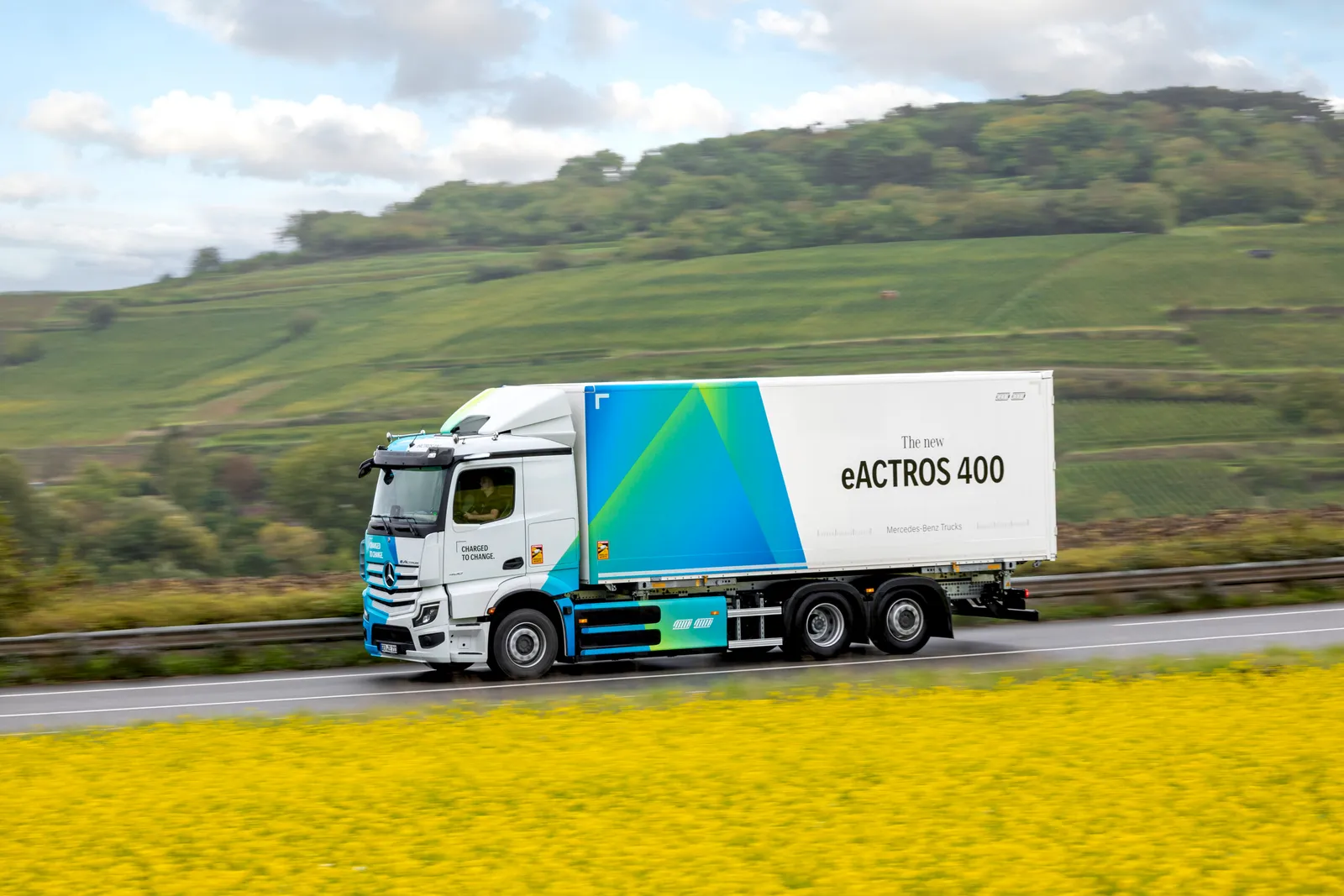
Mercedes-Benz Trucks has been producing its battery-electric eActros 600 long-haul truck in series production since late 2024, offering a powerful alternative to diesel trucks. The manufacturer has now presented the eActros 400, a new variant based on the eActros 600’s technology, for the first time at a driving event for journalists around its plant in Molsheim, France. With numerous new combinations based on both models, Mercedes-Benz Trucks is specifically expanding its range of battery-electric trucks to meet even more requirements for electric vehicles in heavy-duty long-haul and distribution transport. In future, Mercedes-Benz Trucks will offer the eActros as the eActros 400 with two battery packs and the eActros 600 with three battery packs, each available as a tractor unit or platform chassis and tailored to individual requirements for application, range and payload. Customers will also be able to choose between two cabs: the proven L-cab, with its lower entrance, or the larger, aerodynamically improved ProCabin for maximum cab comfort. In addition, numerous new wheelbase variants and further axle configurations for the platform chassis will be available to cover even more applications.
- The second generation eActros offers more than 40 possible combinations of the base vehicle, depending on the application and requirements for range, payload and comfort.
- Configurations can optionally be specified with two or three battery packs, and with either the ProCabin or the proven L-cab in classic Actros design.
- Additional wheelbases and axle configurations are available for tractor units and platform chassis.
- The key technological features of the second-generation eActros are based on the eActros 600: an integrated electric axle, lithium iron phosphate (LFP) battery cell technology, Multimedia Cockpit Interactive 2 and modern assistance systems for greater safety.
- Achim Puchert, CEO of Mercedes-Benz Trucks: “The eActros 600 proves that battery-electric long-haul transport is a reality. The vehicle is already operating successfully in more than 15 European countries. But one thing is clear: for the transition to succeed, the expansion of charging infrastructure must keep pace with the vehicles, and operating them must be profitable for our customers.”
- New model variants available to order from October 2025.
Achim Puchert, CEO of Mercedes-Benz Trucks: “Since 2021, we have been actively shaping the transformation of goods transport and providing practical solutions. The eActros 600 proves that battery-electric long-haul transport is a reality. The vehicle is already operating successfully in more than 15 European countries. But one thing is clear: for the transition to succeed, the expansion of charging infrastructure must keep pace with the vehicles, and operating them must be profitable for our customers.”
The first new models will be available from October in EU30 markets and selected non-EU markets, with some due to roll off the production line at the Wörth am Rhein plant in 2025. The new vehicle variants in the second-generation eActros range retain the key technological features of the eActros 600, which is distinguished by its innovative overall technology concept combining modern drive technology and high energy efficiency. These include the in-house-developed electric drive axle, LFP cell technology, known for its long service life and usable battery capacity of more than 95 per cent, the 800-volt electrical system, the new Multimedia Cockpit Interactive 2 and comprehensive assistance systems designed to increase safety. With the expansion of the second-generation eActros range, Mercedes-Benz Trucks will stop producing the first-generation eActros 300/400 models at the end of 2025.
Stina Fagerman, Head of Marketing, Sales and Services at Mercedes-Benz Trucks: “Our eActros model family is growing in line with our customers’ needs: flexible cab configurations, battery packs and chassis give transport companies tailor-made solutions. Our range is complemented by digital services, TruckCharge charging solutions and a well-developed service network, providing reliable support on the road to electromobility.”
Battery packs determine range, payload and purchase price
Rainer Müller-Finkeldei, Head of Mercedes-Benz Trucks Product Engineering: “We have consistently developed the second-generation eActros as a modular model. It combines modern LFP battery technology, efficient electric drive and intelligent assistance systems. Thanks to this modularity and the combinable options for battery capacity, cab and chassis, we offer more than 40 possible combinations for the eActros base vehicle. This enables us to respond even more specifically to our customers’ diverse requirements and makes an important contribution to decarbonising road transport.”
The customer’s choice of the right vehicle variant depends largely on the specific operating profile, whether long-haul work with high daily mileage or heavy-duty distribution transport over shorter routes, as well as payload requirements, available charging infrastructure and the economic conditions.
The new eActros 400 variants offer a more attractively priced entry into electromobility. They are equipped with two 207 kWh LFP battery packs, providing a total installed battery capacity of 414 kWh, hence the 400 designation. The different eActros configurations offer different ranges, depending on vehicle class and operating profile. With a consistent driving style in long-haul transport, ranges are generally greater than when driving in regional heavy-duty distribution transport. For example, an eActros 400 6×2 with a box body, as used for conventional heavy-duty distribution transport, can achieve a range of up to 480 kilometres when partially laden and at an ambient temperature of 20 degrees Celsius.
As before, the eActros 600 has three battery packs with a total installed battery capacity of 621 kWh, hence the 600 designation. This enables a range of 500 kilometres without intermediate charging, and considerably more depending on vehicle configuration, driving style, route and other influencing factors. In its most efficient configuration, the eActros 600 with three battery packs can achieve a range of up to 560 kilometres in conventional long-haul transport with a gross combination weight of 40 tonnes. If the eActros tractor unit is fitted with the proven L-cab and just two battery packs, it can achieve a range of up to 330 kilometres under the same operating conditions and with almost identical general conditions.
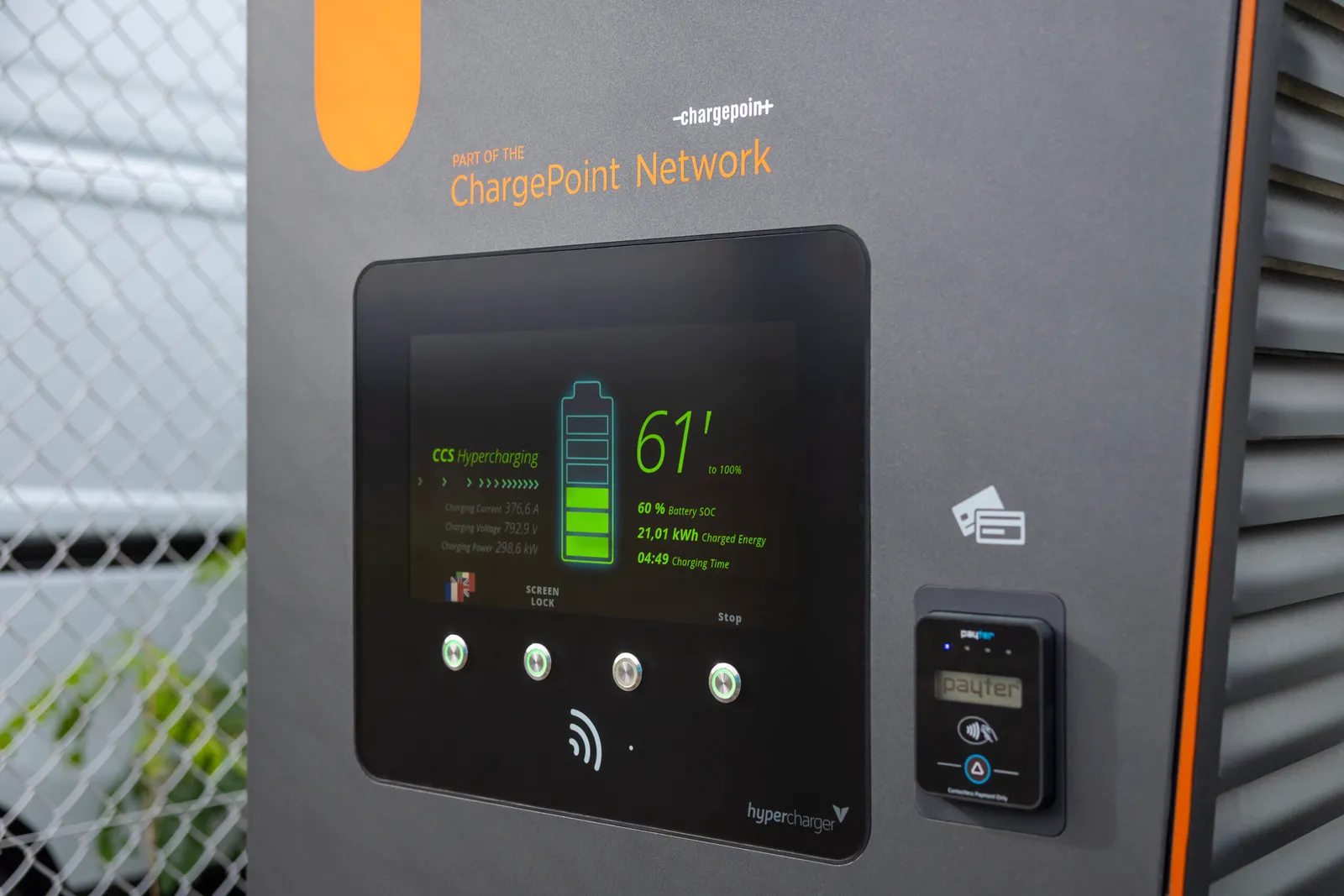
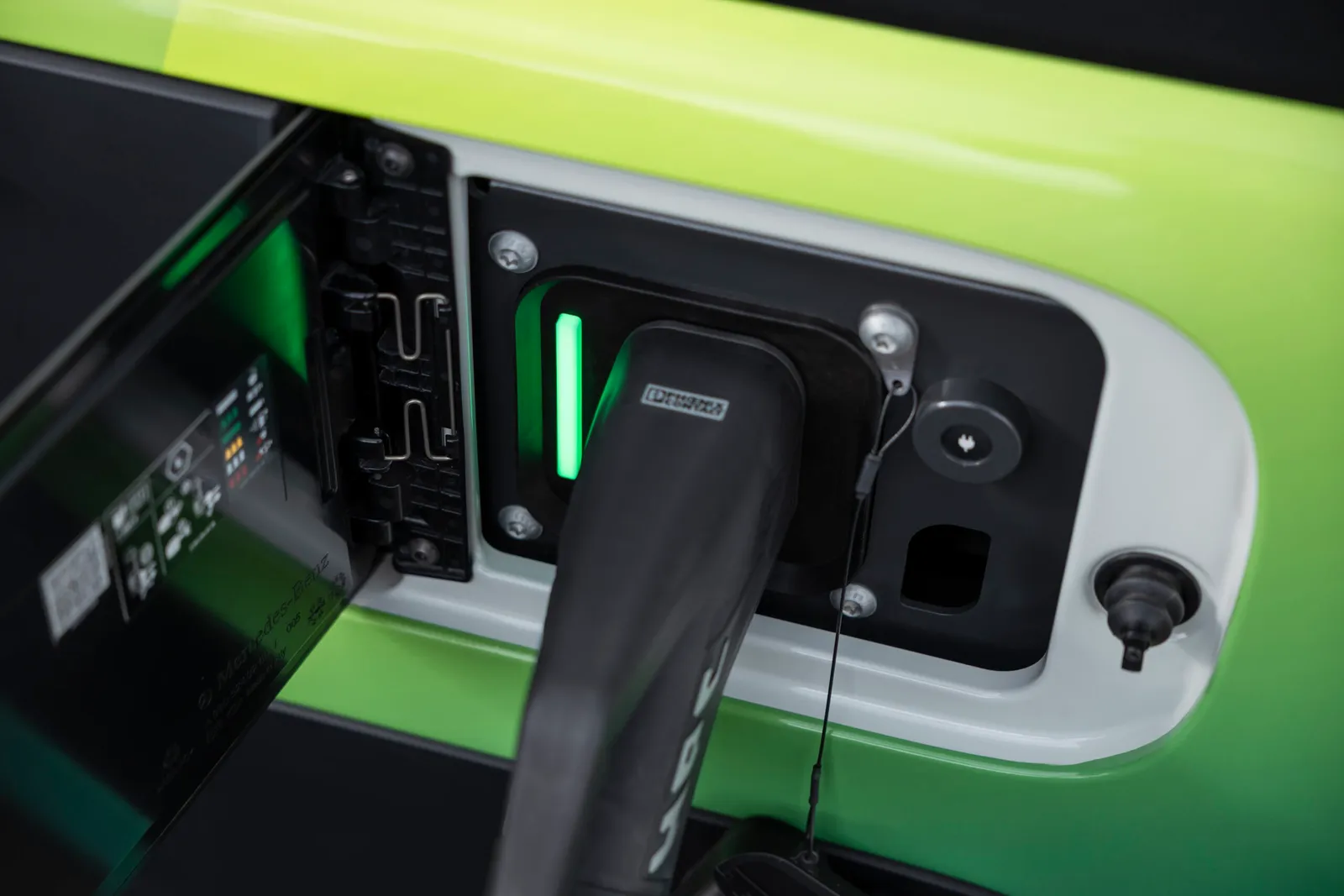
The eActros 400 with two battery packs has a lower vehicle weight and therefore offers a higher payload than the eActros 600 with three battery packs. The reduced weight increases the maximum fifth-wheel load of the eActros 400 to 9.5 tonnes. Combined with a standard semi-trailer, the eActros 400 achieves a payload of more than 25 tonnes. This gives the eActros 400 an additional payload of more than 3 tonnes compared with the eActros 600, bringing it in line with diesel trucks in terms of payload. Both the eActros 400 and the eActros 600 can charge at up to 400 kW via the standard CCS2 charging socket on the left-hand side of the vehicle behind the cab. A second CCS2 charging socket on the right-hand side of the vehicle is available as an option. Two battery packs charge from 10 to 80 per cent in about 46 minutes, while three battery packs take about 70 minutes.
In addition to CCS charging, the eActros 600 with ProCabin, designed for long-haul transport, will also support megawatt charging at a later date.
Individual cab variants for different applications
Requirements for the cab also vary depending on the main application, whether heavy-duty distribution or long-haul transport. The flexible choice of different cab variants allows customers to tailor comfort, ergonomics and economy to the specific needs of their operation. In future, customers will be able to choose between two cabs: the L-cab in the proven Actros design and the futuristic ProCabin. Both variants are available for the eActros 400 with two battery packs and for the eActros 600 platform vehicle with three battery packs.
With its entrance 170 millimetres lower and its compact dimensions, the proven 2.30-metre-wide L-cab is well suited to operations involving frequent entry and exit and shorter distances. Available in Classic or StreamSpace versions, it features an ergonomically designed cockpit, plenty of storage space and numerous practical comfort features, such as Multimedia Cockpit Interactive 2 and LED headlamps as standard. The proven L-cab can be an economically attractive solution for price-conscious customers and offers a slight payload advantage thanks to its lower weight.
The futuristically designed ProCabin offers maximum comfort and, with its flat floor and generous sense of space, is particularly well suited to long journeys with regular overnight stops. The cab is also aerodynamically optimised to reduce energy consumption. The 2.50-metre-wide cab, available in three versions, Stream, Big or Giga, features numerous comfort enhancements, including improved seat heating, premium flat-woven seat covers and beds with full slatted bases and thick premium mattresses. Other ProCabin features include more functions on the bed control panels, ambient lighting and additional LED reading lights with flexible arms. Further options include extra USB-C sockets on the side walls, a high-quality two-tone curtain, a second fridge, a 230-volt socket and the SoloStar concept in two additional seat-cover variants.
MirrorCam is part of the standard equipment on both cabs
The mirror camera system developed by Mercedes-Benz Trucks helps make situations such as overtaking, manoeuvring, driving in poor visibility and darkness, cornering and passing through narrow spaces safer and less stressful. Additional useful features include a wide-angle mode when reversing, distance lines on the displays to help judge the distance to objects behind the vehicle, rotation of the camera image when cornering and monitoring the surroundings during breaks. The interaction between MirrorCam and Active Sideguard Assist 2 can help reduce the severity of dangerous situations, particularly in complex traffic situations and at unclear junctions. Sideguard Assist uses the MirrorCam displays to provide visual warnings.
Additional wheelbases and axle variants for a wider range of applications
Mercedes-Benz Trucks now offers its customers even more ways to adapt its electric vehicles to individual requirements. The range of wheelbases and axle variants for the battery-electric models will be significantly expanded in future.
New additions include the eActros 400 as a 4×2 semi-trailer tractor with a wheelbase of 3,700 mm. Its shorter wheelbase gives it a tighter turning circle and makes it easier to manoeuvre in confined spaces, such as narrow streets or tight depots. Also new for the eActros 400 are 4×2 platform chassis with wheelbases of 4,000, 5,500, 5,800 and 6,100 mm, as well as 6×2 platform chassis with six different wheelbases between 4,000 and 5,800 mm. These variants are available with either the ProCabin or the proven L cab.
There is also more choice for the eActros 600: in future, it will also be available as a 4×2 platform chassis with wheelbases of 4,000, 5,500 and 5,800 mm. In addition to the wheelbases of 4,600 and 4,900 mm already available, the 6×2 platform truck will have four further wheelbase options, as with the eActros 400: 4,000, 4,500, 5,200 and 5,800 mm. These variants are available with either the ProCabin or the proven L cab.
Integrated e-axle for greater efficiency
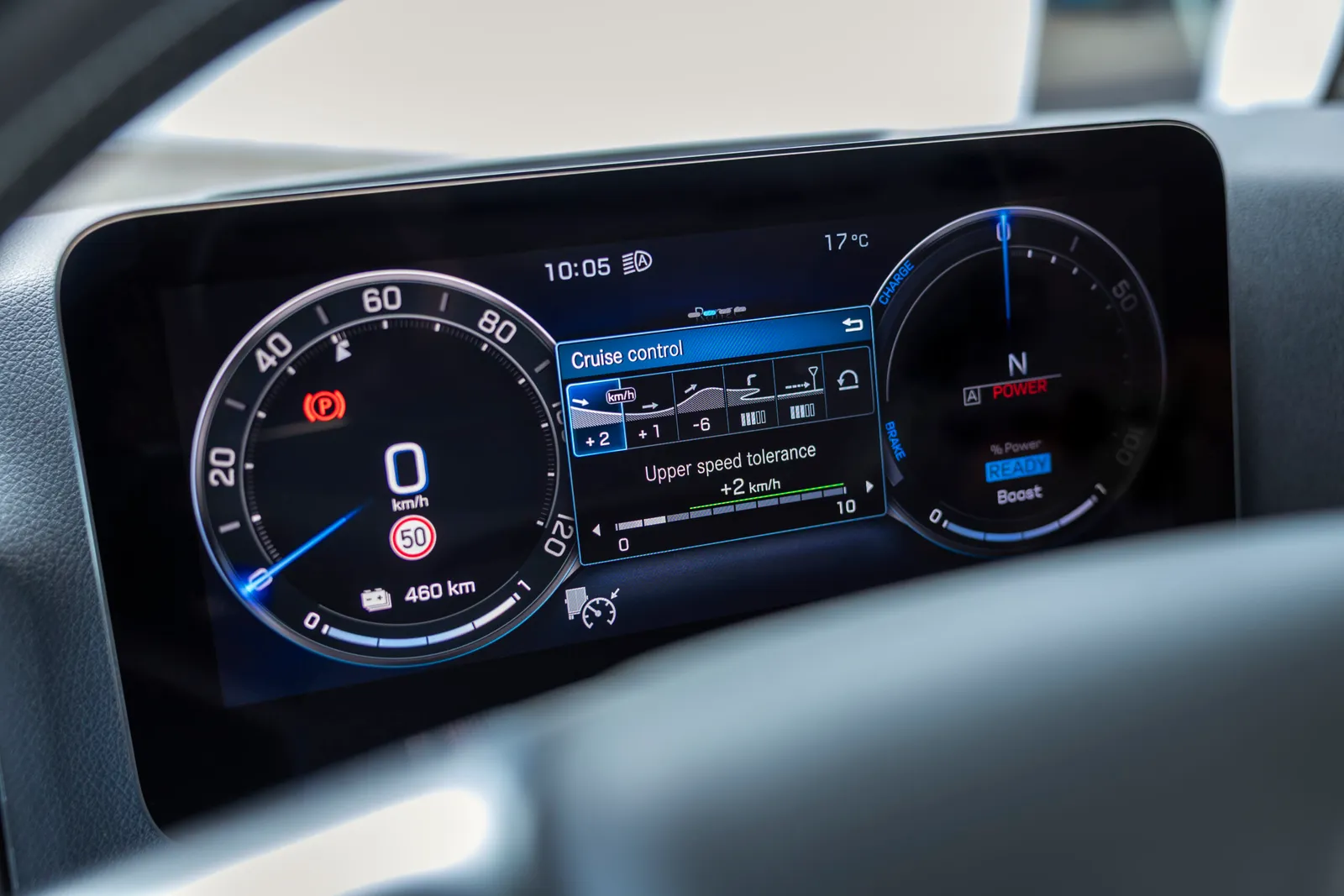
The electric motors deliver a continuous output of 400 kW and a peak output of 600 kW, providing powerful acceleration, a high level of driving comfort and dynamic performance. Full torque is usually available continuously. In addition, anticipatory driving allows electrical energy to be recovered through recuperation, feeding it back into the batteries for use by the drivetrain. Recuperation also reduces brake wear, a welcome side benefit. Depending on the situation, the driver can choose from five recuperation levels. One-pedal driving, which means decelerating through recuperation while using the mechanical brakes less, can also be activated via the touchscreen in the digital dashboard.
The eActros is equipped with the Predictive Powertrain Control (PPC) cruise and transmission management system, which has been specifically tailored to the electric drivetrain. The predictive system automatically takes account of topography, the road layout and traffic signs to ensure the most efficient driving style possible. It also uses route information from the navigation system to better identify upcoming events, preventing unnecessary braking and acceleration and making more efficient use of battery energy.
Multimedia Cockpit Interactive 2 with voice control and improved connectivity
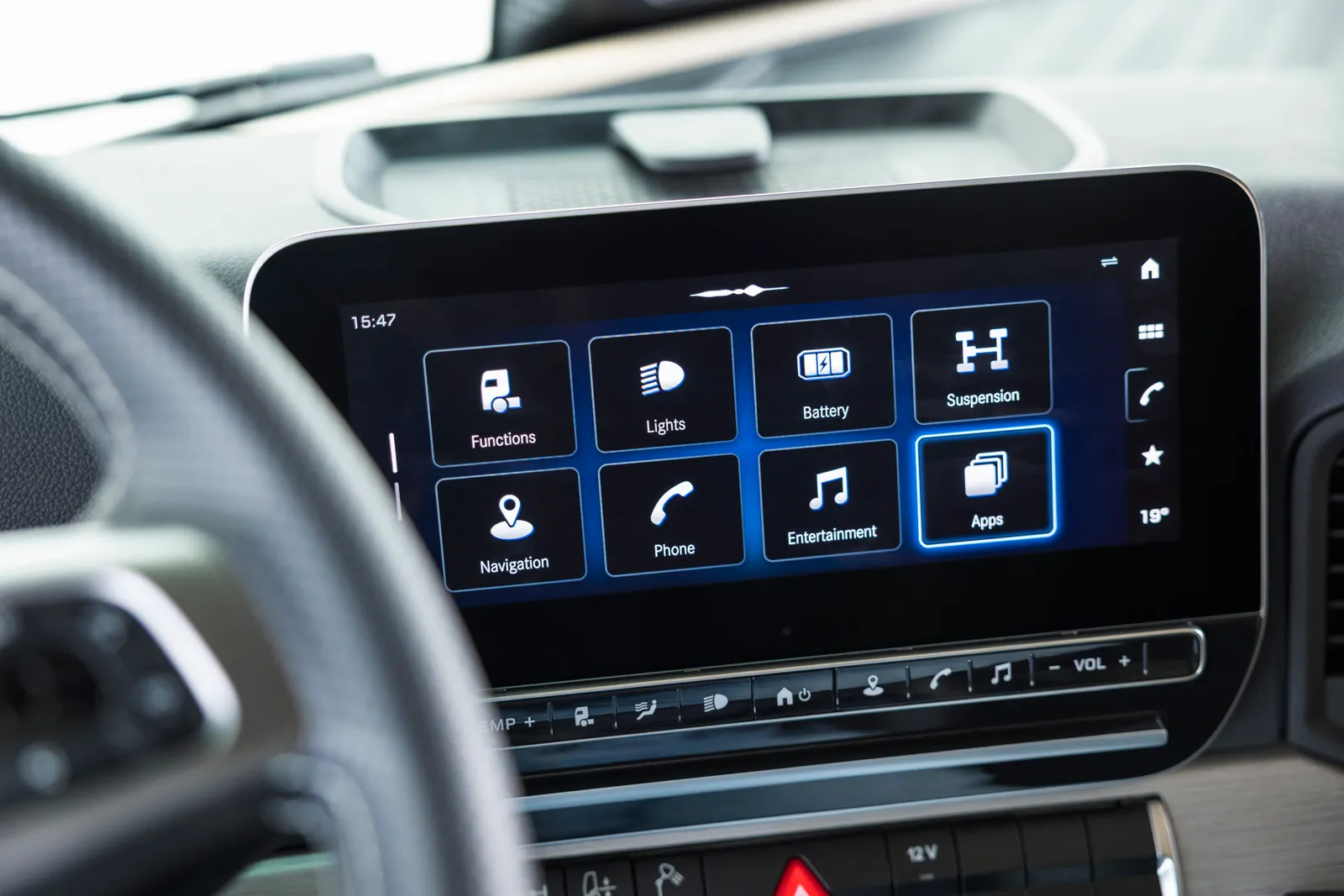
The Multimedia Cockpit Interactive 2, fitted as standard in the ProCabin and proven L cab, is proving highly useful in day-to-day operations and makes the vehicles even better connected. Its 12-inch instrument display and upgraded touchscreen are intuitive to use and individually configurable, while many functions can now be activated more safely and quickly by voice. This allows the driver to keep their eyes on the road and hands on the wheel. The Multimedia Cockpit Interactive 2 continuously informs the driver about the battery level, predicted remaining range, and current and average energy consumption. Its integrated navigation system is specifically designed for electric vehicles and takes current charging infrastructure into account. All variants also benefit from the PPC system, specially adapted to the electric drivetrain, which integrates navigation route information to better identify upcoming events and further improve efficiency. Functions such as heating, air conditioning, navigation, telephony, lighting and the integrated radio infotainment system can also be controlled via the touchscreen or multifunction steering wheel.
Electromobility with measurable climate benefits
The eActros model range offers clear potential for CO₂ savings compared with a comparable Actros with a diesel engine. Actual figures depend on the model in question and the energy mix used to charge the batteries. Based on the EU average electricity mix, savings of around 40% are possible. If only electricity from renewable sources is used, CO₂ reductions of more than 80% are possible compared with a diesel vehicle over an assumed service life of ten years.
For example, for an eActros 600 semi-trailer tractor with ProCabin in long-haul transport, this means savings of 436 tonnes or 871 tonnes of CO₂, depending on the energy mix. For the comparable eActros 600 platform chassis with ProCabin, the figures are even higher at 458 tonnes or 939 tonnes in long-haul transport.
Further CO₂ savings can also be achieved by choosing a vehicle variant with just two battery packs. For example, this results in 22 tonnes less CO₂ during production of an eActros 400 6×2 platform chassis with the proven L cab, compared with the same configuration with three battery packs. This equates to a reduction of around 23% in production-related CO₂ emissions.
Intelligent digital solutions and services for even more efficient operation
To simplify processes and workflows related to e-trucks for fleet operators, Mercedes-Benz Trucks offers a wide range of digital solutions and services. TruckLive, combined with MyTruckPoint, provides an introduction to Mercedes-Benz Trucks’ digital services. These include various connectivity services that can be accessed via the MyTruckPoint customer portal and in the vehicle through the Multimedia Cockpit Interactive 2. Examples include Maintenance Management, which improves vehicle availability, and Live Traffic, which supports route planning with real-time traffic data.
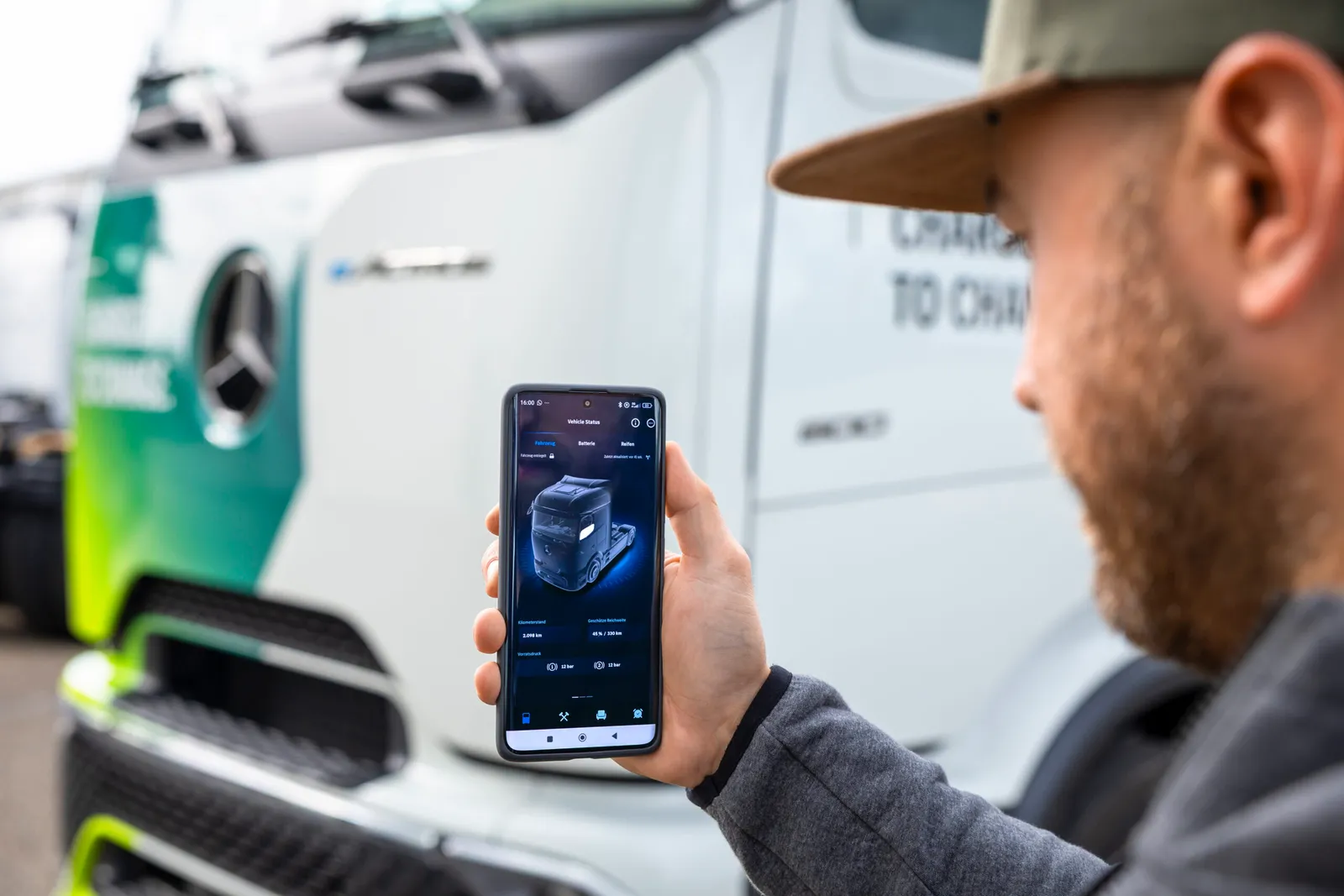
Other connected services are also available, including Connected Traffic Warnings, Service24h Connected, over-the-air updates and the Mercedes-Benz Trucks Remote Truck 3.0 app. The Remote Truck 3.0 app is the digital interface between users and their Mercedes-Benz truck, displaying important status information such as battery level and charging status, as well as push notifications.
The Connected Traffic Warnings feature helps improve road safety by detecting hazard warnings and passing them on to vehicles in the immediate vicinity. Drivers receive up-to-date traffic alerts on the vehicle map or as a pop-up in the cockpit. An audible warning sounds around ten seconds before the vehicle reaches the hazard area. The system warns of ten types of hazard, including accidents, fog, heavy rain, roadworks and slippery roads. It also includes a wrong-way warning.
With Service24h Connected, fleet managers can easily report a breakdown online via MyTruckPoint. Much of the relevant information is pre-filled, saving time compared with calling the service hotline. The vehicle’s current location and diagnostic data are also transmitted, allowing the breakdown service to prepare more effectively.
With vehicles becoming more connected and an increasing number of driver assistance systems being installed, vehicle software is crucial. Over-the-air updates make it possible to keep software up to date regardless of time and location. Drivers are prompted to install updates via the Multimedia Cockpit Interactive 2.
Fleet managers can use a range of digital functions via the Fleetboard Portal to manage their eActros vehicles efficiently. These include intelligent charging management for planning and monitoring charging processes, a digital logbook with detailed information on driving, standstill and charging times, as well as consumption data. A mapping tool is also available, displaying vehicle location, battery level and operational status in real time. The range is rounded out by BEV Basic performance analysis, developed specifically for electrically powered commercial vehicles, which provides deeper insights into energy consumption and driving behaviour. It offers objective performance indicators on driving style, supports the assessment of efficiency potential and provides monthly reports to analyse and optimise vehicle use. Other functions, such as time recording, remote diagnosis and uptime management, ensure transparency, predictive maintenance and high operational reliability for the electric fleet. These connectivity solutions help make electric trucks as efficient, safe and comfortable as possible in everyday traffic.
Driver assistance systems
A key Mercedes-Benz Trucks priority is to ensure that drivers can travel as safely as possible in every traffic situation. The driver assistance systems available across the various vehicle models help them identify hazards early, brake in good time and remain alert to traffic. Electronic assistants are particularly useful in reducing moments of inattention, such as those caused by fatigue, stress or distraction, for all road users.
As with other Mercedes-Benz truck models, the safety concept of the second-generation eActros builds on further development of proven safety systems. The newly developed electronic platform, introduced with the eActros 600 and Actros L, offers 20 times greater data processing capacity than previous versions. A total of six sensors installed around the vehicle cover a 270-degree field. This allows assistance systems such as Active Brake Assist 6, Active Sideguard Assist 2, Front Guard Assist and Active Drive Assist 3 for semi-automated driving (SAE Level 2) to make even better use of their capabilities. In some cases, the systems exceed legal requirements, including the EU’s General Safety Regulation (GSR) standards, which have applied since 2022 and 2024 respectively.
From February 2026, the systems will also be enhanced to meet future GSR regulations taking effect in July 2026 and September 2028. Attention Assist 2, Mercedes-Benz Trucks’ improved attention assistant, uses the built-in infrared camera from 20 km/h to monitor the position of the driver’s pupils. The resulting field of vision is calculated by the relevant control unit, enabling the driver to be warned if they are distracted from the road. Attention Assist 2 also incorporates the functionality of the attention assistance system, which monitors driver fatigue based on parameters such as lane keeping, driver activity and steering behaviour. Active Brake Assist 6 Plus, a further development of Active Brake Assist 6, can respond even faster to critical situations thanks to 270-degree sensor fusion technology. Features include improved pedestrian protection, better detection of cyclists and improved cornering response, with the aim of preventing more accidents, especially at speeds of up to 90 km/h.
Daimler Truck’s TruckCharge: building a European network for electric charging
Under the TruckCharge brand, Daimler Truck brings together its offering for e-infrastructure and charging electric trucks. This includes advice, installation and operation of charging infrastructure. TruckCharge also aims to establish a Europe-wide network for electric trucks, with more than 1,000 dealers and interested Mercedes-Benz Trucks customers opening their charging infrastructure to third parties to improve utilisation. By 2030, the network will include more than 3,000 fast-charging points across Europe, making it the largest network in Europe.
Flexible financing models for the transport revolution
Daimler Truck Financial Services facilitates the transition to electric mobility with integrated financing and insurance solutions. Alongside traditional financing options for trucks and charging infrastructure, “eService Leasing” is available in Europe. This integrated offer is based on a leasing model with a guaranteed residual value and also includes the Mercedes-Benz Trucks Complete service contract, including Mercedes-Benz Trucks Uptime. eService Leasing is complemented by a modular package of optional services from Mercedes-Benz Trucks and Daimler Truck Financial Services. Throughout the entire period of use, the customer pays a fixed monthly fee, with the residual value guaranteed. This eliminates unexpected costs, ensures minimum downtime and provides optimum maintenance support. In addition, flexible rental options in Germany through CharterWay offer further benefits: full cost control throughout the period of use, the complete integration of all services, such as insurance, maintenance, statutory inspections and repairs, into a single monthly fee, maximum flexibility in contract duration and vehicle changes, plus optional digital services. This gives the customer an all-inclusive package with no risk, while allowing them to respond at any time to new requirements in their transport business.
The evolution of the e-truck portfolio at Mercedes-Benz Trucks
Mercedes-Benz Trucks has had electric trucks in its portfolio since 2021. The eActros 300/400 was initially introduced as the first battery-electric vehicle for heavy-duty distribution transport, followed just a year later by the eEconic, designed for municipal waste collection and still produced in this form today. Series production of the second generation of electric trucks from Mercedes-Benz Trucks, the eActros 600, began in late 2024. The new eArocs 400 for urban construction transport, unveiled at Bauma 2025, will be launched next year and will also adopt key components from the eActros 600.
Flexible production of battery-electric models in Wörth
Like the eActros 600, the second-generation eActros 400 is built on the existing assembly line for the Wörth A-series, alongside diesel-powered trucks in a parallel and flexible production process. It also receives all its electric components in this production area. The complete system is commissioned at the end of the assembly line: from that point, the truck is ready to drive and, like all other trucks, undergoes the final finishing process and final inspection. Assembly of the new model generation therefore takes place in a single production area. The earlier eActros 300/400 and eEconic models leave the production area for the assembly of the electric drive components and are then electrified at the Future Truck Center in Wörth.
The Daimler Truck plants in Mannheim, Kassel and Gaggenau also play an important role in producing the new eActros portfolio. They supply the components required for the battery-electric drive, such as the electric axle, transmission components and the front box, which houses numerous high- and low-voltage components and is installed in the space formerly occupied by the internal combustion engine.
Footnotes:
(1) Nominal capacity of the new battery, based on internally defined conditions, may vary depending on usage and ambient conditions.
(2) The estimated range is derived from the results of internal simulations and actual driving tests. The actual range may differ from the estimated range due to numerous factors, such as topography, weather conditions, speed, preconditioning, auxiliary systems, individual vehicle configuration and driving style.
(3) The range was determined internally under specific test conditions using a 4×2 tractor unit with a total towing weight of 40 tonnes, at an ambient temperature of 20°C, in long-distance transport, and may differ from the values determined in accordance with Regulation (EU) 2017/2400.
(4) Charging time is based on the conditions defined in ISO/SAE 12906 for heavy-duty trucks, with a charging power of 400 kW at a standard DC fast-charging station with 500 A.
(5) CO₂ represents all greenhouse gases generated (CO₂ equivalent).
(6) Based on a life cycle assessment in accordance with ISO 14040:2006+A1:2020 and ISO 14044:2006+A1:2017 +A2:2020, critically reviewed by the independent third party TÜV Rheinland. The choices made during the development of this LCA, including the functional unit and methodologies, have a significant impact on the results. Comparison with other truck models or vehicles is therefore neither recommended nor intended.
(7) With all assistance systems, Mercedes-Benz Trucks aims to support the driver as effectively as possible within the limits of the systems. However, as required by law, the driver remains fully responsible for operating the vehicle safely at all times.
Een zakelijke vraag aan Mercedes-Benz Belgium Luxembourg? Get in touch
Companies in this story
Keep following this
Get an email when a new story is published. No account needed.
- ThemeTowards low-emission equipment and transport
- SubjectTransport & off-road
- CompanyMercedes-Benz Belgium Luxembourg