Matexpo Daimler Truck BeLux
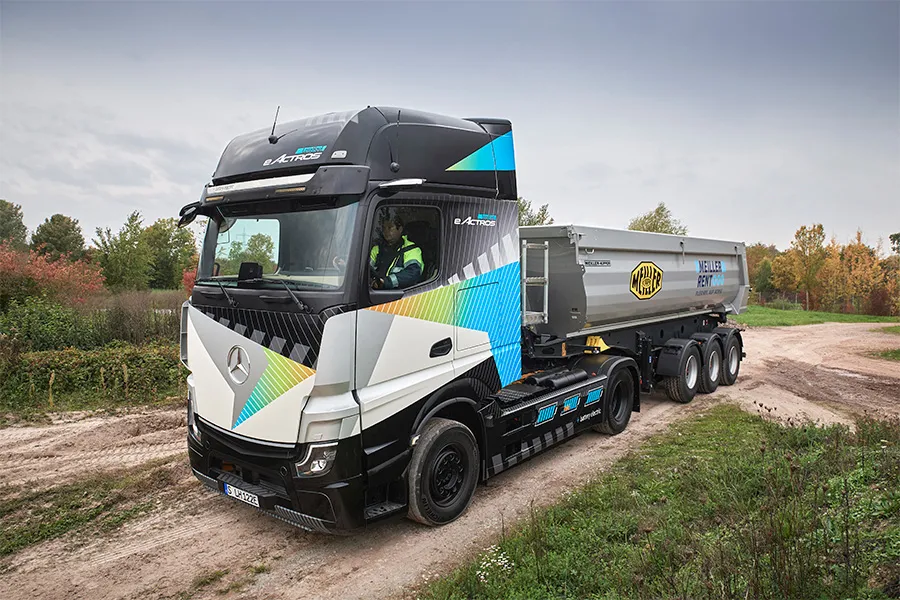
The launch of the Mercedes-Benz Urban eTruck in 2016 made it clear that Daimler Truck was serious about its pioneering role in innovation, particularly eMobility. Just 7 years later, the first electric vehicles are already in series production. The transition is accelerating exponentially, and if the necessary conditions, such as charging infrastructure, fall into place, there will be little to stand in the way of this progress. It is a development that is also having an impact on the advanced digitalisation and connectivity of trucks, and on the organisation of the dealer network. Construction transport is going electric too. At Bauma 2022, the prototype battery-electric Arocs was among the vehicles unveiled. Here in Kortrijk, the models from the electric range that are already in series production are on display:
eActros 300 LS tractor unit
eEconic 300 L 6×2
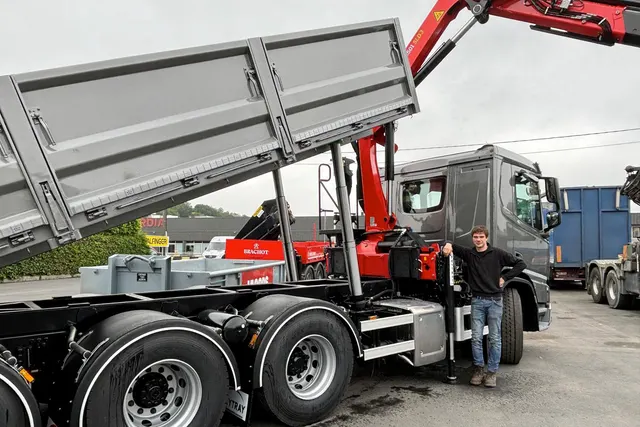
eActros 400 L 6×2 with AJK hooklift system
As for conventional powertrains, you can admire an SLT outside the entrance to Kinepolis. Inside the stand, you will find the Arocs 3348 LK 6×4 with WAF hooklift system. The Mercedes-Benz Trucks stand is inside Hall 5, at no. 523. Information about the vehicles can be found at the end of this document.
Alternative powertrains
On its journey towards a CO₂-neutral future, Daimler Truck has clearly defined its strategic direction and is consistently pursuing a dual strategy for electrifying its range, with battery-electric power on the one hand and hydrogen on the other.
The Mercedes-Benz GenH2 Truck is being developed primarily for flexible, demanding applications in the key heavy-duty and long-haul transport sectors. The development target is a range of 1,000 kilometres or more. Series production is expected to start in the second half of this decade. The vehicle is currently undergoing intensive testing in real-world conditions.
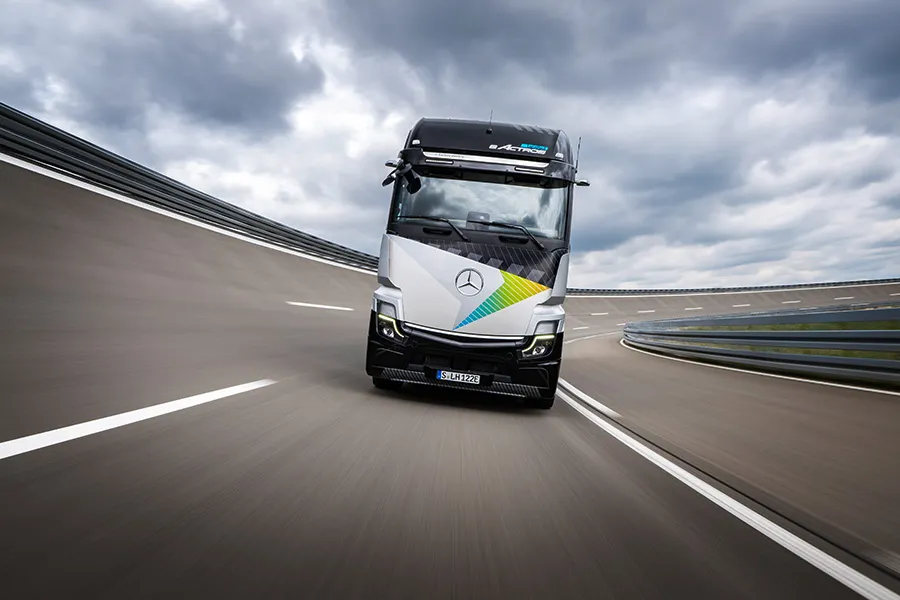
Meanwhile, the range of battery-electric vehicles is continuing to expand. These include the eActros LongHaul, which is scheduled to enter series production in 2024 and will be built at the truck plant in Wörth. This vehicle has a new e-axle with two integrated electric motors, delivering a continuous output of 400 kW and a peak output of more than 600 kW. The eActros LongHaul draws its power from three battery packs mounted under the chassis in drawer-like units. This gives it a total capacity of more than 600 kWh. The batteries use lithium iron phosphate (LFP) cell technology, known above all for its long service life and greater usable energy. The eActros LongHaul is suitable for high-performance or megawatt charging. The batteries can be charged from 20 to 80 per cent in less than 30 minutes at a charging station with a capacity of around 1 megawatt. With a full charge, the eActros LongHaul has a range of around 500 km. This type of vehicle could offer a highly attractive Total Cost of Ownership. The first prototypes are already undergoing intensive testing, and will also be tested on public roads later this year. Next year, near-production prototypes will be sent to various customers for real-world trials.
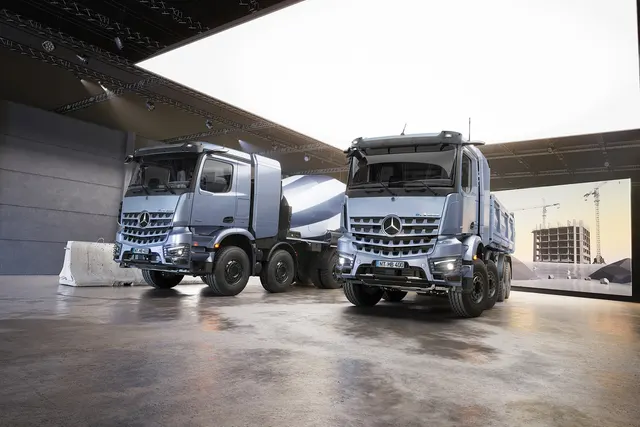
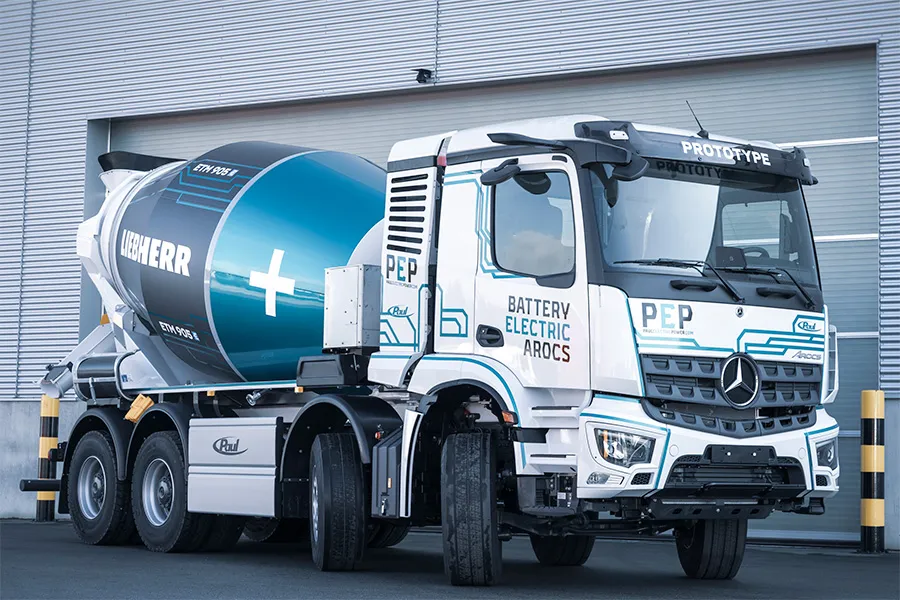
Progress is also being made in the construction segment. At Bauma, the Arocs was unveiled as a battery-electric vehicle. It will be available in Germany by the end of 2023.
The Econic is now also available as an electric model. The first examples of this vehicle rolled off the production line in Wörth last summer. The key technical specifications of the eEconic are largely identical to those of the eActros. As a refuse collection vehicle, the eEconic is designed to cover most typical Econic collection routes in a single shift without needing to recharge. The electric powertrain allows for a flat cab floor, making it easier to move through the cab, a major advantage when the driver wants to exit through the folding door on the passenger side. The modern, intuitive Multimedia Cockpit is also a significant upgrade over the conventional Econic. Another equipment highlight is the panoramic glass. In addition, the coated, heated Thermocontrol windscreen prevents misting and improves forward visibility. It also reduces the amount of solar heat entering the cab. An important safety benefit in urban traffic: the eEconic comes as standard with the S1R Sideguard Assist turning assistant and fifth-generation Active Brake Assist emergency braking system.
eActros 300 tractor unit 4×2
At IAA in September 2022, the battery-electric Mercedes-Benz eActros 300 was also unveiled in a tractor unit version for flexible heavy-duty distribution transport. The eActros 300 tractor unit can tow all standard European semi-trailers, subject to the maximum permitted overall length. The electric truck is based on the same technology as the eActros 300/400. Three battery packs, each with an installed capacity of 112 kWh1, provide a range of up to 220 km on a single charge. Series production is scheduled to start in the second half of 2023. Several extensions to the eActros wheelbases and axle loads are also planned: 04/2023: 4×2 wheelbase 4000, 08/2023: 6 new variants, 10/2023: 12 new variants, 04/2023: rear axle load increased from 11.5 tonnes to 12 tonnes.
Consulting
Daimler Truck offers its electric trucks as an integrated solution that includes consultancy services to maximise vehicle utilisation and optimise Total Cost of Ownership. For example, the eConsulting teams use existing driving routes to determine usage profiles for electric trucks that are as realistic and relevant as possible for each customer. Depending on customer requirements, and in addition to depot electrification, eConsulting also covers all aspects of planning, ordering and implementing charging infrastructure and grid connections. As part of its consultancy services, Daimler Truck also opened a customer charging park at BIC in Wörth am Rhein in July 2022, together with its project partner, the services division of Netze BW.
At the eTruck Charging Park, electric truck customers can test charging stations and charging concepts from various manufacturers, and work on site with Daimler Truck experts to develop charging solutions tailored to their specific applications. Charging technology is made available for testing and combined with a comprehensive range of consultancy services to help customers make a smooth transition to e-mobility.
Challenges in rolling out eMobility
Charging infrastructure
For charging infrastructure at customer sites, Daimler Truck has strategic partnerships with “Siemens Smart Infrastructure” and “ENGIE”. Daimler Truck can also help identify potential subsidies for infrastructure and vehicles. For public infrastructure, Daimler Truck has formed a joint venture with Traton Group and Volvo Group. The joint venture plans to install and operate at least 1700 high-power, green charging points on and near motorways and logistics hubs throughout Europe. The parties have committed to investing a total of 500 mio.
Daimler Truck is also participating in the “High-performance charging in long-distance truck transport” (HoLa) project. The aim of this project, under the auspices of the VDA, is to plan, build and operate selected high-power charging infrastructure for battery-electric long-haul trucks. Two high-power Megawatt Charging System (MCS) charging points will be installed at various locations in Germany and tested in real-world conditions. Various other consortium partners from industry and research are involved in the project.
At local level here in Belgium, Mercedes-Benz Trucks works mainly with Ekoenergytika, Siemens, ABB and Kempower. There will be 3 Ekoenergytika chargers on the Matexpo stand:
Plug Charger GO 30,
Plug Charger 40,
Axon Easy 180
Satellite
Euro VII
Daimler Truck has taken note of the EURO VII proposal submitted by the European Commission, which sets new targets for further reducing pollutant emissions from commercial vehicles. However, it regrets that the arguments and objections put forward have not been taken into account in the proposal. The contribution EURO VII would make to air quality is considerably smaller than that of a rigorous and consistent renewal of the vehicle fleet based on existing EURO VI technology. The draft legislation will require the industry to invest billions of euros in new engine and aftertreatment technologies, when these resources could instead be used for zero-emission technologies that address not only CO2 emissions but also emissions of other pollutants. We remain convinced that it would be better to focus financial resources on zero-emission technologies. We now see a risk that the competitiveness of the European automotive industry will be weakened. It is now up to the European Parliament and the Member States to finalise the draft legislation. We trust that they will ensure a balanced approach and support the automotive industry on its path towards zero-emission vehicles.
Dealer network
The dealer network is one area set to undergo significant change in the coming years. The network will be strengthened throughout Europe. It is also clear that where there is no service point, no trucks are sold. These gaps need to be addressed too. This will involve close cooperation with several major partners. A sales model like that used for passenger cars, based on direct sales, is not on the cards for Trucks. In Belgium, the Vereenooghe group was taken over by the Van Mossel group in 2022, which was already active in the Antwerp region. Further changes to the network are expected in the coming years.
The dealer network is an important partner in maintaining good customer relationships. A good relationship with their dealer is, in fact, one of the most important purchase criteria for truck customers. In Belgium, we will place even greater emphasis on further professionalising the sales and servicing of our trucks, with a particular focus on our electric truck range. Customer satisfaction is central to this.
Customer Services & Parts
Electric driving also brings a range of challenges for Customer Services & Parts. Drivers not only have to adopt a new driving style, but workshop staff also need to be made aware of the risks. Working on high-voltage vehicles can literally be life-threatening. That is why Daimler Truck operates eService points, where staff receive specific training in working safely with the new powertrains. They are supervised by Daimler Truck BeLux Technical Advisors, who are qualified as high-voltage specialists. They provide advice during the initial set-up phase of an eService point, then monitor safety, skills development and efficiency.
The infrastructure also has to meet special requirements that differ considerably from those of ‘traditional’ workshops. For example, diagnostic work requires adapted infrastructure. Mobile chargers are used to provide the flexibility needed for diagnostics, allowing several work bays to be served. Clear space must also be provided alongside vehicles so that the battery can be removed sideways. In addition, a quarantine area must be provided for vehicles with an unstable battery, in accordance with requirements set by the Belgian authorities (local fire brigades). The area must be permanently accessible to fire engines, and the surface must be able to support their weight, with a maximum gradient of 6%. It must also be at least 16 m from buildings and combustible materials.
Daimler Truck BeLux has already recognised 13 such eService points*, with assessments under way for 4 more candidates (new-build facilities and potential analysis).
*Van Mossel-Vereenooghe Brugge, Van Mossel Deurne, Groep Jam Hasselt, CAR Avenue Liège, Hedin Automotive Sint-Niklaas, Hedin Sint-Pieters-Leeuw, Ghistelinck Waregem, Hedin Aalst, Truck Center Jost (Amel), Merbag Leudelange, Garage Miers (Asse), Eekhout (Tournai) and VDH Herentals.
Services
My TruckPoint/TruckLive
With its new customer portal, My TruckPoint, Daimler Truck is responding to many customers’ wish to make fleet management even easier, freeing up more time for their day-to-day operations. After registering at mytruckpoint.mercedes-benz-trucks.com, customer data, such as vehicle and contract details, is uploaded to the portal automatically. Customers can also manage their data online themselves. The fully digital workplace gives customers a 360-degree overview of relevant information, documents and processes, all through a single login.
As well as an overview of the fleet, including detailed vehicle data, the tool, which is free for Daimler Truck customers, provides extensive information on service contracts, including Mercedes-Benz Uptime and Fleetboard contracts, with start and end dates, contract terms, conditions and current mileage. Customers can also add vehicles from other manufacturers manually. The platform also supports fleet management by providing information on upcoming maintenance and inspection work and contractual matters. When a contract expires, MyTruckPoint automatically generates a notification. Customers can also order Mercedes-Benz genuine parts for specific vehicles. They can track their order history at any time, making future parts orders much easier. The production and delivery status of new vehicle orders can also be viewed using online tracking.
The new customer portal also provides access to TruckLive, the gateway to Daimler Truck’s digital services. This new digital service is already available in a number of selected European countries, including Belgium, and can be activated by taking out a TruckLive contract. TruckLive launches with two modules: maintenance management and live traffic information (Live Traffic). The maintenance management module provides visibility of truck maintenance work and selected information on the vehicle’s current condition. It connects customers with Mercedes-Benz Service, making vehicle data available for maintenance planning and simplifying maintenance. Customers can also carry out certain maintenance tasks themselves. Live Traffic uses up-to-date traffic information to reduce journey times and improve the accuracy of arrival-time estimates.
Fleetboard
Fleetboard @ Retail
Here, too, the dealer network has an increasingly important role to play in maintaining close customer relationships, supporting customers with vehicle activation and monitoring the KPIs provided by this connectivity tool. Dealers will not only be the first point of contact for sales of the new Fleetboard packs (see below), but will also proactively monitor customers and recommend corrective measures relating to driving style, efficiency and other areas. They will also be the first point of contact for technical support on connectivity.
New pricing strategy
Daimler Truck BeLux will simplify its Fleetboard Connected Services offering for customers. It will offer 4 packages, tailored to the needs of every type of customer.
The ‘tachograph package’, for example, includes automatic downloads of the driver card and tachograph mass memory, with live monitoring of all driving and rest periods. The comprehensive ‘Pack L’, meanwhile, includes tachograph services, Track & Trace and extensive monitoring of driving behaviour via the Performance Analysis tool, among other features.
Mercedes-Benz Uptime
Mercedes-Benz Uptime is an integral part of Mercedes-Benz Complete and Select, providing a service that sustainably increases vehicle availability. The intelligent system records relevant vehicle data, from tyre pressure to engine performance, and now also includes the battery status of the eActros and eEconic. Mercedes-Benz Uptime has added more than 200 e-specific parameters in this area, which continuously monitor charging processes and voltage curves for the high-voltage battery, for example. Mercedes-Benz Uptime fully automates and remotely supports almost all diagnostic procedures for predictable faults. Once the data has been collected in the truck, the system sends specific recommendations for action to the customer and Mercedes-Benz workshop within an average of 240 seconds. By connecting vehicles, Mercedes-Benz Service and transport companies, workshop visits for anticipated and unexpected incidents, such as breakdowns and stranded vehicles, can be reduced. Mercedes-Benz Uptime will be included as standard for 3 years on vehicles produced from October 2023.
Vehicles
Vehicle A:
- Model: eActros 300 LS tractor unit
- Colour: Arctic White, MB 9147
- Wheelbase: 4000 mm
- Weight variant: 19,000 kg (FA: 8,000 kg, RA: 12,000 kg)
- Gross combination weight: 40,000 kg
- Motor: electric motors integrated into the eAxle
- Battery packs: 3 × 112 kWh installed capacity
- Cab: M cab, ClassicSpace, 170 mm engine tunnel
- Tyres: Front axle: 315/70R22.5
- Rear axle: 315/70R22.5
Specific equipment: eActros tractor unit:
The eActros 300 tractor unit offers another way to make the transition to CO2-neutral transport in heavy distribution operations. Its three battery packs, with a total capacity of 336 kWh, provide a range of up to 220 km on a single charge. Suitable for all standard ISO trailers / Fifth-wheel coupling height: 1150 mm / Fifth-wheel coupling position: max. 900 mm
MirrorCam
The new Actros is equipped with the innovative, aerodynamically optimised MirrorCam. It provides excellent rearward visibility and visibility around the A-pillar. In addition, the MirrorCam’s camera view swivels with the vehicle, enhancing safety when manoeuvring, turning and changing lanes.
- Improved visibility along the A-pillar, as vision-restricting mirrors, for example at roundabouts, are eliminated
- Greater safety when turning, thanks to guide lines on the display and colour markings for merging lanes when the indicator is activated, helping drivers maintain the optimum distance from traffic approaching from behind when merging
- Greater safety thanks to distance lines that help drivers judge traffic approaching from behind
- Improved visibility of the trailer on bends, as the camera view swivels digitally.
Vehicle B:
- Model: Arocs 3348 LK 6×4
- Colour: Steel Grey Metallic matt, MB 7850
- Wheelbase: 3900 mm
- Weight variant: 33,000 kg (FA: 9,000 kg, RA: 2 × 13,000 kg)
- Gross combination weight: 80,000 kg
- Engine: OM471, R6, 12.8L, 350 kW (480 hp), 2300Nm
- Transmission: G330/12 Powershift 3 ‘Advanced’
- Cab: M cab, ClassicSpace, 170 mm engine tunnel
- Tyres: Front axle: 385/65R22.5
- Rear axles: 315/80R22.5
Predictive Powertrain Control, with interurban function
With its intelligent Predictive Powertrain Control (PPC) cruise control system, Mercedes-Benz Trucks is the first manufacturer on the market to offer a powertrain that anticipates the road ahead, makes active use of coasting phases and automatically adapts gear selection to the topography, on motorways, country roads and urban roads alike.
Thanks to new functions, PPC can reduce fuel consumption by up to 5% in urban areas and on secondary roads. With its interurban function, PPC can ‘recognise’ bends, junctions, roundabouts and speed limits, for example, and adapt the driving style by decelerating and accelerating proactively. PPC can factor upcoming gradients and descents into its calculations of shift points, gear changes and speed control. Combined with the PowerShift3 automatic transmission, this enables a driving style adapted to the topography.
Powershift Advanced:
PowerShift Advanced is an electronic system that automates and controls clutch engagement and gear changes. Optimised pneumatic and electronic control, combined with improved software, results in optimised clutch control. This enables improved starting and shifting performance and faster gear changes, particularly in the higher gears, reducing torque interruption during gear changes by as much as 40%.
PowerShift Advanced is only available in combination with Mercedes PowerShift 3.
Vehicle C:
- Model: eEconic 300 L 6×2
- Colour: Bright White, MB9678
- Wheelbase: 4000 mm
- Weight variant: 27,000 kg (FA: 8,000 kg, RA: 1 × 11,500 kg; 1 × 8,000 kg)
- Gross combination weight: /
- Motor: 2 electric motors integrated into the eAxle
- Battery packs: 3 × 112 kWh installed capacity
- Cab: high Direct Vision cab
- Tyres: Front axle: 315/70R22.5
- Rear axles: 315/70R22.5
High Direct Vision cab
The high cab features a very comfortable interior layout with a high degree of ergonomic functionality. It is designed for distribution vehicles and refuse collection vehicles. The cab frame consists of an extremely strong and rigid aluminium safety cell, clad in SMC plastic panels. It meets the safety requirements of ECE R 29/2 (simulated frontal impact) and the specifications of the so-called ‘Swedish test’ in its reinforced form. The roof hatch is included as standard.
Digital solutions:
eMobility presents us with new challenges. That is why, with the new eEconic, you can count not only on maximum support from Mercedes-Benz Trucks’ tried-and-tested Fleetboard services, but also on new services designed specifically for electric vehicles. Our proven intelligent Mercedes-Benz Uptime system has also been expanded with e-specific components to ensure maximum availability for the new eEconic. In addition, we do everything we can to prepare you for the challenges of electric driving. This gives you real-time insight into all vehicle activities and data (mapping***), a digital logbook (logging) and the Fleetboard Charge Management planning tool for scheduling charging sessions.
Vehicle D:
- Model: eActros 400 L 6×2 with AJK hook-lift system
- Colour: Pool White, MB 9147
- Wheelbase: 9000 mm
- Weight variant: 27,000 kg (FA: 8,000 kg, RA: 1×11,500 kg; 1×8,000 kg)
- Gross train weight: /
- Motor: 2 electric motors, integrated into the eAxle
- Battery packs: 4× 112 kWh installed capacity
- Cab: M cab, ClassicSpace, engine tunnel 170 mm
- Tyres: Front axle: 315/70R22.5 /Rear axles: 315/70R22.5
eActros:
A range of up to 400 km and short charging times make this truck ideal for heavy-duty distribution transport in urban areas. But the eActros is more than just a truck. It is part of the integrated eActros Solution, which includes the new eConsulting and innovative digital solutions, as well as the truck and the usual services. It all brings us a step closer to the goal of locally emission-free driving.
Charging:
From filling station to charging station. The standardised charging system makes charging the new eActros as intuitive as possible: simply apply the parking brake, plug the connector into the vehicle’s charging socket (it locks automatically) and charging can begin. With a charging capacity of 160 kW, it takes just over an hour to charge the three battery packs from 20 to 80%. To stop charging, simply press the stop button next to the charging socket and unlock the vehicle.
eConsulting:
The newly developed eConsulting service guides you step by step on your journey to eMobility. First, a detailed concept is drawn up for electrifying your operations, based on an analysis of your fleet’s routes. This analysis helps determine, for example, which charging infrastructure is suitable and which software and hardware solutions are required. Based on the measures identified, all associated costs and any available subsidies are broken down transparently, analysed and optimised. The implementation phase follows. During this phase, all the necessary processes are integrated into your operations. From intelligent charging systems to support with driver training, Mercedes-Benz Trucks is there to advise and assist you.
Question about this story? Ask your question
Companies in this story
Keep following this
Get an email when a new story is published. No account needed.
- ThemeTowards low-emission equipment and transport
- SubjectTransport & off-road
- CompanyAJK
- CompanyWAF