Leading infrastructure player sets its sights on reducing its environmental footprint
Text and images Colas Belgium
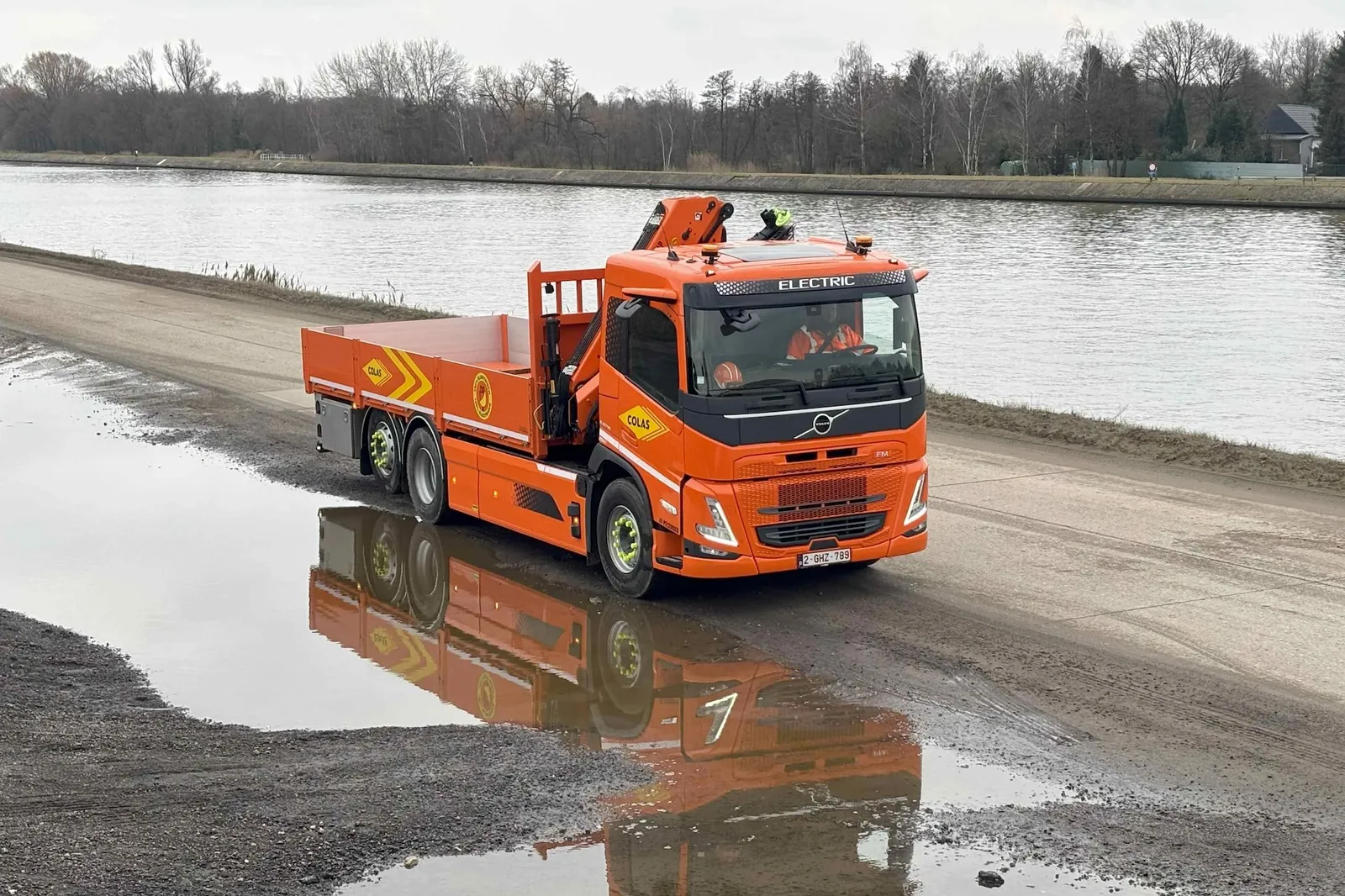
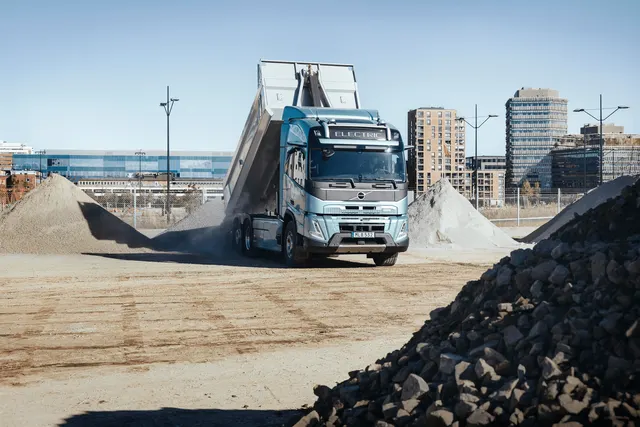
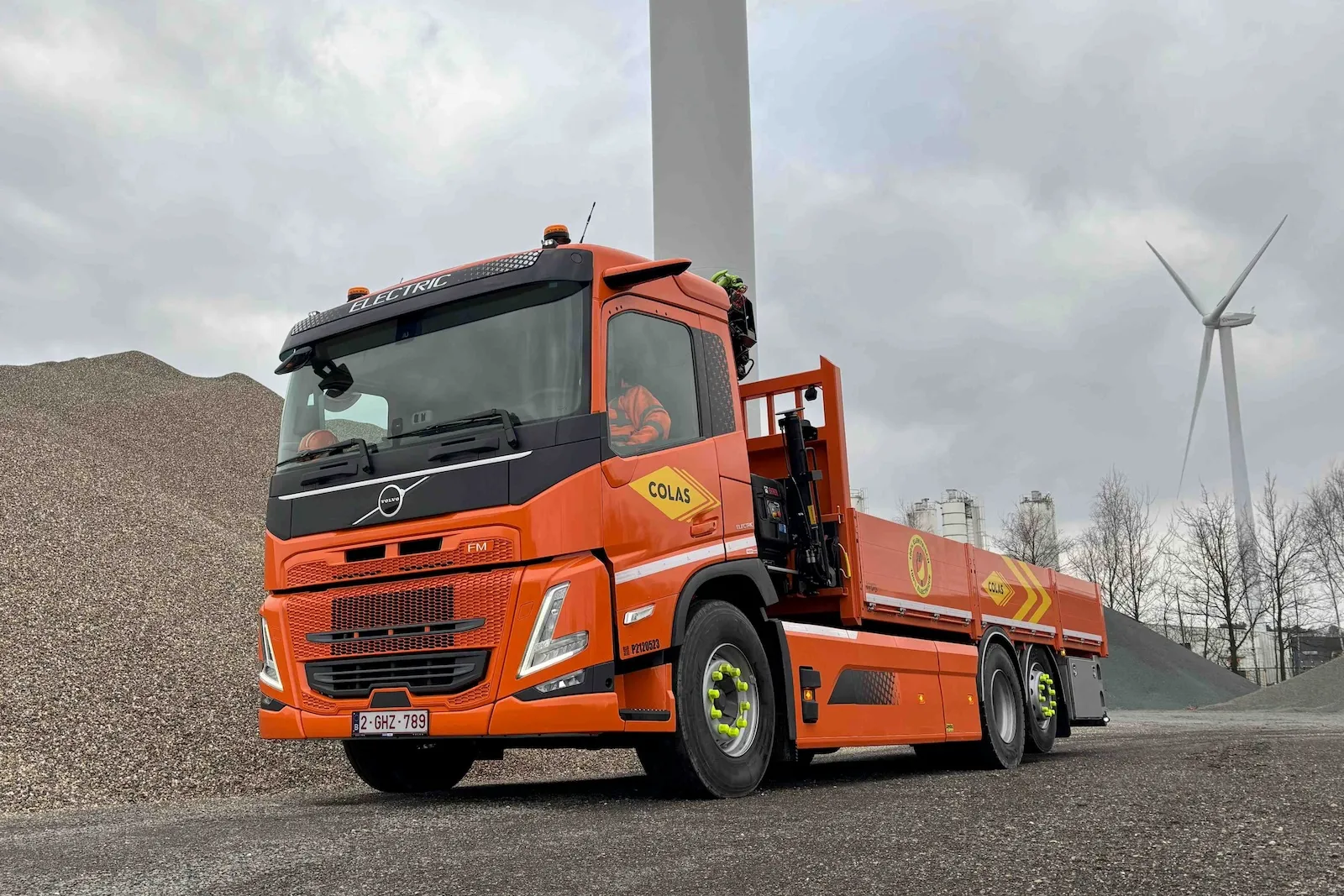
Colas Belgium has recently taken delivery of its first Volvo FM 6×2 Electric truck. The vehicle will be used in the north of the country to install the road signs required for roadworks. The investment forms part of Groupe Colas’ drive to significantly reduce its CO₂ footprint by 2030.
Colas Belgium, part of the French Colas Group, specialises in the construction and maintenance of road, rail, port, airport, industrial and logistics infrastructure. Its operations are supported by a versatile fleet of 95 trucks. “Just over half of this fleet is assigned to materials transport, while the rest is used for what we call operational activities. Volvo Trucks has been Colas Belgium’s exclusive truck supplier since 2020. This means the manufacturer already accounts for almost half of our truck fleet. Although our group has already invested in several electric trucks across Europe, this Volvo FM Electric is the first to join our Belgian fleet. And it certainly won’t be the last, given our strong ambition to reduce our environmental footprint,” says Christian Jacques, Equipment Director at Colas Belgium.
In 2021, Groupe Colas launched the ACT programme, one of whose objectives is to reduce direct and indirect greenhouse gas emissions (Scopes 1, 2 and 3) by 46.5% by 2030. The purchase of this FM Electric is therefore clearly part of the programme.
Transporting and installing road signs
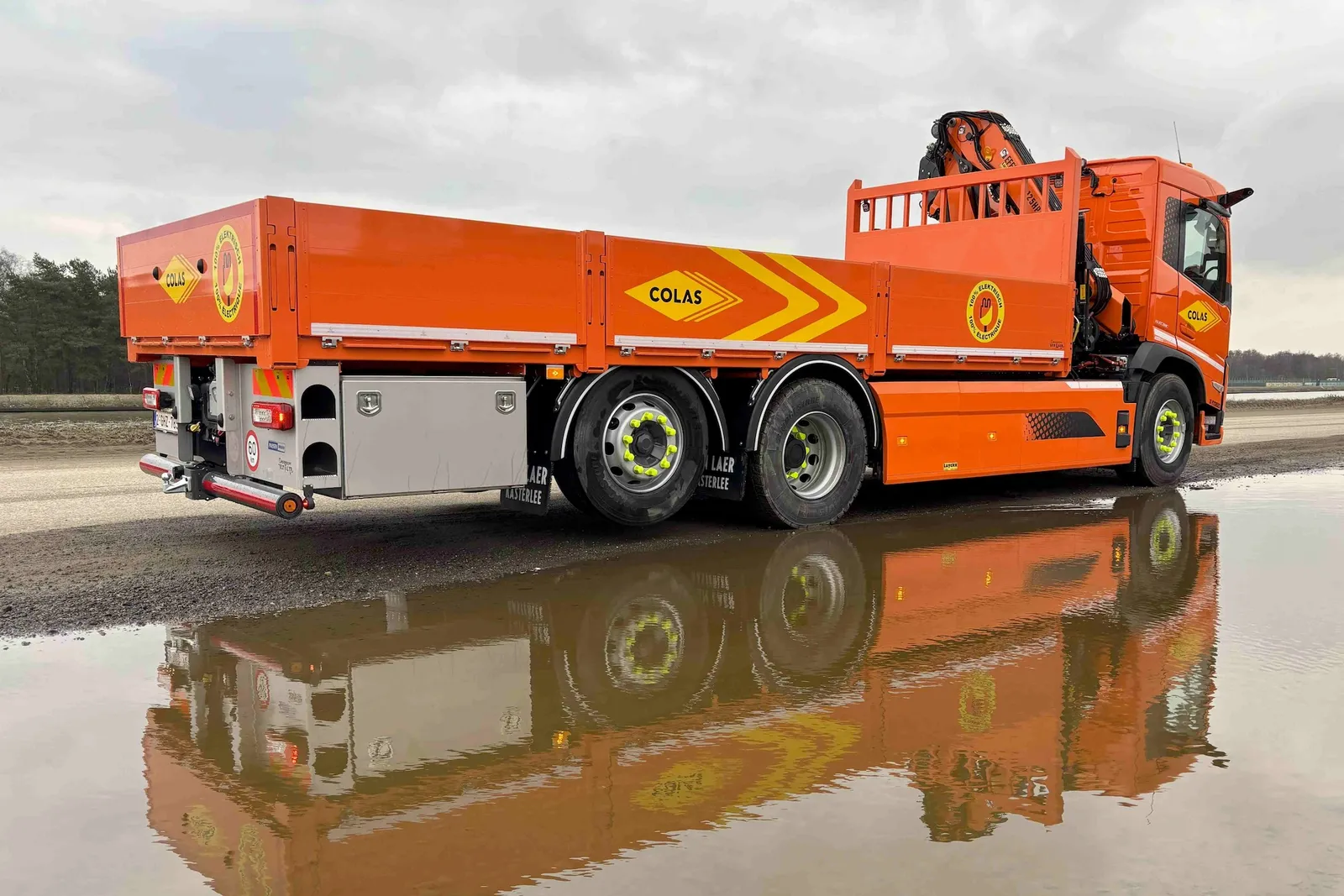
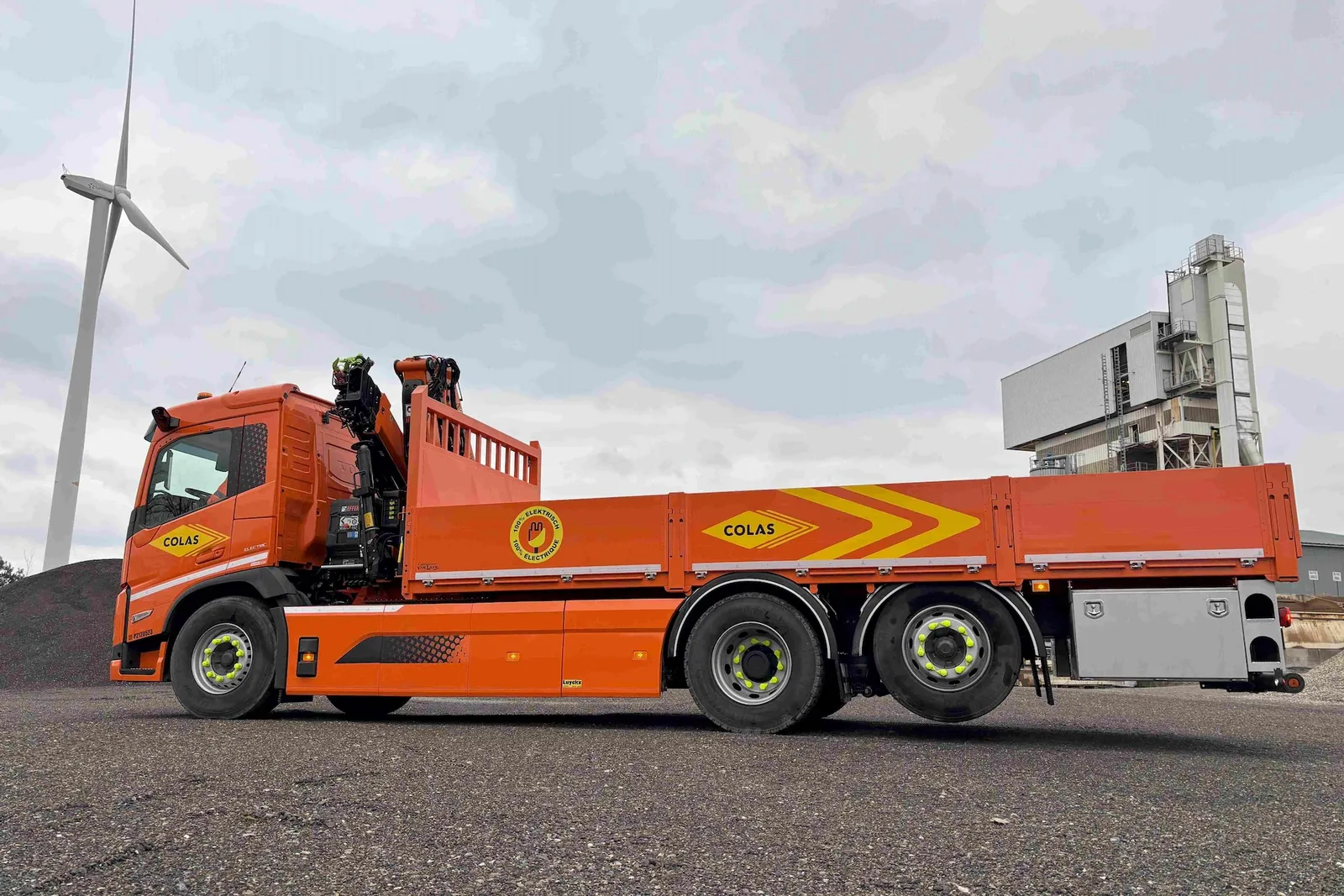
“Colas Transport Belgium’s FM Electric, supplied by our dealer Paesen Trucks in Heusden Zolder, is a 6×2 rigid truck fitted with a crane behind the cab and an open body. The bodywork was built by Luyckx in Brecht. The truck is equipped with six battery packs, totalling 540 kWh, giving it a range of 250 to 300 km, depending on how intensively the crane is used,” adds Yves Verheyden, Key Account Manager at Volvo Trucks Belgium.
“The vehicle is based in Heusden Zolder and is used to deliver and install temporary signage at our worksites, such as signs, posts and concrete support blocks. It operates across most of Flanders and returns to base every day. We have equipped the base with rapid chargers, powered mainly by electricity generated on site by our wind turbines and photovoltaic panels,” adds Christian Jacques.
Suited to the construction sector
“We analysed the journeys made by the previous signage vehicle over the course of a year. We found that it rarely covered more than 300 km a day. The FM Electric’s range is therefore perfectly suited to this operation,” continues Christian Jacques.
Yves Verheyden adds: “The construction sector is particularly well suited to electric trucks, as these vehicles generally cover relatively short distances. They also often operate from their base, making it easier to charge the batteries. Volvo Trucks has therefore developed a particularly broad range of electric models for this sector, from basic 4×2 rigids to complex 8×4 vehicles.”
TCO on a par with diesel trucks
The FM Electric has a gross vehicle weight (GVW) of 28 tonnes. As electric trucks are permitted to weigh 2 tonnes more than the statutory limit, its payload is almost the same as that of a diesel vehicle, despite the weight of the batteries.
“As part of our policy to reduce CO2 emissions, electrifying our truck fleet, and eventually our construction machinery too, seems the right way forward. Thanks to the subsidy from the Flemish Agency for Innovation and Entrepreneurship (VLAIO), and because this truck mainly uses electricity generated on site, the operating cost (TCO) of this FM Electric is comparable to that of a diesel truck. HVO is also being considered, but the high cost of this sustainable fuel remains a barrier to its use,” concludes Christian Jacques.
Question about this story? Ask your question
Keep following this
Get an email when a new story is published. No account needed.
- ThemeConstruction transport on road and site
- SubjectTransport & off-road