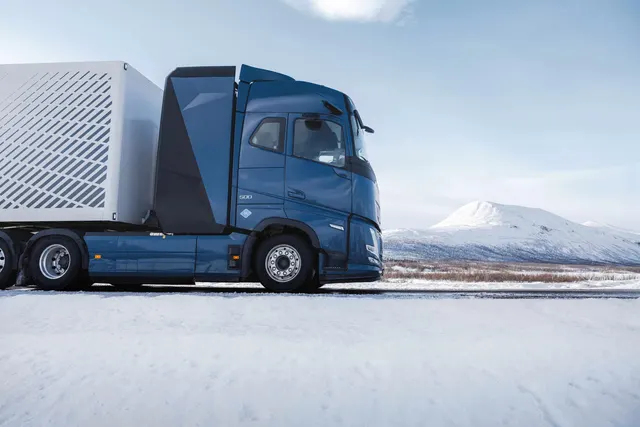
How Daimler Truck is advancing ‘Vision Zero’ and using the latest assistance systems to improve safety for all road users.
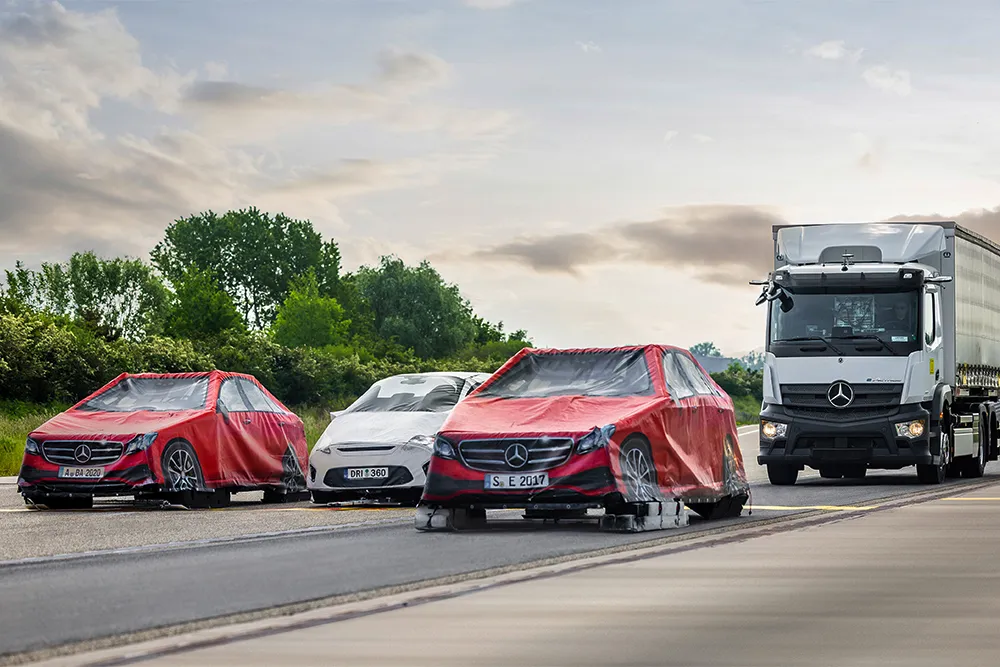
· From July, stricter rules will apply to new trucks in the EU.
· With its latest safety systems, Daimler Truck in some cases goes well beyond the legal requirements.
· All road users are at the heart of its approach: according to EU data, car occupants, cyclists and pedestrians make up the majority of casualties in accidents involving trucks.
· The new 270° sensor fusion technology provides an extended view around the vehicle.
· The systems are being installed across all model series, including the eActros 600 and the new generation Actros L.
· Rainer Müller-Finkeldei, Head of Product Development at Mercedes-Benz: “The EU’s General Safety Regulation, which comes into force this year, is an important step towards accident-free driving, our ‘Vision Zero’. We have pursued this path consistently for decades, and are now setting new standards with our improved safety assistance systems. Our aim is to prevent accidents as effectively as possible, protecting drivers and all road users.”
The countdown is under way: from July 2024, all new trucks, buses and coaches registered in the EU must comply with the provisions of the updated General Safety Regulation (GSR2). The regulation has applied to new vehicle models since July 2022. The GSR mandates a range of driver assistance systems to improve road safety for everyone. In particular, electronic assistance systems can help prevent lapses in attention caused by fatigue, stress or distraction from having serious consequences.
This benefits not only the drivers and passengers of trucks, buses and coaches, but also all other road users travelling by car, bicycle or on foot.
With assistance systems such as Active Brake Assist 6, Active Sideguard Assist 2, Front Guard Assist, Active Drive Assist 3 and Traffic Sign Assist, Daimler Truck comfortably meets these requirements. These systems set the new standard across all models and provide additional benefits for the eActros 600 and all other Mercedes-Benz Trucks electric models, the Actros series and the new generation Actros L, the Arocs, Atego and Econic.
Rainer Müller-Finkeldei, Head of Product Development at Mercedes-Benz Trucks: “The EU’s General Safety Regulation is an important step towards accident-free driving, our ‘Vision Zero’. We have pursued this path consistently for decades, and are now setting new standards with our improved safety assistance systems. Our aim is to prevent accidents as effectively as possible, protecting drivers and all road users.”
All road users at the heart of the approach
According to figures from the EU CARE database, car occupants, cyclists and pedestrians together accounted for an average of around 70% of all fatalities in accidents involving trucks weighing 3.5 tonnes or more in recent years. Car occupants alone accounted for almost 50%. Passengers in the goods vehicles involved made up 12% of casualties in these accidents. Overall, the number of road users killed in such accidents has fallen considerably in recent years. While there were still 4,586 deaths in this category in 2011, the figure fell by around 40% to 2,722 in 2021, according to the latest figures from the European Commission. This represents around 14% of all fatal road accidents in the EU, a proportion that has remained at roughly this level for some time. The most common types of accident in the EU are rear-end collisions, particularly at the end of a traffic queue; unintended lane departures; side-impact collisions at junctions; collisions on bends caused by blind spots; and accidents resulting from incorrect overtaking manoeuvres.
Legal requirements to become stricter in the coming years
Driver assistance systems that can identify critical situations early and prevent accidents or mitigate their consequences are therefore becoming increasingly important. Under the GSR, systems such as Sideguard Assist, a Lane Departure Warning System, Intelligent Speed Assist, the Tire Pressure Loss Warning System, Reverse Assist with a camera or sensors, and a driver fatigue and attention warning system will be mandatory from July 2024. Provision must also be made for the installation of an alcohol interlock. From 2026, new trucks will need an advanced warning system that detects when the driver’s concentration is declining in order to be registered. An event data recorder will follow in 2029.
In addition, a wider direct field of vision from the cab must be ensured.
Daimler Truck has been a pioneer in this field for years
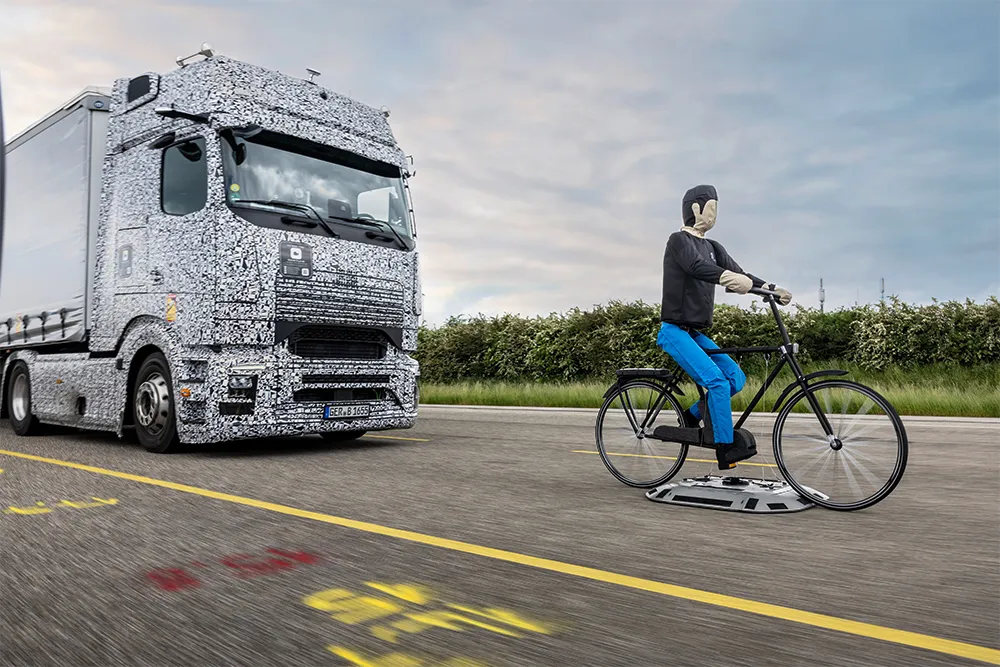
With the safety systems being used in Daimler Truck vehicles this year, the company is once again strengthening its pioneering position in the industry: the systems not only meet the GSR standards that apply from 2024, but in some respects go further. For example, a truck equipped with Active Brake Assist 1 (ABA), launched in 2006, was the first to be able to perform an emergency stop within the system’s limits. The emergency braking assistant’s functions have been consistently expanded for the upcoming sixth generation. A key milestone was ABA 5, available from 2020, which responds to people in motion not only with partial braking but also with an emergency stop. In 2016, the company became the first truck manufacturer to offer a factory-fitted turning assistant. Since 2018, Active Drive Assist (ADA) has enabled partially automated driving (SAE Level 2) in a standard truck for the first time. Finally, in June 2021, Daimler Truck became the first manufacturer to introduce Active Sideguard Assist (ASGA) with braking intervention.
The company’s commercial vehicle accident research team plays a central role in developing the systems. Its accident analyses, conducted since 1972, have laid the foundations for the continuous integration of new improvements into vehicles. Ingo Scherhaufer, who has been responsible for developing new assistance systems for around 20 years,
also received the “European Commercial Vehicle Safety Award 2023” a few months ago in recognition of his achievements in vehicle safety in this category. The award has been presented annually since 1990 by the European Association for Accident Research and Analysis, in cooperation with the expert organisation DEKRA and the German Road Safety Council.
270° sensor fusion technology for an almost complete field of vision
Equipping vehicles with cameras and sensors is crucial to the effectiveness of assistance systems. To make an even greater contribution to accident prevention, Daimler Truck has developed a new electronic platform. By fusing data from radar and cameras, it provides an even wider view to the front and sides.
The electronic platform processes data 20 times faster. The six sensors installed in total, four short-range radars at the front and rear on both sides, a long-range radar at the front in the centre, and the multifunction camera in the windscreen, can now cover a 270-degree angle around the vehicle. This significantly wider field of vision allows the assistance systems on board to make even better use of their capabilities. This applies to both new and improved systems.
Active Brake Assist 6 with multi-lane monitoring
Active Brake Assist 6 is a good example of the effectiveness of 270-degree fusion technology and the implementation of the GSR. At speeds of up to 60 km/h, compared with 50 km/h for ABA 5, the latest version of Daimler Truck’s emergency braking assistant can now also brake fully automatically for road users crossing, approaching or standing in the vehicle’s lane. The GSR will not require the response to pedestrians and cyclists to be extended for new trucks until 1 July 2026. As before, the system can respond to stationary vehicles with an emergency stop at speeds above 80 km/h. Another benefit of ABA 6 is its ability to monitor multiple lanes up to 250 metres ahead, helping it to detect hazards more effectively. This enables the system to respond better to critical situations and moving or stationary objects, for example when driving around bends on motorways. Radar technology also generally ensures high system availability, even in poor visibility.
Active Sideguard Assist 2 with extended functionality on the driver’s side
The second-generation Active Sideguard Assist (ASGA 2) demonstrates how equipping vehicles with six sensors and the resulting wider field of vision improves road safety. ASGA 2 monitors traffic on both the driver’s and passenger’s sides. Its two-stage warning system can alert the driver to potential hazards, allowing them to intervene in good time in a critical traffic situation. The side monitoring area on both sides of the vehicle is 4.25 metres wide, compared with 3.75 metres previously on the passenger’s side. The warning area, which is active at speeds of up to 30 km/h, extends up to 30 metres behind and seven metres in front of the vehicle. At steering speeds of up to 20 km/h, the system can also apply the brakes automatically to bring the vehicle to a stop within the red warning area if the driver has not already responded to an audible and visual warning on the passenger’s side. This function also goes beyond the GSR requirements, which only stipulate that Sideguard Assist must issue a warning when necessary. ASGA 2 also offers an intelligent lane-change warning concept based on the vehicle’s position in its lane, and assists drivers on both sides when changing lanes.
Active Drive Assist 3 provides even better support for partially automated driving
Active Drive Assist (ADA), which has enabled partially automated driving (level 2) in a standard truck since 2018, has also been further improved. While the second generation of ADA, fitted from June 2021, was enhanced with an emergency braking function, ADA 3 now provides drivers with even better support for the truck’s longitudinal and lateral control. A key new feature is the emergency steering function (Lane Keeping Assist): if ASGA 2 warns of a collision risk when changing lanes, ADA 3 can actively countersteer to prevent the truck from leaving its lane and guide it back to the centre of the lane or into its own lane. As with the previous generation, ADA 3 can also maintain a set distance, accelerate and steer automatically when system conditions are met, such as a sufficiently wide bend radius or clearly visible lane markings. If the driver gets too close to the vehicle ahead, ADA 3 can automatically brake the truck until the set following distance is reached. When the distance is sufficient again, the system can accelerate the vehicle to the set speed. If the system detects that the driver is no longer intervening in the driving process, for example due to a medical problem, it can gently bring the vehicle to a stop or activate emergency braking.
The Traffic Sign Assist recognises road signs in real time
With another assistance system, Daimler Truck goes beyond GSR requirements: Traffic Sign Assist. While EU legislation requires the speed limits applicable to the vehicle to be displayed continuously, with any warnings shown when overtaking, the system also recognises no-overtaking signs and when they end, as well as warning signs, displaying the latter two types of sign in the multimedia cockpit or conventional cockpit. Thanks to the intelligent combination of camera and map data, Traffic Sign Assist also supports the driver by always displaying the truck’s current speed limit, making it easier to comply with speed limits. This can help avoid speeding fines. An audible signal sounds if the permitted maximum speed is exceeded. The OCR technology used also ‘reads’ time restrictions on the relevant regulations (‘Optical Character Recognition’). Combined with the GPS system, the high computing power and installed sensors provide precise real-time data for accurately determining the vehicle’s position and surroundings.
Additional systems work together to provide even greater safety
Finally, other features also contribute to greater safety, including a reversing camera to prevent collisions when manoeuvring or coupling up, a tyre pressure warning system to extend tyre life and reduce fuel consumption, an attention assist system to assess driver fatigue, and the option of retrofitting the vehicle with an alcohol-test-based immobiliser.
With all the assistance systems across its entire product portfolio, Daimler Truck aims to support and relieve the driver as much as possible while driving, within the limits of the systems. However powerful these systems may be, they cannot change the laws of physics. The driver therefore remains fully responsible at all times for driving the vehicle safely, as required by law.
Question about this story? Ask your question
Keep following this
Get an email when a new story is published. No account needed.
- ThemeConstruction transport on road and site
- SubjectTransport & off-road