Group-GTS puts six Volvo Trucks LNG trucks into service
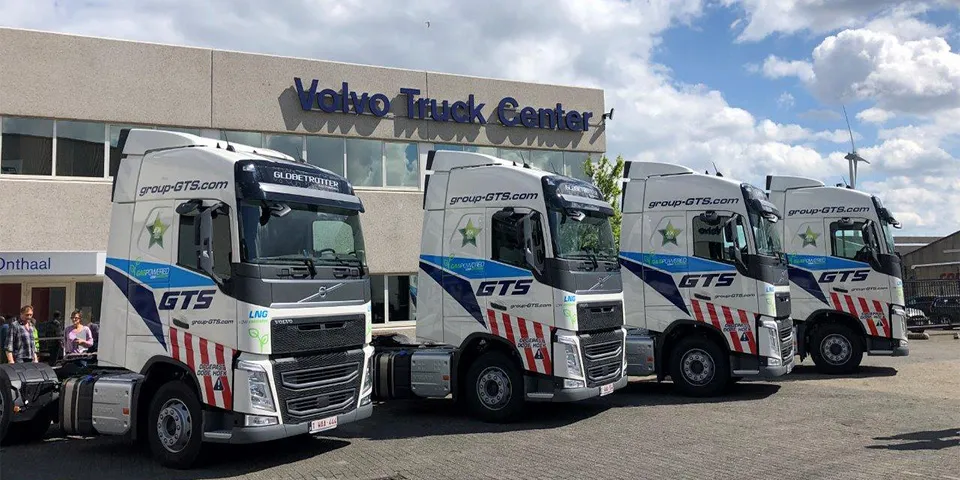
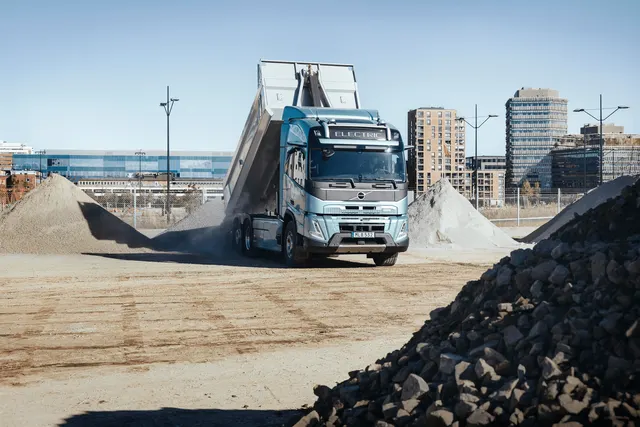
Group-GTS is also convinced of the environmental and economic potential of Volvo Trucks running on natural gas. The group, based in Tessenderlo, has just taken delivery of six FH LNG trucks. They will be used on domestic and international shuttle services. Managing director Ben Geybels expects to place another order before the end of the year.
The keys to the six 460 hp FH LNG trucks were handed over at the end of April by Stijn Van den Bulck, account manager at Volvo Trucks Center in Olen. “Group-GTS has made a carefully considered choice with this purchase. Diesel is becoming more expensive, the FH LNG uses considerably less fuel, and more and more freight forwarders expect their carriers to reduce their CO2 footprint. But it was the favourable TCO that convinced them above all,” he says.
Ben Geybels confirms this: “We carried out extensive tests and, together with our fleet manager, calculated that there is a genuine business case. However, there are a few conditions. The trucks must cover 130,000 kilometres a year and be used on fixed shuttle services, because the network of LNG filling stations is still fairly limited.”
Four of the six FH LNG trucks will be used for distribution within Belgium. “They will carry building materials and serve the mechanical engineering industry. The other two will mainly shuttle between Belgium and the Ruhr region,” explains Ben Geybels. He stresses that the Maut benefit in Germany is a welcome bonus, but was not decisive. “We do not want to make this investment dependent on subsidies. Nor, for that matter, on marketing arguments. In the short term, we believe LNG is the best alternative to diesel for long-distance transport.”
Lower CO2 emissions
“More and more customers have a climate policy and ask us to reduce CO2 emissions. Most, however, are not willing to pay more for their transport. But if we cover the planned distances, LNG works out cheaper than diesel. It also has a significantly lower environmental impact, in terms of both CO2 and noise, while delivering the same driving performance. The tests confirmed this,” says Ben Geybels.
Investing step by step
That is why he is considering placing another order at the end of the year. “We are not rushing headlong into an adventure and do not want to skip any steps. First, we want to gather more data and identify the transport operations that are suitable. This will depend mainly on the availability of filling stations along the routes,” he adds.
Group-GTS has sites in Tessenderlo and Kallo. There is already an LNG filling station in Kallo, and one is due to open in Tessenderlo in June. This means detour costs there will be virtually nil.
Updated livery
To highlight the lower CO2 emissions, literally, the trucks’ cab livery has been updated with the words ‘Gas Powered, Low Emission’. “And because we also place great importance on safety, we took the opportunity to add signage warning vulnerable road users about the blind spot,” concludes Ben Geybels.
Question about this story? Ask your question
Keep following this
Get an email when a new story is published. No account needed.
- ThemeConstruction transport on road and site
- SubjectTransport & off-road