Daimler Truck unveils Mercedes-Benz NextGenH2 Truck, limited series production planned from late 2026
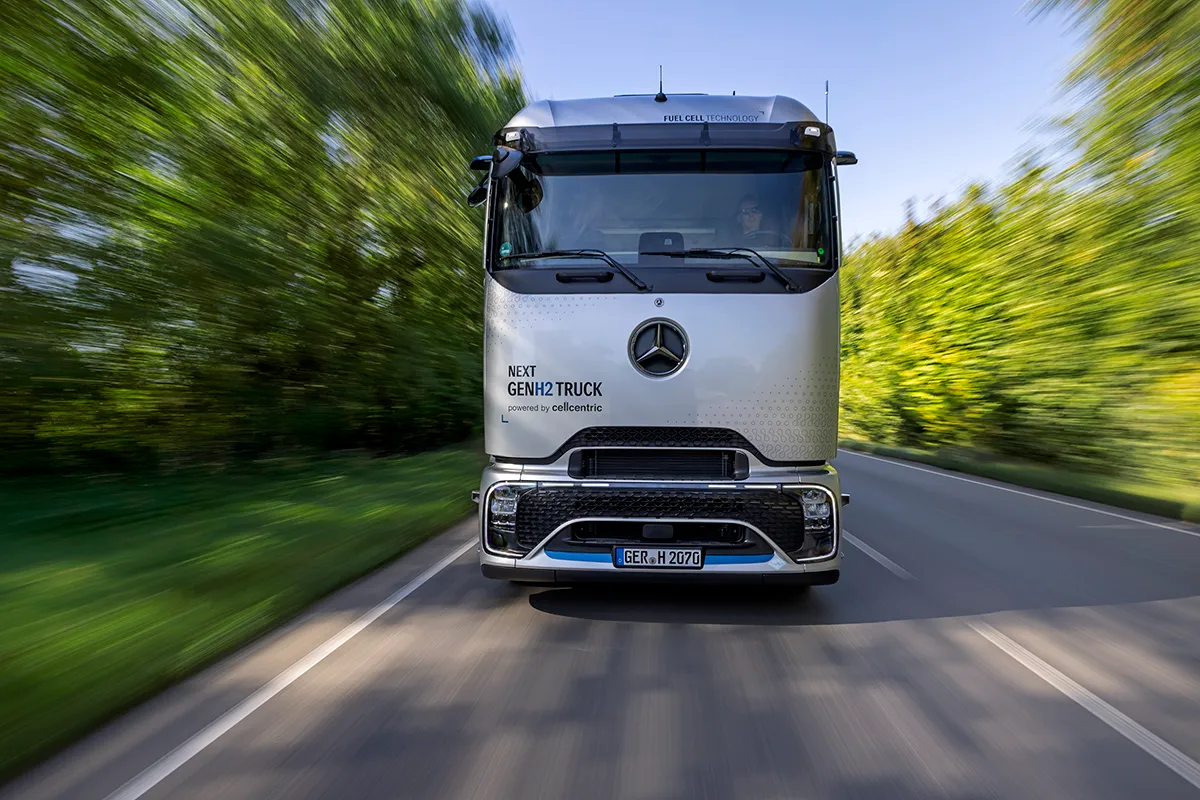
Following the development and successful prototype testing programme for its first-generation fuel cell trucks, Daimler Truck is presenting the Mercedes-Benz NextGenH2 Truck. This fuel cell truck marks a new development milestone on the road to sustainable hydrogen-powered transport. A limited series of 100 further-developed tractor-trailer combinations will be built at the Mercedes-Benz plant in Wörth and deployed with various customers from late 2026.
- The Mercedes-Benz NextGenH2 Truck marks the next development step towards hydrogen-powered freight transport.
- As part of a limited small-scale production run, 100 vehicles will be deployed with customers from late 2026.
- Proven components, such as the cellcentric fuel cell and liquid hydrogen technology, have been carried over from the first-generation Mercedes-Benz GenH2 Truck and further developed. Innovative technical safety solutions and more compact packaging increase customer value by enabling compatibility with a wider range of trailers.
- New features of the NextGenH2 Truck include key series-production components from the battery-electric Mercedes-Benz eActros 600, such as the integrated e-axle, the aerodynamically optimised ProCabin, Multimedia Cockpit Interactive 2 and the latest safety systems.
- Achim Puchert, CEO Mercedes-Benz Trucks:
“Alongside battery-electric solutions, hydrogen powertrains are crucial to the sustainable transformation of our industry. With the NextGenH2 Truck, we are taking the next technological step in fuel cell trucks. Together with our customers, we aim to deploy a small series in everyday transport from late 2026, offering a long range and technology close to series production.”
Achim Puchert, CEO Mercedes-Benz Trucks:
“Alongside battery-electric solutions, hydrogen powertrains are crucial to the sustainable transformation of our industry. With the NextGenH2 Truck, we are taking the next technological step in fuel cell trucks. Together with our customers, we aim to deploy a small series in everyday transport from late 2026, offering a long range and technology close to series production.”
In developing the new model, the team retained the proven strengths of the first-generation Mercedes-Benz GenH2 Truck. Liquid hydrogen enables a range of well over 1,000 kilometres on a single fill at full payload. The proven cellcentric BZA150 fuel cell converts hydrogen on board into electrical energy.
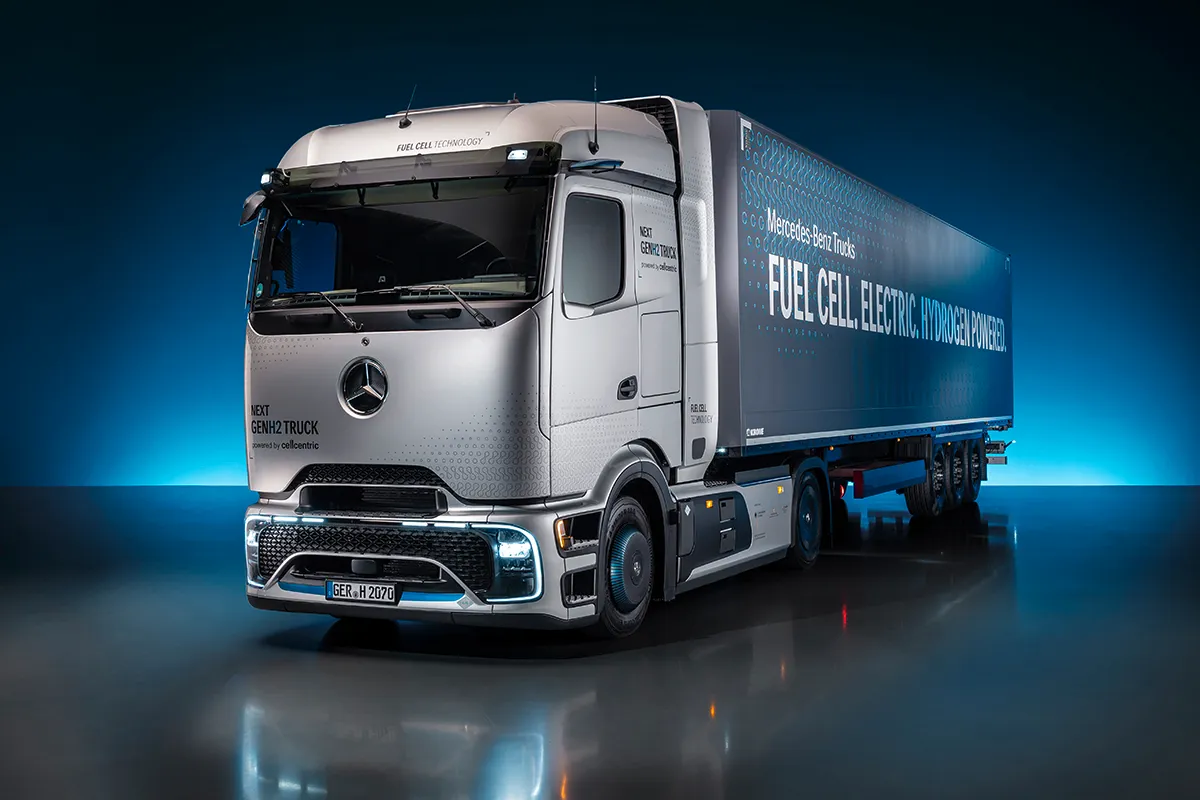
Liquid hydrogen enables a range of more than 1,000 kilometres
Daimler Truck has deliberately opted for liquid hydrogen in developing its hydrogen powertrains. At a temperature of −253 degrees Celsius, liquid hydrogen has a significantly higher energy density than gaseous hydrogen, allowing more hydrogen to be stored, substantially increasing range and enabling performance comparable to that of conventional diesel trucks. The capacity of the two liquid hydrogen tanks has been increased compared with the first-generation Mercedes-Benz GenH2 Truck, so they can now hold a total of up to 85 kg of hydrogen. As the two tanks are interconnected, refuelling is possible from either side. Thanks to the sLH2 refuelling standard developed by Daimler Truck and Linde, the truck can be filled with liquid hydrogen in 10 to 15 minutes, just as safely, quickly and easily as refuelling a diesel truck today.
Transporting liquid hydrogen requires less logistical effort, while liquid hydrogen tanks offer cost and weight advantages over high-pressure tanks for gaseous hydrogen. These benefits enable higher payloads, making the trucks suitable for operations comparable to those of today’s diesel trucks. Daimler Truck successfully demonstrated this at the end of 2023 during the #HydrogenRecordRun, when a Mercedes-Benz GenH2 Truck with a gross vehicle weight of around 40 tonnes covered 1,047 kilometres on a single tank of liquid hydrogen.
Reliable and efficient fuel cell technology
The cellcentric BZA150 fuel cell, developed by a joint venture between Daimler Truck and Volvo Group, remains at the heart of the NextGenH2 Truck’s powertrain. Two fuel cell modules work together as a twin system, delivering a total system output of 300 kW (150 kW per module), and are integrated space-efficiently in the engine compartment beneath the cab. After years of intensive testing, the hydrogen-powered drive concept proved reliable and efficient under real-world operating conditions. For example, in early customer trials with the Mercedes-Benz GenH2 Truck, average hydrogen consumption ranged from 5.6 kg/100 km to 8 kg/100 km, at gross vehicle weights of between 16 and 34 tonnes.
While driving, the fuel cell generates electrical energy through the reaction between hydrogen (H₂) and oxygen (O₂). Together with a buffer battery, this powers the electric motors in the e-axle, delivering strong performance. The only emission is pure water vapour.
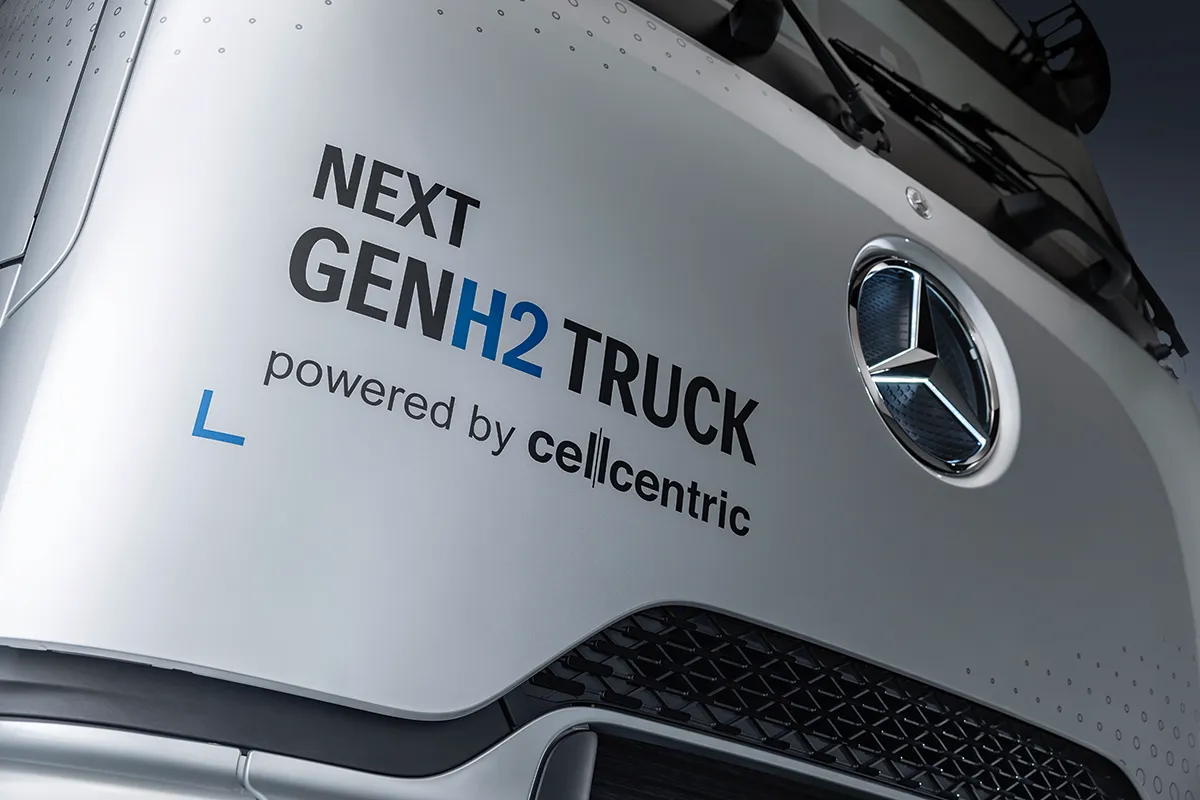
Series-production components deliver a technological leap
The Mercedes-Benz NextGenH2 Truck offers a high level of technological maturity, thanks in part to the use of state-of-the-art components from Mercedes-Benz Trucks’ series production. These include the ProCabin, already available in the Mercedes-Benz Actros L and the battery-electric eActros 600, which is now being used in a fuel cell truck for the first time. As a result, the NextGenH2 Truck benefits from a nine per cent improvement in its drag coefficient [1] compared with the previous cab.
The NextGenH2 Truck delivers a high-quality driving experience comparable to that of its battery-electric counterpart, the eActros 600. Its familiar benefits include dynamic power delivery with immediate high torque, smooth and comfortable handling, and low noise levels in and around the cab. This hydrogen-powered electric truck makes full use of these advantages. Even in demanding conditions such as steep gradients or heavy loads, the vehicle delivers up to 340 kW in Economy mode and up to 370 kW in Power mode.
At the heart of the energy storage system is a high-voltage battery developed by Daimler Truck, with an installed capacity of 101 kWh [2]. This lithium iron phosphate (LFP) battery acts as a buffer for the fuel cell and stores energy during recuperation. The NextGenH2 Truck uses the same efficient, in-house-developed electric drive axle as the eActros 600, with a four-speed transmission (including two reverse gears) for optimum power transfer in all conditions.
Together, these components enable highly efficient energy recuperation when descending or braking, with recovered electricity stored directly in the buffer battery. This noticeably extends the overall range and improves efficiency.
The high-voltage components and the latest E/E architecture have also been carried over from the Mercedes-Benz eActros 600. This gives the NextGenH2 Truck the latest advanced safety systems, including Active Brake Assist 6, Front Guard Assist and Active Sideguard Assist 2, as well as compliance with current cybersecurity standards.
Innovative solutions improve customer usability
Customer trials with the Mercedes-Benz GenH2 Truck provided valuable feedback for Daimler Truck’s development team. This was incorporated directly into improvements to the NextGenH2 Truck, further increasing customer value.
An innovative, space-saving layout of components in the Tech Tower behind the cab has made this section significantly more compact. This made it possible to shorten the wheelbase by 150 mm to 4,000 mm compared with the previous model. This gives customers greater flexibility, enabling compatibility with various trailer combinations and a wide range of standard trailers within EU length regulations.
The Tech Tower also houses a new boil-off management system that meets all legal requirements for handling hydrogen, including parking the vehicle in enclosed spaces. An integrated cooling system ensures stable operating conditions, even at very high ambient temperatures or in demanding terrain.
A new sensor system, which responds to the extremely unlikely event of a hydrogen leak, now makes it possible to sleep in the cab’s two standard berths. This improves comfort and the truck’s operational flexibility, particularly for long-haul drivers on multi-day journeys.
In addition, a newly designed side panel with integrated crash elements offers improved protection for the liquid hydrogen tanks in the event of an accident. The aerodynamically improved panel features practical access steps, enhancing both safety and accessibility while reducing drag.
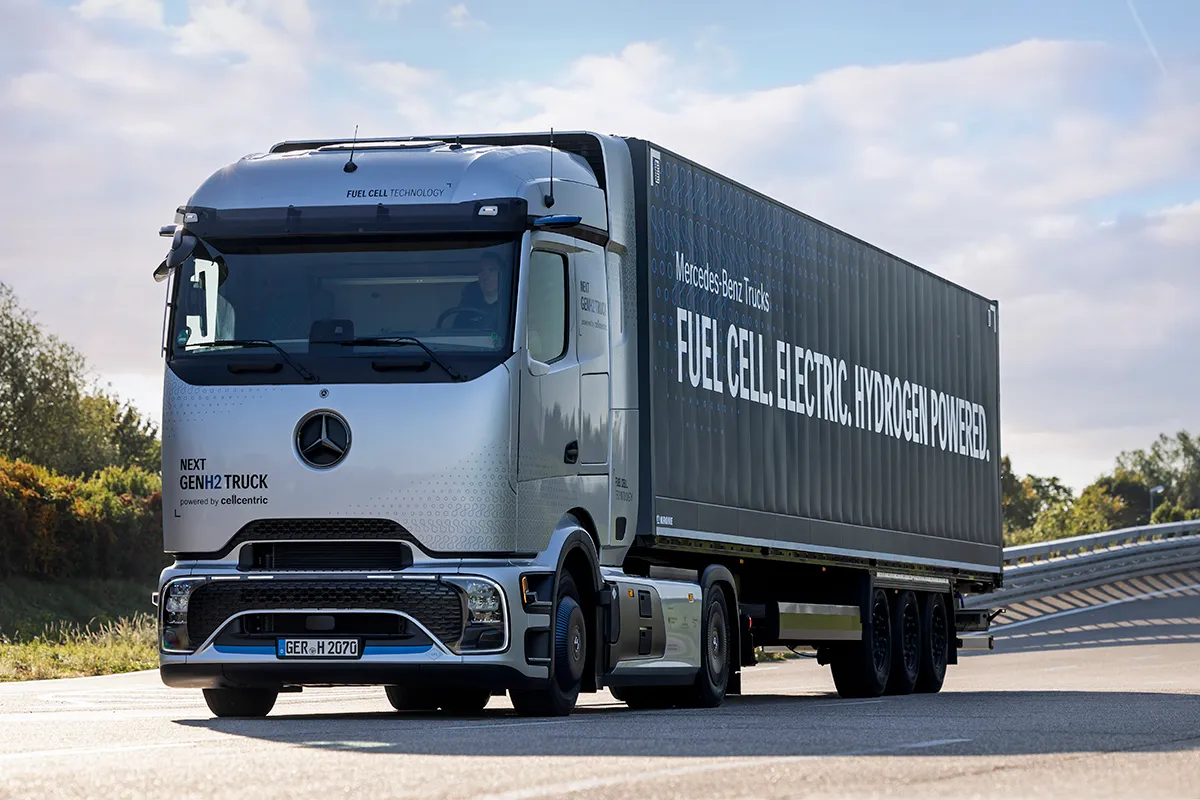
Testing and funding for the NextGenH2 Truck
Last year, Daimler Truck tested prototypes of the Mercedes-Benz NextGenH2 Truck in extreme conditions in the Swiss Alps, during both winter and summer trials, to ensure reliability in demanding operating scenarios. The findings from these tests are being fed directly into further development.
The development, production and practical deployment of the NextGenH2 Trucks from late 2026 are being supported by the German Federal Ministry of Transport (BMV) and the federal states of Rhineland-Palatinate and Baden-Württemberg, with a total of 226 million euros.
Series production of fuel cell trucks is targeted for the early 2030s.
[1] Customer-focused application in long-haul transport (motorway driving, standard trailer, 40 tonnes); value determined by simulation.
[2] Nominal capacity of a new battery, based on internally defined parameters.
Question about this story? Ask your question
Keep following this
Get an email when a new story is published. No account needed.
- ThemeConstruction transport on road and site
- SubjectTransport & off-road