From garage to global powerhouse: JCB celebrates its 75th anniversary
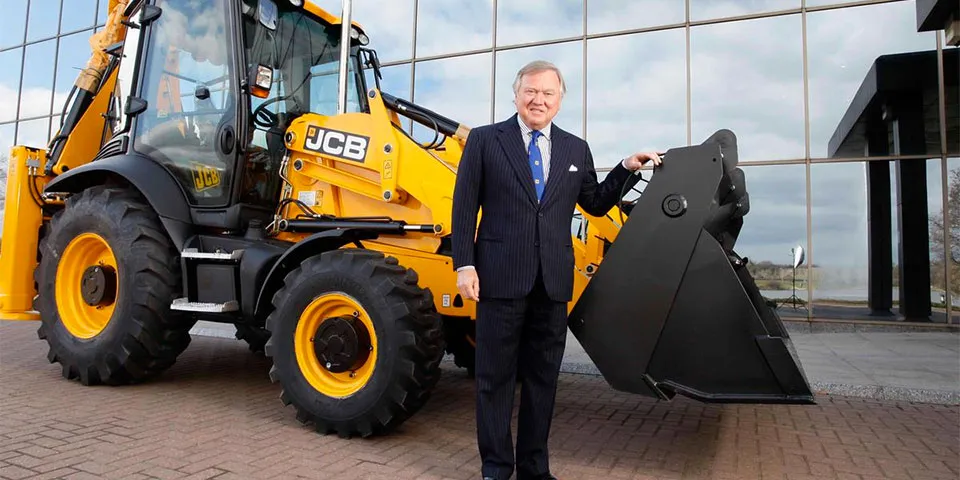
JCB was founded on 23 October 1945 by the late Joseph Cyril Bamford in a small garage in the market town of Uttoxeter, Staffordshire, England. It was the same day his son Anthony, now Lord Bamford, was born. Mr Bamford observed: “Having a son sharpens the mind. If you start at the bottom, there is only one way to go, and that is up.”
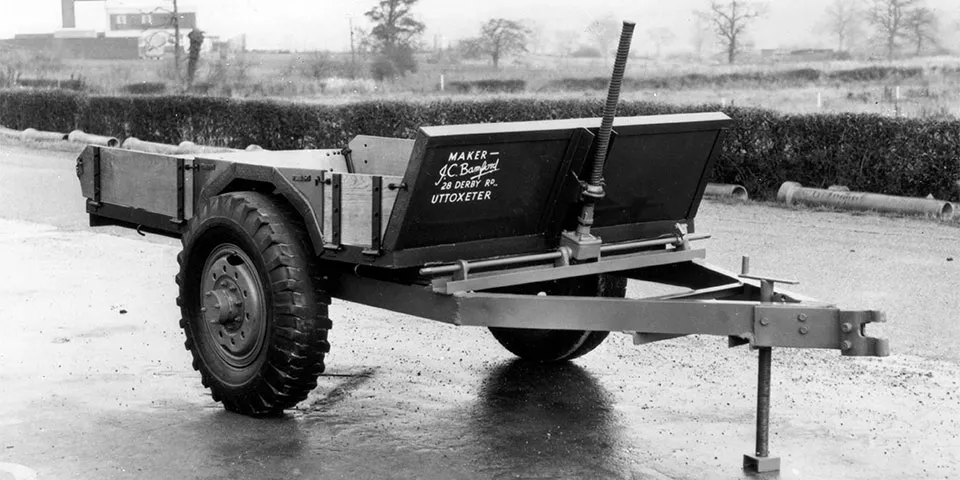
The foundation for the growth that followed was the manufacture of an agricultural tipping trailer, made from wartime scrap, which is now on display in the showroom at JCB’s headquarters.
The trailer was built in his garage and sold at the market for £45. Joe Bamford refurbished the customer’s old trailer and sold it on for another £45, recouping the original asking price of the trailer.
In 1947 the company expanded. As Mr Bamford’s landlady disapproved of him working on Sundays, he moved a few miles away to a stable block at Crakemarsh Hall, owned by Mrs Julia Cavendish, a survivor of the Titanic disaster. JCB also hired its very first full-time employee, Arthur Harrison, as foreman.
In 1950 JCB moved again, this time to the site of a former cheese factory in Rocester. The move was the brainchild of Bill Hirst, who was pleased that his workplace was now closer to home, giving him the chance to “spend 10 extra minutes in bed”. Bill joined JCB in 1947 as a tea boy, earning £1 a week. He rose through the ranks and eventually became Service Director.
1953 was a pivotal year, with the launch of the first backhoe loader, the JCB Mk 1. It was the first machine to be produced with a hydraulic excavator at the rear and a front loader. That ingenuity continues to pay dividends: JCB has now manufactured more than 600,000 backhoe loaders across three continents.
1953 was also the year the world-famous JCB logo first appeared on a machine. It was registered as a trademark five years later.
With the launch of a range of new backhoe loaders at the start of the 1960s, it became clear that these machines were revolutionising the construction industry. Productivity increased and reliance on manpower fell.
As the new decade began, the company also made use of new tools to generate business and promote the brand.
JCB Aviation was established in 1961, and the company’s first aircraft, a twin-engined De Havilland Dove, took to the skies. Customers from Europe could now fly out and back in a single day for a factory visit. JCB Aviation is older than most airlines operating today.
It was in 1962 that the JCB “Dancing Diggers” first took a bow. JCB’s first overseas subsidiary opened in Ulestraten, the Netherlands, and a year later the JCB 3C backhoe loader, a recognised design classic, was launched.
The company was doing so well that in 1964, following a 60% rise in turnover to £8 million, employees shared a £250,000 bonus. The news made the national headlines, and the payouts were so substantial that some employees were able to buy their first home with their bonus.
Mr JCB said at the time: “I am giving you this money because I want you to share in the success of the company you helped to create.” That same year, JCB also exported its very first machine to the US, a JCB 4C backhoe loader.
In 1969 JCB produced a record 4,500 machines and exported more than half of them. In recognition of this success, the company received its first Queen’s Award that year, the first of 27 such honours. Also that year, Joe Bamford was appointed Commander of the Order of the British Empire (CBE) in recognition of the company’s export achievements.
At the start of 1970, JCB expanded its US operations and established a base in Whitemarsh, Baltimore, to capitalise on the huge growth opportunities offered by North America.
Between 1971 and 1973, turnover doubled to £40 million. In 1975, Mr JCB retired and handed the reins to his son Anthony, with the parting message: “Anthony faces the difficult task of leading JCB through the coming decades and into a new century. It is a demanding task, but he is well trained for it and backed by a very strong team, from the factory floor to management. There is no limit to what can be achieved.”
And so a new era began, one in which both production facilities and product ranges would expand dramatically.
1972 got the ball rolling with the opening of JCB France. In 1977, the Loadall telehandler was launched, revolutionising the way loads were handled on construction sites and farms alike. The telehandler went on to become one of the most successful products in JCB’s history.
1977 also marked the start of a number of high-profile visits to JCB by members of the British Royal Family. The first was His Royal Highness the Prince of Wales, who toured the Rocester factory.
A year later, another milestone was reached with the construction of JCB’s second UK factory, JCB Transmissions in Wrexham.
The decision to begin manufacturing in India in 1979 ushered in a period of global expansion. Today, JCB has factories in New Delhi, Pune and Jaipur, and India is JCB’s largest market after the UK.
Product innovation remained central to the company, and in 1985 the 3CX Sitemaster backhoe loader was launched. It would later become JCB’s best-selling backhoe loader. That year, JCB also celebrated the production of its 100,000th backhoe loader.

1986 was marked by charitable work, when JCB named the children’s charity NSPCC as its chosen charity. Carole Bamford, now Lady Bamford, initiated the formation of an NSPCC fundraising committee.
To date, JCB and its employees have raised millions of pounds for the charity.
In 1987, Britain’s first female Prime Minister, Margaret Thatcher, visited JCB’s headquarters and drove a machine off the production line. An excited crowd welcomed her, and one onlooker kissed ‘The Iron Lady’ on the cheek as she toured the factory.
The JCB GT was launched in 1988, a backhoe loader with a top speed of 160km/h and a brilliant promotional vehicle that drew large crowds wherever it went around the world.
In 1990, JCB broadened its horizons with the launch of the JCB Fastrac, the world’s first true full-suspension high-speed tractor. It cost £12 million to develop and took the agricultural world by storm. That year, Anthony Bamford was also knighted by HM The Queen, becoming Sir Anthony Bamford, an honour that “recognises the efforts of the whole JCB team”, he said. To celebrate, JCB employees were given an extra day’s holiday.
Product development continued apace, with the launch of the 2CX backhoe loader in 1990, followed three years later by the smaller 1CX.
In 1994, a rose was named after Joseph Cyril Bamford. The yellow rose, named ‘Mr JCB’, was unveiled in the presence of HM The Queen at the Chelsea Flower Show.
A year later, JCB celebrated its 50th anniversary. HM The Queen visited the headquarters, where she unveiled a replica of the Uttoxeter garage in which Mr Bamford had started his business all those years before.
Future Labour Prime Minister Tony Blair visited in 1996 and helped assemble a 4CX. In 1997, the innovative Teletruk forklift, which can lift loads and place them over obstacles, was launched. In 1998, JCB opened its second factory in Wrexham, Wales, JCB Transmissions. A year later, JCB Earthmovers opened in Cheadle, Staffordshire.
In 2000, the first machines rolled off the production line at JCB’s new North American headquarters in Savannah, Georgia.
On 1 March 2001, flags at all JCB factories around the world flew at half-mast following news of the death of the company’s founder, Joseph Cyril Bamford. The British newspaper Financial Times said he had been blessed with a rare combination of “engineering genius and marketing flair”.
That same year, JCB expanded its charitable work with the establishment of the Lady Bamford Charitable Trust in India. A school a few hundred metres from the JCB factory in Ballabgarh, near New Delhi, was included in the fund.
In 2004, employees gathered at the headquarters for a photograph to mark production of the 500,000th machine. It had taken 60 years to reach that milestone. The next half-million machines would be produced over the following nine years.
It was also the year JCB took the bold step into engine manufacturing with the launch of the Dieselmax engine, produced at JCB Power Systems in Derbyshire.
In 2005, JCB opened its factory in Pudong, China, and announced the largest order in its history: a $140 million deal to supply the US Army with a high-speed backhoe loader for military engineering tasks, a machine known as the High Mobility Engineer Excavator (HMEE).
In 2006, Jo, Sir Anthony Bamford’s eldest son, became a director at JCB, marking the third generation of the Bamford family to hold such a position.
That year, JCB also set a world record with the JCB Dieselmax streamliner car. Powered by two JCB Dieselmax engines, it reached speeds of 350.092 miles per hour (approx. 563km/h) on the Bonneville Salt Flats in the US. This remains the record for the world’s fastest diesel car. Sir Anthony Bamford joined the team on the Salt Flats to celebrate the successful outcome of his idea.
JCB’s support for disadvantaged children extended further around the world with the opening of the Lady Bamford Center for Early Childhood Development in Savannah, Georgia, in 2007, with the aim of supporting preschool education and social development.
That year, JCB achieved its highest-ever machine sales, at 72,000 units.
In 2008, JCB Heavy Products, which manufactures tracked and wheeled excavators, moved to its brand-new factory on the outskirts of Uttoxeter.
This was followed in 2009 by an investment of £40 million in JCB’s factory in Ballabgarh, India, to make it the world’s largest backhoe loader factory.
In 2009, HRH Prince William followed in his father’s footsteps, 32 years earlier, when he visited the company’s headquarters and joined employees in celebrating production of the 750,000th machine.
A national shortage of engineers inspired Lord Bamford to establish the JCB Academy in Rocester, Staffordshire, in 2010, to train the engineers and business leaders of the future. The facility has been a resounding success, with almost 1,000 students.
JCB also announced a $40 million project to develop an entirely new range of skid-steer loaders and compact track loaders, to be manufactured at its North American headquarters.
Looking to the future, JCB also celebrated its heritage with the opening of ‘The Story of JCB’ in 2011, a permanent exhibition charting JCB’s growth and the Bamford family’s roots in industry. Those roots go back almost 200 years, to when they began as blacksmiths in Uttoxeter, before founding Bamfords Ltd., a manufacturer of agricultural machinery, in the town in 1871.
In 2012, global production expanded to Brazil, and British Prime Minister David Cameron officially opened the new £63 million factory in the state of São Paulo.
That year, JCB also celebrated winning a £60 million order for more than 1,000 backhoe loaders from the Brazilian government.
As JCB approached its 68th anniversary in 2013, a new independent economic report revealed that the company had helped provide jobs for 24,000 people in the UK and contributed £545 million to the British exchequer. That same year, hundreds of employees gathered at the headquarters to take a photograph marking the production of JCB’s one-millionth machine.
It was also a memorable year for JCB chairman Sir Anthony Bamford, who became Lord Bamford after being invited by Prime Minister David Cameron to become a Conservative peer in the House of Lords, prompting hundreds of congratulatory messages from around the world.
In 2014, Lady Bamford presented a £2 million cheque to HRH The Countess of Wessex for the NSPCC following a company-wide marathon. Employees raised £1 million, which Lord Bamford matched. Production began at JCB’s new £62 million factory complex in Jaipur, India, and plans were announced for a new £20 million headquarters for JCB Germany in Cologne.
In 2015, JCB celebrated its 70th anniversary and introduced the all-new 3CX Compact backhoe loader, a machine 35 per cent smaller than its larger sibling, designed to work on construction sites that are becoming increasingly confined and congested.
2016 was a year of milestones, as the company celebrated production of the 200,000th Loadall telescopic handler. JCB took almost 30 years to sell its first 100,000 telescopic handlers, but less than 10 years to sell the next 100,000, demonstrating the product’s growing importance and JCB’s strength in the sector.
Today, JCB is the world’s largest producer of telescopic handlers. That same year, JCB marked production of its 100,000th mini excavator and celebrated the 25th anniversary of the revolutionary Fastrac tractor.
In 2016, the new JCB Hydradig also received international acclaim.
2017 was another landmark year on two fronts: the launch of a new range of JCB access platforms, following two years of secret development. JCB entered a market worth $8 billion a year for the first time. That year, the company also celebrated the 40th anniversary of the Loadall. Later that year, JCB marked production of its 500,000th engine.
2018 was no less significant, with the unveiling of JCB’s first-ever fully electric excavator. The 19C-1E electric mini excavator was developed in response to customer demand for a zero-emission machine that could work indoors and close to people in urban areas. Once fully charged, it can run for a full, normal working day on site.
The year also saw the launch of the hugely successful X-Series range of tracked excavators and the start of dumper production at the global headquarters in Rocester.
JCB also announced a £50 million investment in a new factory to manufacture cabs in Uttoxeter.
In 2019, the new electric mini excavator went into full production at JCB Compact Products in Cheadle, Staffordshire, and the first 50 orders were delivered to customers.
2019 also saw a host of records. In June, JCB set a Guinness World Record for the fastest tractor. Named Fastrac One, the tractor reached a speed of 103.6 miles per hour (approx. 167 km per hour), with driver and truck mechanic Guy Martin at the wheel.
JCB then embarked on an ambitious plan to break its own record, developing Fastrac Two, which is 10% lighter and even more streamlined than its smaller sibling. In October, Fastrac Two reached an astonishing peak speed of 153.771 miles per hour (approx. 247 km per hour) and an average speed of 135.191 miles per hour (approx. 217 km per hour) at Elvington.
That same year, chairman Lord Bamford officially opened a brand-new £50 million headquarters for JCB Germany.
As JCB entered its 75th anniversary year, sad news was reported in January: Bill Hirst, the company’s third employee, recruited in 1947, had died aged 86.
In March 2020, JCB marked production of its 750,000th backhoe loader, before the Covid-19 pandemic struck. When the company’s production lines were shut down in March, JCB turned its attention to helping people in need during these unprecedented times.
In India and the UK, company chefs prepared more than 200,000 meals for homeless people and others in urgent need. A production line in Staffordshire was reopened to make prototypes of specialist casings for a new type of ventilator, following a national call to action.
JCB also reopened its innovation centre at its international headquarters in Rocester, where employees could volunteer to make medical-grade face shields for NHS staff using the company’s rapid 3D printers.
By the time the production lines reopened in June, JCB had offered a preview of an exciting new development: the construction industry’s first hydrogen-powered excavator. The 20-tonne 220X excavator, powered by a hydrogen fuel cell, has been undergoing extensive testing at JCB’s test sites for more than 12 months. This development makes JCB the first construction equipment company in the world to unveil a working prototype of a hydrogen-powered excavator, a fuel source widely regarded as the fuel of the future.
Question about this story? Ask your question
Keep following this
Get an email when a new story is published. No account needed.
- SubjectProduct information