#1 Podcast: In conversation with Marleen Geens of Gebroeders Geens
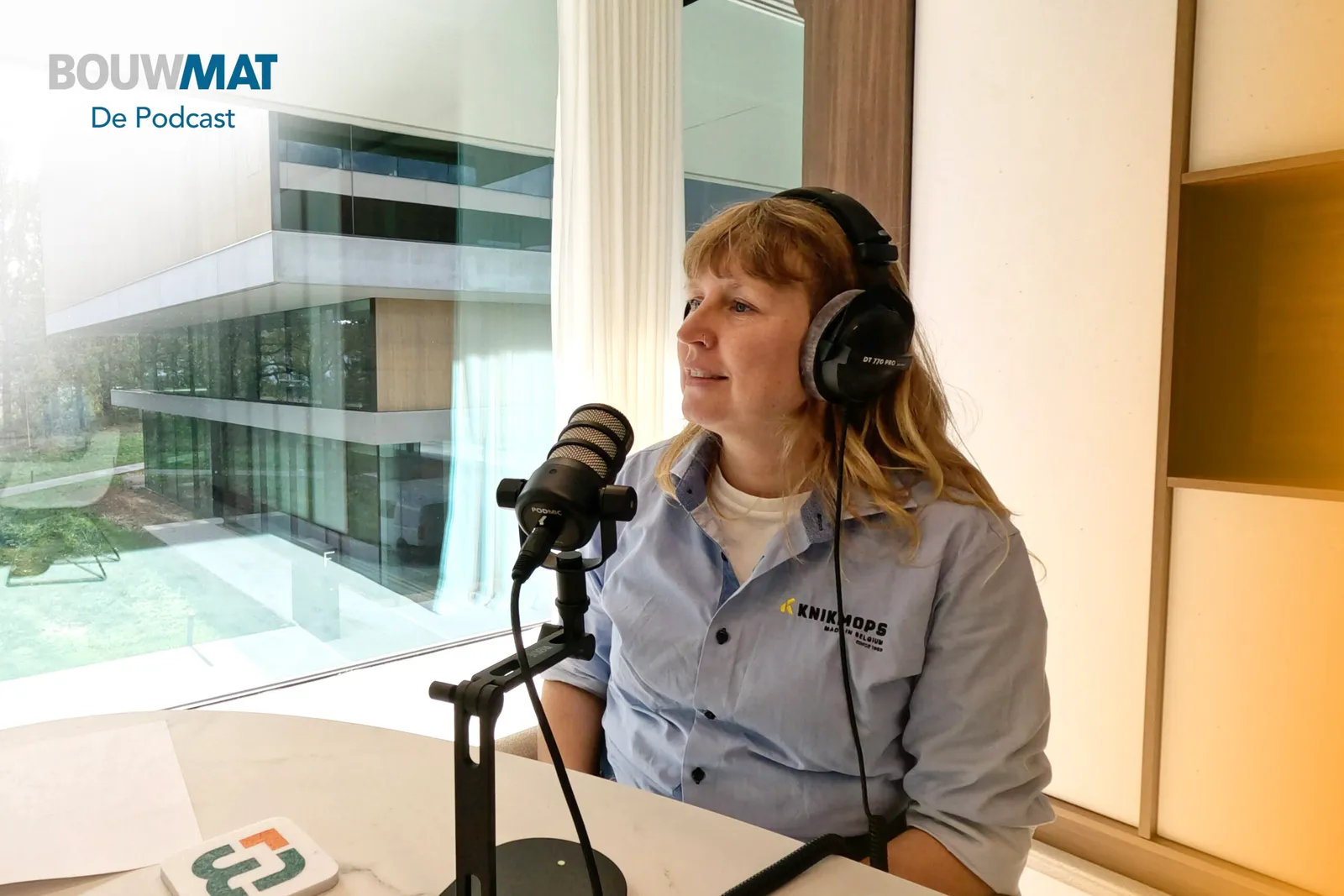
In the very first episode of the BouwMat Podcast, we welcome Marleen Geens of Gebroeders Geens, the family business from the Kempen behind the Knikmops and Rollmops. For 35 years, they have built their machines entirely ‘Made in Belgium’, producing almost 900 units a year. How do you keep production in your own country profitable? And why do so many customers still choose Belgian quality over foreign alternatives?
A conversation about innovation, entrepreneurship and the strength of local craftsmanship.
Spotify Embed: #1 - In conversation with Marleen Geens of Gebroeders Geens
Een zakelijke vraag aan Gebroeders Geens nv? Get in touch
Full transcript
00:01 Welcome to the Bouwmat Podcast, the platform for construction and materials professionals. Today we’re heading to Hoogstraten, where Gebroeders Geens has been proving for 35 years that Belgian machine manufacturing is very much alive and kicking.
00:19 The machinery company, known for the Knikmops and Rollmops, produces almost 900 machines a year. And, importantly, they are entirely made in Belgium. Today we’re speaking to Marleen Geens, the second generation
00:35 about innovation, family and the strength of family and local craftsmanship. Hello Marleen, welcome to the BouwMat Podcast. It’s great to have you here. Hello Chris, thanks for inviting me. That’s
00:49 very welcome. How does it feel to see the family business still growing, and wanting to grow, after, well, 35 years? Yes, it’s incredibly rewarding. Those who
01:01 also work in a family business will certainly recognise that ambition, I think. But in 2025, it’s not always something you can take for granted. We can see that there’s a market for our products,
01:15 with room to grow in the Netherlands and Flanders, and international growth markets are really starting to take off too. So we’re right to focus on those as well. Things are moving fast for
01:37 Gebroeders Geens. For those who don’t know you well yet, which is quite unlikely, but still, what exactly do you do and how did it all start in Hoogstraten? We’re Gebroeders Geens, based in
01:49 Hoogstraten, in the northern Kempen, and we make two brands, Knikmops and Rollmops. They’re small articulated loaders or transport machines, mainly for outdoor work. So pavers, landscapers, earthworks contractors,
Read the full transcriptCollapse transcript
02:08 they’re all part of our customer base. And you’ve grown from two brothers, the Gebroeders Geens, to 60 employees.
02:19 How did that happen? My father and uncle started the company with the invention of the Rollmops. It was the late 1980s, when, incredibly to think now,
02:32 there was a big trend for paving driveways and car parks. Pavers are paid by the square metre, as they still are today. They were looking for a way to work more efficiently without having to take on a lot of staff.
02:49 With a Rollmops, they quickly achieved efficiency gains. Instead of needing a team of four, with three people bringing materials over and one laying them, they could use the Rollmops to have one person bring materials over and three people laying them.
03:02 So they could lay a lot more square metres in a day. That was due to various factors, but the Rollmops certainly played a part. And that’s how we got our start as a machine manufacturer.
03:18 Then, in 1997, we expanded our portfolio from the Rollmops, of which we have three different types, to include the Knikmops. That’s a small articulated loader. It’s larger and can do more,
03:31 and it can be fitted with various attachments. We’ve found that it’s the product that lets us offer a great solution in lots of different markets, not just to pavers. And so our journey continued, and since 2016,
03:48 our focus has really been on machine manufacturing and expanding our production. We’ve been doing that steadily, on an ever larger scale.
04:00 Thinking off the top of your head, what do you think has changed most in the 35 years since you started? If you have a view on that, of course. The biggest change is definitely that we now work with a large team.
04:16 So, 60 employees. We’ve really grown into a manufacturing company. Previously, we were also a local agricultural blacksmith and did some bespoke work,
04:30 sometimes interiors, sometimes very specific niche solutions for people, both small-scale jobs and large hydraulic projects. We do much less of that now. Today, our main focus
04:51 is producing the Knikmops and Rollmops. Your machines are mainly Made in Belgium, and you might think that’s an anachronism, or at least a little contrary to the times. You really do produce everything under one roof.
05:05 Why is it so important to you to keep it that way? Let me clarify one thing first. We make the chassis 100% in-house. That means sheet steel comes in through one gate.
05:16 We laser-cut, weld and bend it, do a little milling too, paint it, then assemble the machines. But the components we fit come from all over.
05:30 So I want to make that distinction, but to me, we are a genuine manufacturing company. I think that’s important to point out, because it’s often the other way round for many companies that say they make products
05:49 in Belgium. Often, they only do the final assembly here in Belgium, whereas our entire manufacturing operation really is under one roof. Right. And what are the main benefits of producing locally? You must have thought about that.
06:00 Yes, the first and most important benefit at the moment is that we really are, and can remain, a manufacturing company.
06:14 I have no experience of it, but I feel that if you outsource part of your production, your company also becomes a logistics company to some extent. That’s not something I see in our DNA, whereas manufacturing very much is.
06:31 Then there are the obvious things, I think. Your product development department works very closely with the manufacturing side of the business.
06:43 It’s literally a case of opening the door and being in the welding department. You can’t replicate that if you decide to move a large part of your production elsewhere. And, in the long term, there’s the know-how. You lose some of that know-how.
07:01 Say we decided tomorrow to move our welding department to another country, for example. It would seem very difficult to bring it back in-house. But because we can keep it running here,
07:16 that knowledge is always close at hand. What challenges do you face? No doubt there are some. Doing business in Belgium is a challenge for everyone. What do you sometimes struggle with? The obvious things, I think. Labour costs are definitely a major factor, which means that internationally, you can’t always compete on price.
07:41 So you have to stand out in other ways, which I think we’re doing at the moment. Finding skilled staff is another challenge, although I’d also say…
07:54 For me, finding skilled staff is certainly a challenge, but on the other hand, we provide in-house training. People have never made a Knikmops before, because that can only be done here.
08:07 So unless they’ve worked for us before, I have to train everyone anyway. That has its pros and cons. Do you find that customers consciously choose Belgian-made products?
08:22 Does a Made in Belgium label mean anything? Yes, it definitely means something, especially to our Belgian customers. They’re incredibly proud of it. Internationally, it’s sometimes a little less
08:36 of a deciding factor. But I know that many people who drive a Knikmops are also very proud to be using a Belgian product. And that makes them unique. With many other products, you don’t have the option to choose Made in Belgium,
08:59 but you do with articulated loaders and transport machines. So you can choose Knikmops or Rollmops. Customers in the Netherlands are certainly keen on that too. It’s less about the Made in Belgium story and more about the feeling that the company is local and
09:16 that the whole manufacturing operation is under one roof. They find that just as appealing as someone from the Kempen does. And no doubt producing in-house also has an impact on the quality and service life of your machines,
09:31 doesn’t it? Yes, definitely. I think in-house production may be a little less of a deciding factor there, but the Geens family’s commitment to producing
09:45 quality certainly is. Machines from our first Knikmops production run in 1997 are still out there today. They come back to us for servicing in their third or fourth ownership,
09:57 and then we have a little museum piece in the workshop. That really moves you, especially when I was six at the time. It’s incredible to see those machines come back. So yes,
10:12 a Knikmops can last a lifetime. That’s one way we stand out, because people may be able to choose a product that, in terms of price, perhaps doesn’t compare with a
10:26 machine made in the Middle East or elsewhere, but they know it has a very high resale value, or that they can simply buy it now and
10:39 never wear it out in their lifetime. It’s all about total cost of ownership, of course. You celebrated your 35th anniversary last year, if I’m not mistaken.
10:59 I’d have to look up exactly which anniversary that was. The theme was innovation and growth. You’re a family business, so you might expect tradition and established ways of doing things to be important. But your theme was innovation and growth. What does innovation mean in practice for you?
11:18 As an entrepreneur, and a family-business owner, I think you always have to be willing to maintain that growth mindset. And in a family business, you have the great advantage that the same people have been here for 35 years,
11:33 so they know the product inside out. That’s really… The knowledge my father and uncle have is incredible. It’s a treasure trove, and it’s something we, as the second generation, can draw on enormously. But
11:48 they’re still working on improving their products today. For us, that covers a lot. I chose the theme ‘35 years of innovation and growth’ because it isn’t just
12:00 about updating the Knikmops or the Rollmops. It’s also about innovating in our production: making sure it runs efficiently and being willing to invest in new,
12:12 sometimes daunting production equipment, I’d say. Being willing to make production more efficient is innovation too.
12:25 It’s a constant thread running through the development of our company. Are we talking about automation, or even robotics? Robotics to some extent, yes.
12:39 We have four welding robots. Welding for us is a combination of manual and automated work. Whenever a job requires some brainpower, some thought, that’s done by our people. But when it’s repetitive, long-running work that needs to be done in large quantities, we put it on the welding robot. We also have two laser cutters and an automated
13:04 sheet metal storage system, and things like that, really to improve efficiency and enable us to scale up production with the team we have, without them necessarily having to work inhumane hours.
13:20 And also to make tasks more efficient when you feel they’re the sort of jobs people don’t enjoy, such as small-scale grinding or things like that,
13:33 and take some of that work off their hands. And speaking of innovation, electrifying machines has of course long since ceased to be an innovation. Are you also seeing demand from the market for your machines to be much more electric
13:53 than before? Yes, definitely. The Netherlands is our biggest market, so half our production goes there, so you can probably guess what I’m going to say. The demand comes from the Netherlands. People there have been asking whether something can be electric for much longer than here in Belgium.
14:13 That was also what motivated us to get started. The Dutch market is incredibly rewarding to work for, because the Dutch tell it like it is. So if something isn’t up to scratch, you’ll soon know.
14:27 They’re also open to new things. I feel they’re willing to take that step before many Belgians are. And if they don’t like it, they get rid of it and buy something else. Whereas
14:43 in Belgium it’s much more a case of, ‘Oh, we need to iron out the teething problems first.’ It would take much longer if the Belgian market were our test market. But because we work in the Netherlands, things move a little faster. That’s partly thanks to government support there, of course,
15:05 although we have that here in Belgium too, but it goes a little further in the Netherlands. And the Dutch are more open to new things and much less wary of taking the plunge,
15:23 or at least they seem to be, let’s put it that way. You might think that a family business with 60 employees is no longer really a family business. How do you preserve that feeling? All for one and one for all. I think one of the
15:38 most important things is making sure you know everyone by name. I can still do that with 60 employees, so I also handle the recruitment myself. The first face they see is a member of the family, I’d say. And then it’s
15:55 a matter of trying to maintain a good relationship. Those family values run throughout our business. We can offer people a certain degree of flexibility.
16:08 They can also count on a good work-life balance here. So that is, I think, a reason for how we express our family values in the business. It’s hard to say that about yourself, of course.
16:28 Okay, Marleen, you’re second generation, so you’ve practically grown up with the business. Where do you think Gebroeders Geens will be in five to ten years’ time? We’re in the middle of expanding our production.
16:40 We’ll start building a new production hall at the end of the year. I’ve been saying that for years, but now it’s really happening. It won’t be far away, because we’re very attached
16:55 to Hoogstraat, and our umbilical cord doesn’t stretch beyond Heenwormstraat. We’re expanding just 200 metres away. We’ll move our assembly operations there, install a powder coating line and then scale up, which will also allow us to focus
17:12 more internationally. We’re already taking a lot of steps in that direction, professionalising our communications and things like that, and hopefully we’ll be able to use that
17:24 to break into other markets. Lots of plans. Now, perhaps this is the last question, and it might be better answered by your father or your uncle.
17:35 But if you could start again tomorrow, would you still choose to be Made in Belgium? That’s a good question. I’ve only been with the company for about five or six years myself. But it’s very much part of who we are as people.
17:52 As I said, we’re closely tied to Hoogstraten. I think I live furthest from the company, and that’s three kilometres. The other five members of our family who work in the business all live closer.
18:09 So we’re all within cycling distance. It’s very hard for me to imagine us having a business with sites abroad, or at least production sites abroad. That would also mean having to live there for a year or more.
18:28 I can’t see any of us doing that. We’re too happy here. And yes, that’s why our product follows. That’s a lovely, heartwarming and truly Flemish answer to end this podcast on.
18:43 Marleen, thank you very much for the conversation. And congratulations once again on 35 years of innovation and growth, and above all, good luck with your next move, 200 metres down the road.
18:58 This was the Bouwman Podcast with Marleen Geens of Gebroeders Geens. You can find more stories about innovation in the construction and equipment sectors at bouwman.be and in Bouwman magazine.
Companies in this story
Keep following this
Get an email when a new story is published. No account needed.
- SubjectPodcast
- CompanyGebroeders Geens nv