









World first: 48-tonne hybrid loader crane on a lorry
FASSI BELGIUM: Stand 604-624-626
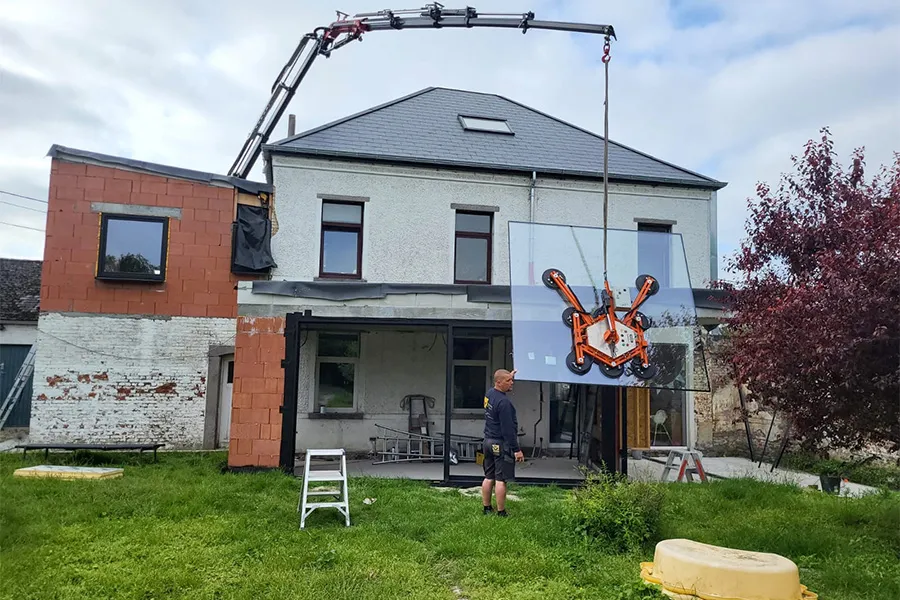
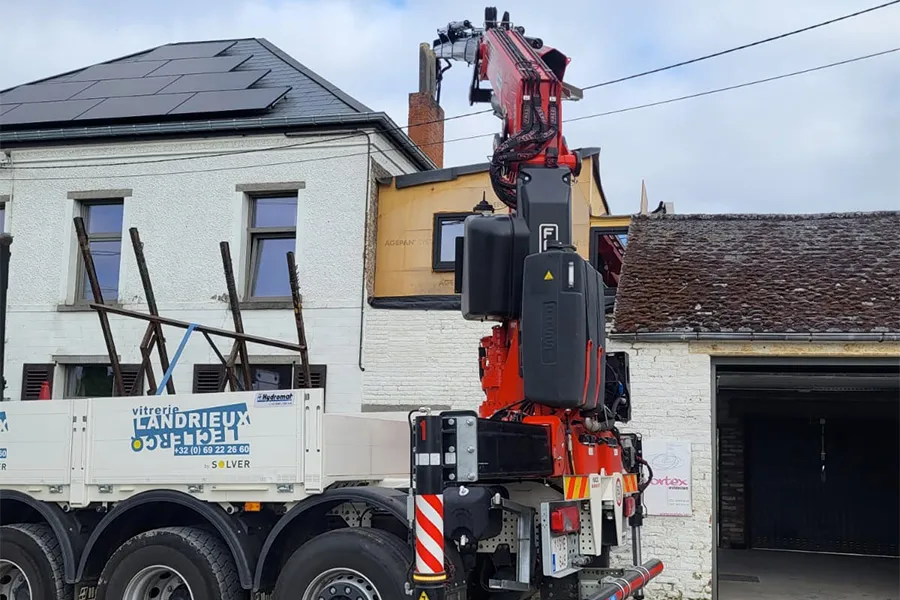
For the past three years, Fassi Belgium has operated from the Fleurus industrial estate, in the heart of Wallonia. The company recently achieved a world first, delivering a 48-tonne hybrid crane mounted on an IVECO lorry to glass company Landrieux-Leclercq in Tournai. The crane is powered by lithium batteries, which are charged by the lorry’s engine while it is moving, or from the mains when it is stationary.
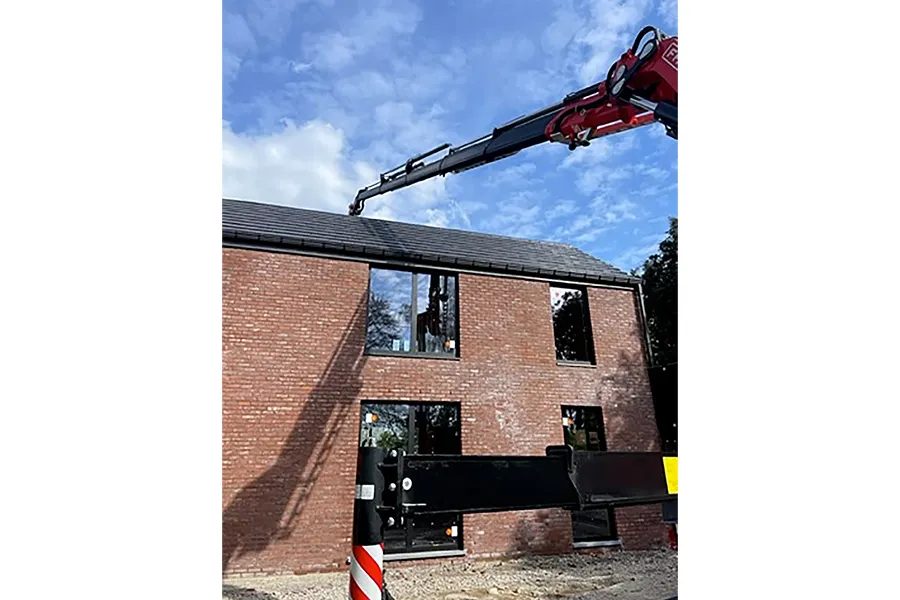
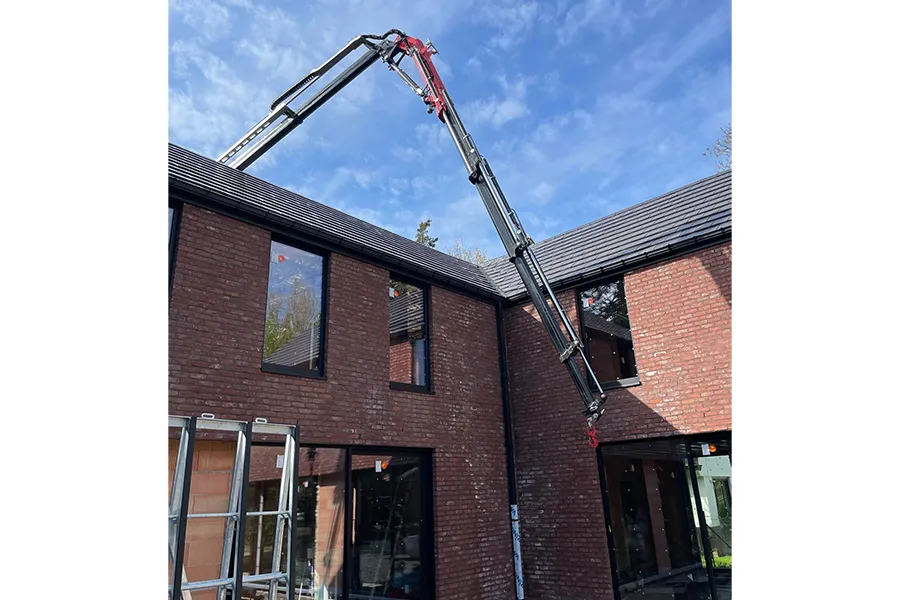
Thanks to this innovative technology, the crane can be used in quiet, emission-free environments. Fassi integrated the electric component into its cranes in response to market demand, particularly from Northern Europe, where exhaust fumes and noise are unwelcome in residential areas. This is precisely one of the main areas of activity for Vitrerie Landrieux-Leclercq in Froyennes (near Tournai). The glass company was keen to acquire such an impressive crane, as the largest windows usually need to be installed at the rear of the house. A long boom is needed to lift them over the building from the street. The investment was also driven by economic considerations: although the hybrid crane costs more to buy, it is cheaper to operate. Managing director Samuel Leclercq says: “As part of our commitment to sustainability and the environment, we were already offering our customers the latest energy-saving glass products. Now we can install them without emissions too. And in silence, which also benefits the operator.”
Smart hybrid technology
The new technology developed by Fassi can be used across a wide range of cranes, from mini cranes to models with a lifting capacity of 40 tm. It is also a safe system, as it operates at low voltage (48V-51V). This means the crane operator does not need to undergo specific training, unlike with medium- or high-voltage systems. The system has also been successfully tested for compliance with ECE Regulation R10 on the electromagnetic compatibility of electrical and electronic components on board vehicles. The total weight of Fassi’s HST system, including the battery pack, is 550 kg.
Two ways to charge
The dual charging system uses a single-phase 220V, 16A power supply. The batteries take nine hours to charge from empty. In practice, however, they are unlikely to be fully discharged, as they are also charged by the engine while the lorry is moving. Some charging therefore takes place on the return journey from the job site. The batteries can also be charged while the crane is operating and the alternator is running.
Fassi’s HST system comprises a 560 Ah battery pack which, in fully electric mode, provides enough autonomy to meet eighty per cent of daily requirements. The battery pack enclosure is fitted with a heater, allowing the crane to be used at temperatures as low as -20°C.
Easy to use
The HST features special software that maximises use of the engine’s power while minimising the loss of hydraulic power. The technology can also modulate the hydraulic power required by the crane when the engine reaches its limit.
Cranes featuring Smart Hybrid technology are equipped with a control panel for activating the battery and switching on the various crane components. The pump can also be switched on and off using the radio remote control.
The FX902 display in the lorry cab provides the driver with all the information needed to operate the system while the vehicle is running. All the data is also sent to the radio remote control, giving the user access to the same information while operating the crane.
Question about this story? Ask your question
Companies in this story
Keep following this
Get an email when a new story is published. No account needed.
- ThemeLifting at height and reach
- SubjectGeneral
- CompanyHST







