









Waeslantnatie invests in three Volvo FM LNG tractor units
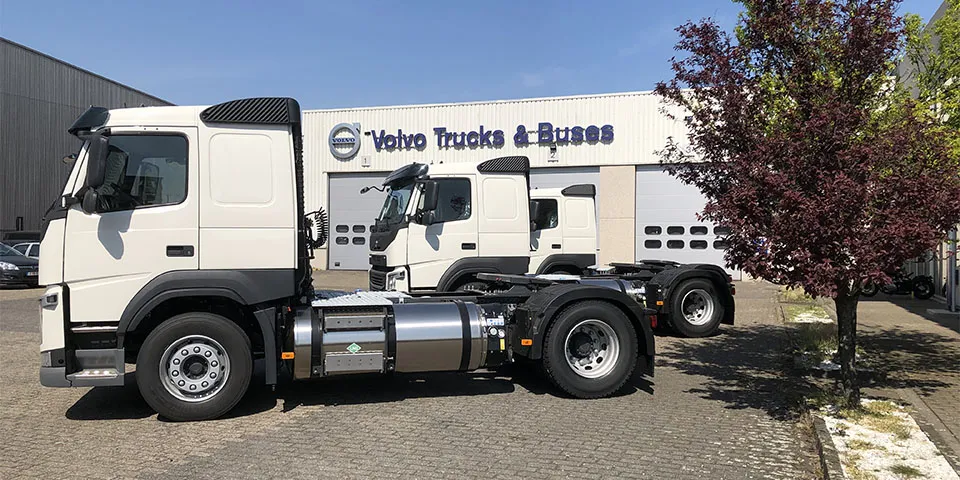
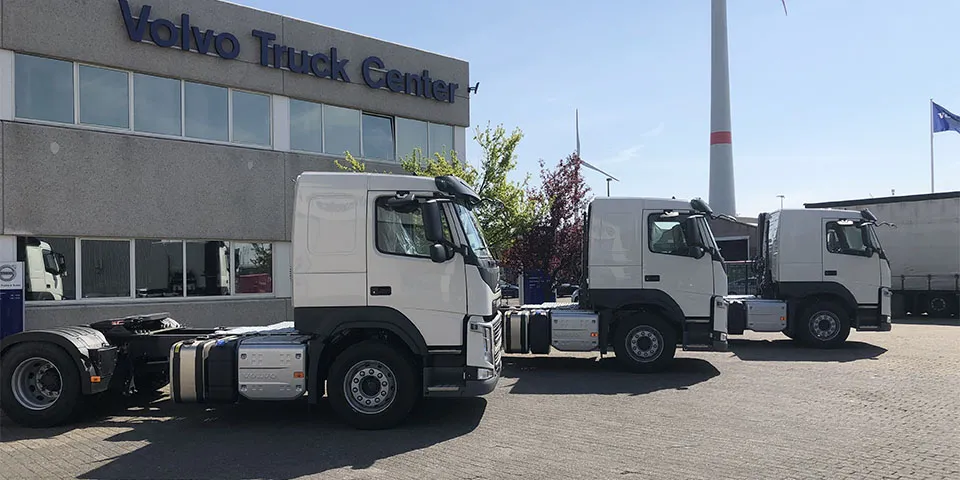
Volvo Trucks has just delivered three FM LNG tractor units to Waeslantnatie. They will mainly be used to transport steel products in containers within the port of Antwerp. “Even a relatively small company like ours can do its bit to help meet the climate targets,” says company director Georges Brys.
Despite what its name might suggest, Waeslantnatie is based on the right bank of the port. Its founders do, however, live in the Land van Waas. The name also gives no indication that it is a young company: it was founded in 2002. “We do operate like a natie of old: the shareholders work together as natiebazen and make decisions jointly. We also share a long-term vision based on good governance and corporate social responsibility,” says Georges Brys, one of the four directors.
“As part of that framework, every year we jointly decide on an investment that benefits the climate. This year, we replaced our four tractor units with models that emit significantly less CO2. Volvo Trucks Center supplied the new trucks. Three are LNG tractor units and the fourth is a diesel. We work in steel transport, and axle loads on the rear axle are sometimes very high. In those cases, the space between the front and rear axles is a little too limited to fit an LNG tank. That is why we had to choose a diesel for the fourth vehicle,” adds Georges Brys.
Three LNG filling stations within the port
Waeslantnatie, which now has around 30 employees, is active in steel product logistics. It has warehouses designed for heavy loads at Schenkeldijk in the port of Antwerp, provides packaging and transhipment services for complex and heavy cargoes, and transports steel products in containers and curtain-sided vehicles within the port area. “The distances we cover are therefore fairly short, and there are three LNG filling stations within the port. LNG tractor units are therefore perfectly suited to our operations,” says Georges Brys.
Following a comparative study, Waeslantnatie chose Volvo Trucks FM 4×2 tractor units. “Every kilo counts in steel transport. That is why they opted for the FM rather than the slightly heavier FH,” says Sven Braekman, account manager at Volvo Truck Center. “Another reason is that the drivers often have to get in and out of the cab. The lower step makes it more comfortable for them,” adds Georges Brys.
Drivers were looking forward to them
“The drivers are also very pleased with the LNG trucks’ driving performance. Steel is heavy, with some containers weighing 30 tonnes, so the trucks need to be able to accelerate well. With 460 hp, the FM LNG is perfectly suited to this requirement. Another important point is that the drivers were looking forward to driving the LNG tractor units: the climate issue matters to them too,” he adds.
“With this purchase, we also want to send a message: small and medium-sized businesses can do their bit to help meet the climate targets too. For Waeslantnatie, the new tractor units are not the only part of this philosophy. The decision to transport more containers by barge within the port of Antwerp is another,” concludes Georges Brys.
Question about this story? Ask your question
Keep following this
Get an email when a new story is published. No account needed.
- ThemeTowards low-emission equipment and transport
- SubjectGeneral







