









Video | Unique combination of trencher and mini excavator is bringing fibre-optic broadband to the whole country
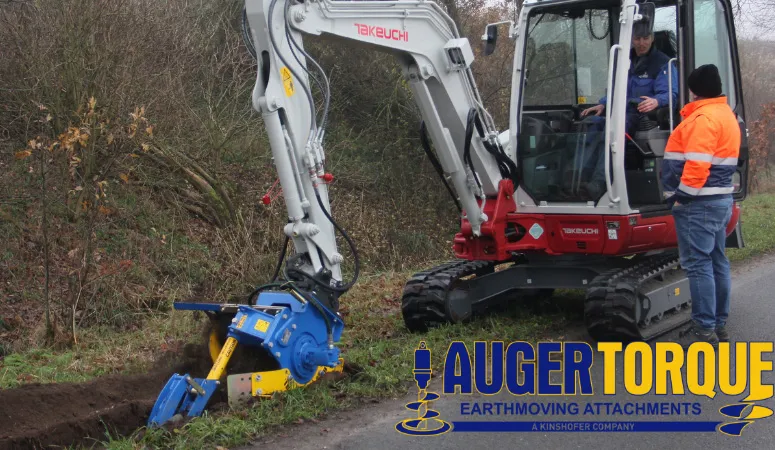
In the coming years, we will see more and more fibre-optic broadband being laid across the country, street by street. Until now, installation crews have had to do a great deal of digging, but that is about to change. Atsa Infra Tel bv, a leading player in this field, recently tested a trencher on a mini excavator in collaboration with Verhoeven, Auger Torque’s trencher importer. The successful combination will make it possible to carry out the work much more efficiently.
Fibre-optic broadband is booming
In December 2018, KPN telecom began installing fibre-optic broadband in four Dutch cities. This is part of the telecoms company’s new strategy, which aims to connect one million households to fibre-optic broadband by 2021. With this strategy, KPN is accelerating its transformation from a telephone company into a modern telecoms business. T-Mobile has also been given approval to connect 35,000 homes in Rotterdam to fibre-optic broadband. An estimated 32,000 km of cable still needs to be laid underground in the coming years.
There is room to work more efficiently
Atsa Infra Tel is one of the larger companies that carries out its own excavation work to lay its cables. In light of the developments mentioned above, Atsa Infra Tel will not be able to take on any new jobs until 2023 unless it expands its capacity. Owner Mr Harun Sarac says: “We currently dig most of the trenches for fibre-optic cables using our Takeuchi TB216 machines, fitted with a banana bucket. Given the amount of work, we cannot afford to stand still, so we are always looking for innovative solutions. Having been a Verhoeven customer for years, we joined forces to explore new options. The question was simple: how can we dig our trenches more efficiently and effectively?”
A unique combination: a trencher mounted on a mini excavator
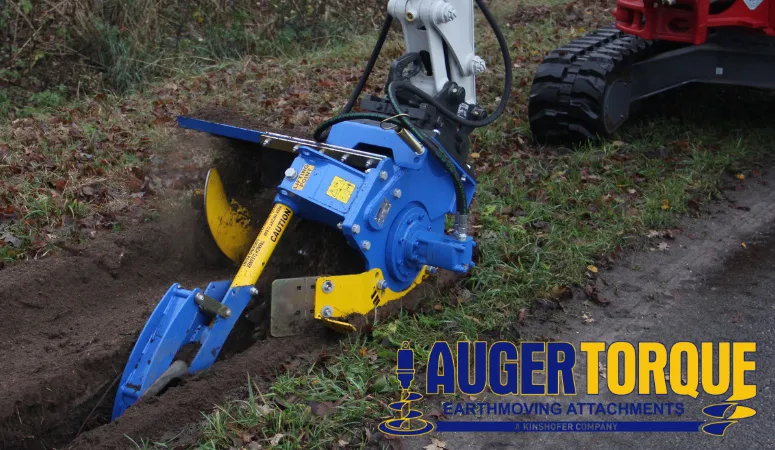
The Auger Torque trencher proved to be the answer to this customer’s needs. What makes it unique is that Auger Torque is the only supplier to offer a trencher for mini excavators. Whereas previously a tracked trencher had to be purchased, this trencher can simply be mounted on an excavator. Sarac says: “We no longer want to lay telecoms cables at a depth of 60 cm, but at 45 cm. This makes it possible to use a trencher without hitting utility services. By mounting a trencher on our excavator, we hope to get the work done faster.”
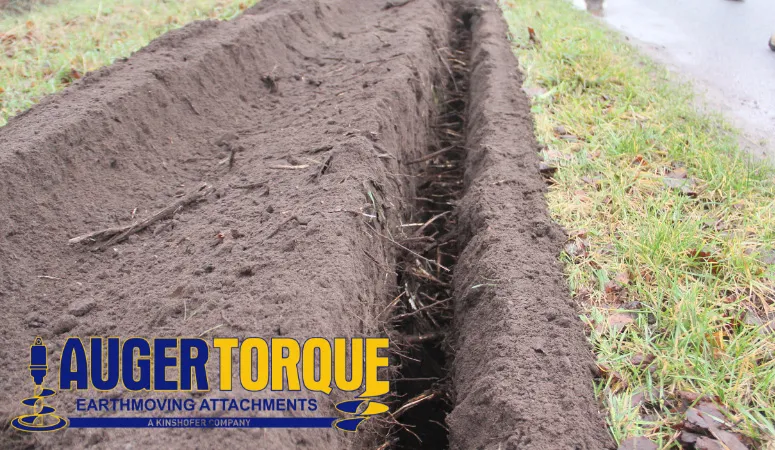
Atsa Infra Tel BV tests the trencher with Verhoeven, Auger Torque’s importer
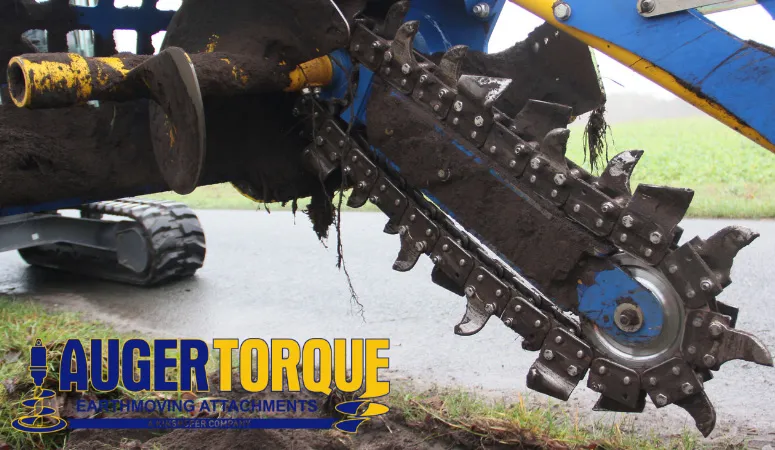
On a Takeuchi TB240, operator Marc Kursten demonstrates the Auger Torque MT600, fitted with a 100 mm HD chain and weighing 254 kg. It achieved an average speed of 2 metres per minute, including manoeuvring around tree roots and removing rubble. The test concluded that the Auger Torque trencher is the perfect answer to market demand for an effective and efficient way to cut trenches. Sarac was also very pleased: “This works brilliantly, it really gets the job done!” he said. The machine’s power, combined with the trencher, delivers significantly better performance than standalone tracked trenchers.
Once level with the ground, the trencher cuts at the optimum angle while maintaining the correct depth. Pulling the trencher along is as simple as reversing the mini excavator. It cuts a perfect trench at a steady pace. Even less experienced operators will find that trenching is a piece of cake. Sarac ends with a message to fellow businesses: “The combination of a trencher and an excavator is ideal not only for laying fibre-optic cables, as Atsa Infra Tel does, but also for companies laying pipes from A to B in greenhouses or providing drainage solutions. There is plenty of work out there!”
More innovation in the pipeline
Atsa is currently working with TU Delft to integrate a ground-view camera into the trencher. The aim of this innovative development is to configure the machine so that it can see 1 m deep and 1.5 m wide into the ground, allowing it to avoid existing cables.
Question about this story? Ask your question
Companies in this story
Keep following this
Get an email when a new story is published. No account needed.
- ThemeEarthmoving and road construction in practice
- SubjectGeneral
- CompanyVerhoeven







