









The emission-free construction site
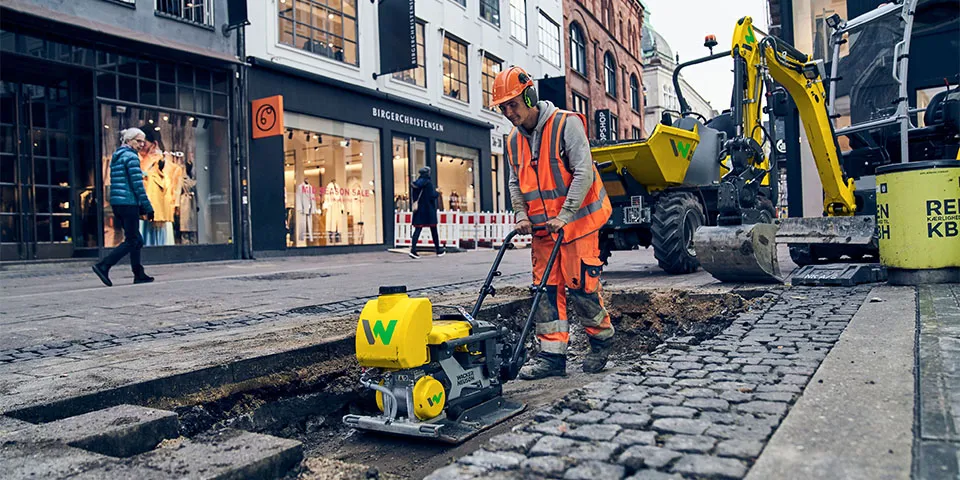
Low-noise construction machinery and equipment were needed for a night-time construction site in Copenhagen’s pedestrian zone in late 2019. As a result, almost the entire Wacker Neuson Zero Emission range was used to lay new cables, from battery-powered rammers and electric wheel loaders to the EZ17e mini excavator.
Wacker Neuson Zero Emission machines at work in the pedestrian zone
No compromises despite zero-emission operation: that is the promise of Wacker Neuson’s Zero Emission solutions. They proved their worth in Copenhagen city centre in late 2019, where new cables were laid in the pedestrian zone. To avoid restricting local businesses’ opening hours and disturbing residents, work was carried out mainly at night and in the early morning. Thanks to Wacker Neuson’s Zero Emission range, the entire site was able to operate completely emission-free and quietly. Noise measurements by the City of Copenhagen recorded no noise emissions from the Zero Emission products. Only passing rubbish lorries with conventional engines produced measurable readings. “As emissions issues become increasingly pressing, particularly in city centres, and solutions become more cost-effective, we are seeing growing demand for emission-free solutions,” says Alexander Greschner, CSO of the Wacker Neuson Group. “Five years ago, we unveiled a world first with our battery-powered rammer, and since then we have expanded our range of emission-free machines, which now comprises a total of 13 products for the construction sector.”
The entire process completely emission-free
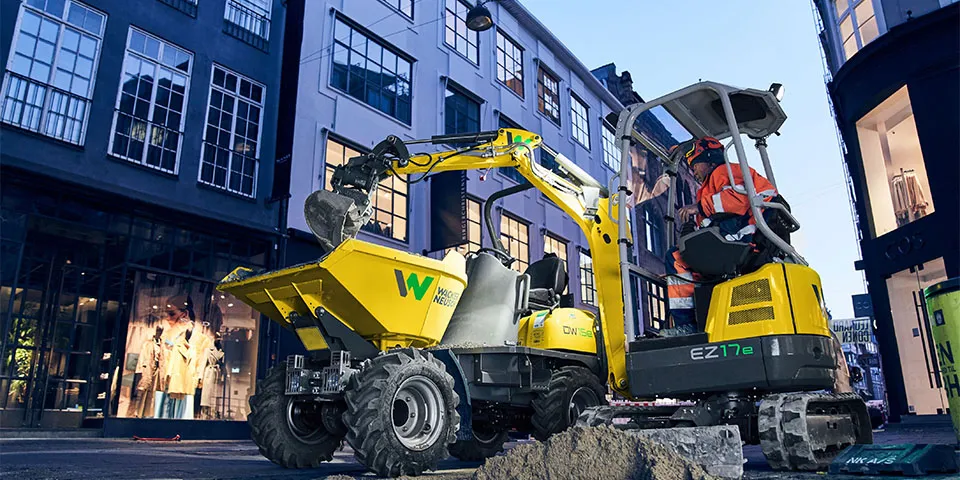
Danish rental company GSV supplied the contractor with Wacker Neuson’s emission-free machines. Peter Fritzbøger, sales and marketing manager at GSV, says of Wacker Neuson’s solutions: “Our experience shows that Zero Emission machines are easy to operate, require no special training and are just as reliable as conventional machines.” First, the pavement in Copenhagen city centre was broken up using the fully electric EZ17e Zero Tail excavator, then the earth was excavated. Thanks to its compact design, the rear never extended beyond the undercarriage. The 1.5-tonne excavator is in no way inferior to fuel-powered mini excavators in the same class: all hydraulic functions have the same power as the conventional model. The EZ17e excavator can be used with complete flexibility thanks to an intelligent charging management system, and its battery capacity is sufficient for an average working day. The excavator can also be charged during use, as it can be plugged in during stationary work, such as demolition inside buildings. The battery can be charged from a standard domestic socket (110-230V). Using a high-voltage power supply, it can also be charged in four hours.
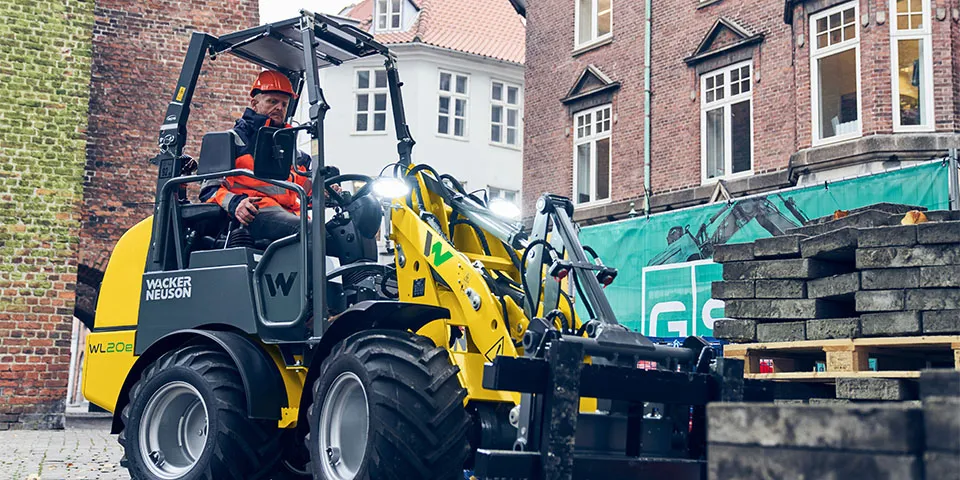
The excavated material was removed using the DW15e electric dumper, which has a 1.5-tonne payload. The dumper’s drive system and working hydraulics each have their own electric motor, allowing power output to be adjusted independently as required and energy consumption to be minimised. When the machine slows down or travels downhill, energy is fed back into the battery to recharge it. The maintenance-free battery is supplied with an integrated charger that can be connected to the charging station. The WL20e wheel loader was also used to transport materials around the site. It has a tipping load of 0.2 cubic metres and comes as standard with a high-performance AGM battery (“Absorbent Glass Mat”). This battery is distinguished by its ease of use and low maintenance requirements.
Once the cables had been laid in the pedestrian zone, the ground was compacted using a battery-powered rammer and a battery-powered vibratory plate. The AP1850e battery-powered vibratory plate was used on larger areas, while the AS50e battery-powered rammer was deployed in tighter spaces. Both machines can be used with the same modular lithium-ion battery, which can be changed in next to no time. This battery is specially designed for demanding work on construction sites and provides enough energy for all the tasks a compaction machine needs to perform during an average working day.
Emission-free operation is becoming increasingly important
More and more cities are considering tightening their emission limits, and Copenhagen is no exception. “There are no regulations yet, but we do want to introduce rules in Copenhagen over the coming years. In this respect, we believe that global cooperation between cities and collaboration with industry are essential,” says Jørgen Abildgaard, director of the Climate Programme of the City of Copenhagen.
Wacker Neuson’s Zero Emission range consists of three battery-powered rammers, three battery-powered vibratory plates, a dual-power (hybrid) excavator, an electric mini excavator, an electric wheel loader, electrically powered tracked and wheeled dumpers, and an electric internal vibrator system for compacting concrete.
Watch the video below about the emission-free construction site in Copenhagen:
For more information, visit www.wackerneuson.com/zeroemission
Question about this story? Ask your question
Companies in this story
Keep following this
Get an email when a new story is published. No account needed.
- ThemeTowards low-emission equipment and transport
- SubjectGeneral
- CompanyWacker Neuson







