









Mercedes-Benz Trucks celebrates world premiere of battery-electric eActros 600 long-haul truck
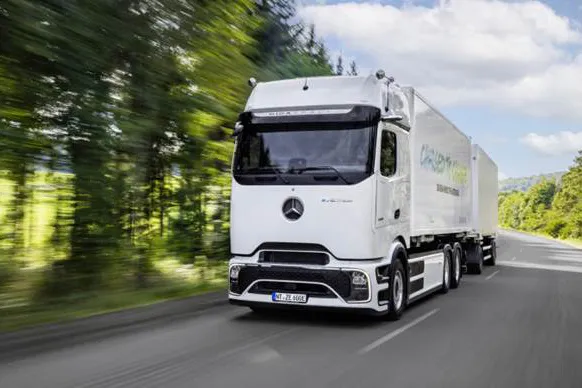
Mercedes-Benz Trucks has unveiled the production version of its first battery-electric long-haul truck. Today, the manufacturer presented the Mercedes-Benz eActros 600 to an international audience at a world premiere event south of Hamburg. With this eTruck, the manufacturer aims to set new standards in road transport in terms of technology, sustainability, design and operating efficiency for electric fleet operators.
- eActros 600 sets new standards in technology, sustainability, design and operating efficiency
- In the long term, it could replace most diesel trucks in the segment
- Range of 500 km1 without intermediate charging
- Significantly more than 1,000 km per day with intermediate charging during legally required driver breaks
- Gross combination weight of up to 44 tonnes
- Payload of around 22 tonnes with a standard trailer
- Sales to begin this year, start of series production planned for the end of 2024
- New cab design language with efficient aerodynamics
- Potential CO2 savings2 of more than 80 per cent over the entire life cycle compared with diesel trucks
- Karin Rådström, CEO Mercedes-Benz Trucks: “The eActros 600 represents the transformation of road transport towards CO2 neutrality like no other Mercedes-Benz truck. It features state-of-the-art drive technology that can offer our customers very high energy efficiency and, in turn, operating efficiency. This makes the switch to eMobility particularly attractive for fleet operators.”
Thanks to its high battery capacity of more than 600 kWh, hence the 600 model designation, and a new, highly efficient electric drive axle developed in-house, the eTruck has a range of 500 km 1 without intermediate charging. This means the eActros 600 can cover more than 1,000 km per day. Intermediate charging during legally required driver breaks, even without megawatt charging, makes this possible. Around 60 per cent of long-haul trips made by truck customers in Europe are shorter than 500 km, so the charging infrastructure at depots and loading and unloading points is sufficient for these journeys. For all other operations, the continued development of public charging infrastructure is essential if the eTruck is to be used to its full potential in pan-European long-haul transport. In addition to CCS charging (Combined Charging System) at up to 400 kW, the eActros 600 will also support MCS charging (Megawatt Charging System) at a later date. Customers can order the necessary preparation from the start of sales. Once MCS technology is available and standardised across all manufacturers, it can be retrofitted to eActros 600 models. The batteries can be charged from 20 to 80 per cent in around 30 minutes at a suitable charging station with an output of approximately 1 megawatt3.
The vehicle has been engineered for a gross combination weight of up to 44 tonnes. With a standard trailer, the eActros 600 has a payload of around 22 tonnes in the EU. National legislation may allow a higher payload in some cases. Visually, the eTruck features an entirely new, pared-back design with clean lines and an aerodynamic shape. In terms of operating efficiency for fleet operators, the eTruck is expected to set new standards, enabling it to replace most diesel trucks in the important long-haul segment in the long term. At the heart of Mercedes-Benz Trucks’ concept for battery-electric long-haul transport is a holistic transport solution for customers, comprising vehicle technology, advice, charging infrastructure and services.
Sales of the eTruck will begin this year. Series production is planned for the end of 2024. Alongside the tractor unit, Mercedes-Benz Trucks will also produce tipper variants of the eActros 600 immediately after its launch, giving customers a much wider range of applications for fully electric transport. A fleet of around fifty prototypes is currently being assembled; in the next stage, these will also go to the first customers for field testing. Karin Rådström, CEO Mercedes-Benz Trucks: “The eActros 600 represents the transformation of road transport towards CO2 neutrality like no other Mercedes-Benz truck. It features state-of-the-art drive technology that can offer our customers very high energy efficiency and, in turn, operating efficiency. This makes the switch to eMobility particularly attractive for fleet operators.”
Electricity prices and toll systems are key to operating efficiency compared with diesel trucks
The time it takes fleet operators to achieve cost parity with a comparable diesel truck on long-distance routes using the eActros 600 varies from country to country, depending primarily on electricity and diesel prices and the toll system. In major transit countries such as France and Germany, for example, low electricity prices and planned CO2-based truck tolls respectively have a positive impact on the TCO of battery-electric trucks. This means the eActros 600 could be more cost-effective than a long-haul diesel truck over the average service life of around 5 years, or after around 600,000 km, despite a purchase price approximately two to two and a half times higher than its diesel equivalent. Government support for eTrucks and charging infrastructure is a crucial lever during the early stages.
Potential CO2 savings of more than 80 per cent over the entire life cycle compared with diesel trucks
The CO24 footprint of the eActros 600 depends heavily on the electricity mix used to charge its batteries. With today’s European electricity mix, the eActros 600 achieves CO2 savings of around 40 per cent compared with an equivalent diesel Actros, rising to more than 80 per cent over its 10-year life cycle, from raw material extraction, when powered entirely by renewable energy sources. This equates to savings of around 370 and 775 tonnes of CO2 respectively. In long-haul transport, the eActros 600 can therefore offset the higher CO2 footprint at the factory attributable to its batteries in its second or first year respectively.2
eMobility in long-haul transport creates more opportunities for fleet operators
Electrifying long-haul transport will change the business model of transport companies and create opportunities for competitive advantage at various levels. More and more customers, for example, attach importance to transporting their goods in a CO2-neutral way. Providers unable to meet this requirement are no longer considered. However, the effects of electrification extend beyond simply acquiring eTrucks to replace diesel trucks and developing charging infrastructure. Many fleet operators have to calculate very carefully on very tight margins. If they can earn more per kilometre driven electrically than with a diesel truck, thanks to electricity prices or tolls, it will make sense for them to use the eActros 600 as much as possible. This may even be the case if the driver buys electricity on the road at a higher price than at the company’s own depot, as costs may still be significantly lower than for diesel trucks. The higher investment in the eTruck therefore pays for itself more quickly, while transport companies can also operate more profitably.
Efficient LFP battery technology
The eActros 600 has three battery packs, each with a capacity of 207 kWh5. Together, they provide a total installed capacity of 621 kWh. The batteries use lithium iron phosphate (LFP) cell technology and have a long service life. Mercedes-Benz Trucks’ development engineers have designed the eActros 600 to meet the same durability requirements for the vehicle and its components as a comparable conventional heavy-duty long-haul Actros. This means a service life of up to 1.2 million km over 10 years. At the end of this service life, the battery’s state of charge (“State of Health”) should still be above 80 per cent. Unlike other battery cell technologies, LFP technology also allows more than 95 per cent of the installed capacity to be used. This enables a greater range with the same installed battery capacity
Innovative powertrain technology: Predictive Powertrain Control in the eActros 600
Mercedes-Benz Trucks has developed a new 800V eAxle with two electric motors and a four-speed transmission specifically for heavy-duty long-haul transport. The electric motors deliver a continuous output of 400 kW and a peak output of 600 kW, providing powerful acceleration, a high level of driving comfort and excellent handling. Full motor power is generally available with virtually no interruption in torque.
In addition, an anticipatory driving style allows electrical energy to be recovered through regenerative braking. This energy is fed back into the eActros 600’s batteries and is then available for propulsion again. Regenerative braking also reduces the load on the eActros 600’s brakes, a useful additional benefit. Depending on the situation, the driver can choose from five different recuperation levels. If desired, ‘one-pedal driving’ can also be activated on the touchscreen in the digital cockpit. This means slowing down through recuperation while making less use of the mechanical brakes.
The eActros 600 is equipped with the proven Predictive Powertrain Control (PPC) cruise control and transmission management system, specially adapted for electric drive. The predictive powertrain management system automatically takes account of topography, road layout and traffic signs to ensure the most efficient driving style. Navigation system route information is now also taken into account to improve the recognition of events along the route. This allows the driver to avoid unnecessary braking, acceleration and gear changes, and to use battery power as efficiently as possible.
The Multimedia Cockpit Interactive 2, fitted as standard in the eActros 600, continuously provides the driver with information on battery charge, remaining range, and current and average energy consumption. Fleet operators can use digital solutions via the Fleetboard portal for efficient fleet management. When series production begins, these will include a tailored Charge Management system, which intelligently manages all processes between the eActros 600 and the charging infrastructure, as well as a Logbook with detailed information on driving, stationary and charging times, and consumption data. A Mapping tool will also show in real time where a vehicle is, whether it is moving, stationary or charging, and the battery’s charge status.
New aerodynamic cab design
The eActros 600’s cab features a new design language distinguished by particularly efficient aerodynamics. Key elements include a large, fully enclosed and rounded front panel, an optimised bumper with underbody panel, an aerodynamically improved step and extended sail-style side deflectors. Air deflectors on the A-pillars, an additional roof spoiler at the front and a sealed engine compartment complete the aerodynamically enhanced cab. The cab is also equipped with aluminium stone guards, a new headlight concept with matrix LED headlights and an LED light strip. Mercedes-Benz Trucks is bringing the cab to market under the name ‘ProCabin’.
Improved aerodynamics are particularly important for battery-electric long-haul trucks, as air resistance is one of the main factors affecting energy consumption. In addition, reduced air resistance allows more energy to be recovered through regenerative braking, increasing the vehicle’s range.
The 80 mm longer front end makes the new cab’s particularly aerodynamic shape possible. This shape was developed using numerous in-house flow simulations, as well as wind tunnel and road testing. As a result, the ProCabin’s drag coefficient has been reduced by 9 per cent6 compared with the current standard Actros cab. This aerodynamic improvement reduces the vehicle’s energy consumption and thus makes a decisive contribution to the eActros 600’s range of 500 km1 .
PTOs for work equipment or refrigerated trailers
Mercedes-Benz Trucks has developed two different PTOs for the eActros 600. The electromechanical PTO can be used to operate hydraulic or mechanical work equipment, such as tipper trailers, walking-floor trailers or silo trailers. Another option is an electric DC or AC PTO. In the latter, an inverter converts the high-voltage system’s direct current into alternating current. This allows equipment such as refrigerated bodies or refrigerated trailers to be used. Depending on the variant, the different PTO applications cover an output range of 22 to 90 kW and can serve the usual applications in long-haul and distribution transport. Proven industry interface standards are still available ex factory for the eActros 600. Compared with the previous diesel-based operation, this solution offers local CO2-neutrality and significantly lower noise levels, making it easier to use in cities and residential areas in particular. Thanks to the systems’ compact design, the eActros 600 can still be used as a tractor unit with standard trailers, a major advantage for transport companies that use the vehicle for a wide range of applications.
Futuristic sound design for the acoustic warning system
The eActros 600 operates very quietly, benefiting both the driver and those around it. To ensure that vulnerable road users, such as pedestrians and cyclists, can still hear the eTruck, it is equipped with an external Acoustic Vehicle Alerting System (AVAS), in accordance with legal requirements. Sounds are played when driving forwards or reversing, depending on the driving conditions. The sound also varies according to road speed and accelerator pedal position, ensuring that the vehicle can be heard clearly in urban traffic. The futuristic sound spectrum of the AVAS fitted to the eActros 600 has been designed to reflect the presence of a heavy vehicle and make it more noticeable in urban traffic.
New milestones in safety assistance systems
With the eActros 600, Mercedes-Benz Trucks is reinforcing its vision of accident-free driving. As in previous years, the manufacturer’s vehicles are equipped with safety assistance systems that go beyond legal requirements in many areas. This also applies to the General Safety Regulation adopted by the European Commission. The regulation requires all new vehicles to be fitted with additional systems as standard from mid-2024. The eActros 600’s safety concept is based on further development of proven safety assistance systems. This is made possible by an entirely new electronic platform and the associated sensor fusion, which combines radar and camera data to provide an even wider view ahead and to the sides. The electronic platform offers twenty times greater data processing capacity for this purpose. The six sensors fitted in total, comprising four short-range radars, one long-range radar and the multifunction camera in the windscreen, cover a 270° area around the vehicle.
Sensor fusion benefits all safety assistance systems in the eActros 600
The substantially wider field of view further increases the effectiveness of the safety assistance systems, including Active Brake Assist 6 (ABA 6), Frontguard Assist, Active Sideguard Assist 2 (ASGA 2) and Active Drive Assist 3 (ADA 3). The higher data processing capacity and the connection between all sensors can save valuable time, allowing the vehicle to respond to traffic conditions as quickly as possible when necessary, ideally preventing accidents altogether or at least limiting their consequences.
Sensor fusion, or the 270° all-round view provided by six sensors, is particularly beneficial for ABA 6. Improved hazard detection and multi-lane monitoring enable the emergency braking assistant to react more quickly in critical situations, such as lane changes and stationary traffic in typical motorway bends.
ABA 6 can respond with an automatic emergency stop to moving people, cyclists on the carriageway, pedestrians crossing or approaching the vehicle, and stationary pedestrians, at vehicle speeds of up to 60 km/h. The new Frontguard Assist can also provide the driver with visual and audible warnings about unprotected road users directly in front of the truck, particularly in hectic situations such as pulling away or at junctions.
While ASGA 1 monitors the full length of the tractor-trailer combination, plus 2 metres at the front and up to 1 metre at the rear, as well as up to 3.75 metres on the right-hand side of the vehicle, ASGA 2’s monitoring area increases through sensor fusion to 7 metres at the front, 30 metres at the rear and 4.25 metres on the right-hand side. A new feature is that ASGA 2 also monitors an area on the driver’s side.
The extended field of view to the left also brings significant additional benefits to the installed ADA 3, which enables partially automated driving (Level 2). The system’s third generation can automatically steer the truck back into its lane if there is a risk of collision, for example if the driver wants to move left to overtake but has failed to notice a vehicle approaching from behind.
Intelligent services
Mercedes-Benz Complete, the most comprehensive service contract in the manufacturer's portfolio, is available for the eActros 600. The fully automatic Mercedes-Benz Uptime telematics service is always included. It continuously monitors the status of many vehicle systems in the truck, enabling critical situations to be detected. Unscheduled workshop visits can be reduced by grouping together identified repair and maintenance work.
Haulage companies can activate the digital TruckLive service via the My TruckPoint customer portal. TruckLive is the central gateway to the digital service world, connecting customers with their vehicles and Mercedes-Benz truck dealer. The service currently comprises two components: ‘Maintenance Management’ and ‘Live Traffic’. ‘Maintenance Management’ helps customers plan maintenance more effectively through up-to-date service intervals and transparency about the condition of their vehicles, from brake wear to tyre pressure. ‘Live Traffic’ helps reduce journey times and plan arrival times more accurately by using real-time traffic data.
For charging eTrucks at public truck charging stations away from their own depots, Mercedes ServiceCard will also offer an eCharge Card when the eActros 600 is launched, as an addition to the existing MSC fuel card. Mercedes ServiceCard will therefore also act as a processing partner for cashless payment of charging costs in the future.
Comprehensive advice on electrifying fleets and depots
With its ‘eConsulting’ advisory service, part of the comprehensive ecosystem for improving the TCO of eTrucks, Mercedes-Benz Trucks is already supporting customers with the electrification of their fleets and depots. The focus is on advice covering all aspects of eTrucks, as well as the planning, use and technical implementation of depot charging infrastructure and grid connections. Mercedes-Benz Trucks consultants can also help identify opportunities for government subsidies for infrastructure and vehicles. Mercedes-Benz Trucks is working with selected partners on technical implementation at depots. The manufacturer plans to expand its service offering consistently. From mid-2024, for example, Mercedes-Benz Trucks will offer charging stations through its dealers, as well as a professional service to ensure trouble-free charging and high vehicle availability. The aim is to offer customers an affordable all-in package for making the move to eMobility, from energy generation to the right charging infrastructure. To this end, Mercedes-Benz Trucks will expand its partner network in Europe.
Financial services from a single source
The transition to sustainable transport is supported by integrated financing and insurance solutions for both the eActros 600 and the charging infrastructure. The financing offer covers everything from pay-per-use with integrated services to vehicle purchase. Daimler Truck Financial Services also works with Marsh, which it describes as the world's largest insurance broker. Marsh negotiates effective, affordable insurance products and offers services tailored to customers' business needs.
Production focused on sustainability and flexibility
The eActros 600 is built on the existing assembly line at Mercedes-Benz Trucks' largest truck plant in Wörth am Rhein, alongside diesel-powered trucks and with the flexibility to produce both. At the same time, the eActros 600 is fitted in Wörth with electric drive components from Mercedes-Benz plants in Mannheim, Gaggenau and Kassel. Like the plant in Wörth, these three plants are also transitioning from diesel technology to become competence centres for emission-free transport. The e-axles, HV batteries and front box, a complex technology module containing various control units, HV components and an electric air compressor, are installed in Wörth in several production stages. Once all HV components have been fitted, the entire system is commissioned and the truck is ready to drive.
The world premiere of the eActros 600 took place at BREAK Autohof Hamburg-Nordheide, directly on the A7 in Egestorf.
Detailed customer information about the eActros 600 is available online at https://eactros600.mercedes-benz-trucks.com
Een zakelijke vraag aan Mercedes-Benz Trucks Belgium? Get in touch
Companies in this story
Keep following this
Get an email when a new story is published. No account needed.
- ThemeConstruction transport on road and site
- SubjectGeneral
- CompanyMercedes-Benz Trucks Belgium







