









Mercedes-Benz eActros 600 put to the test at the ‘eActros 600 Driving Experience’ in Wörth
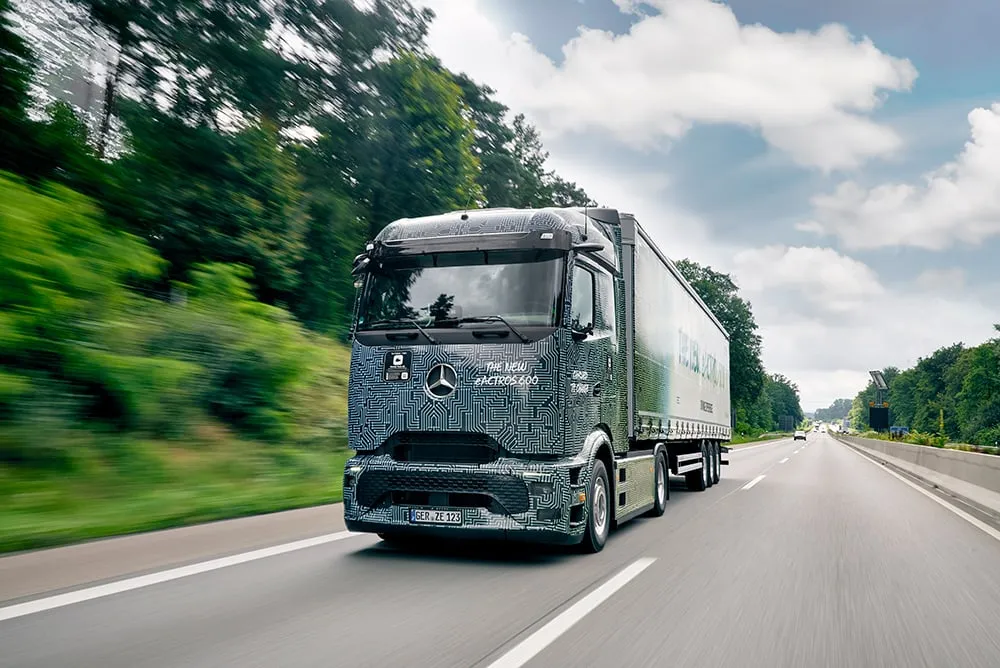
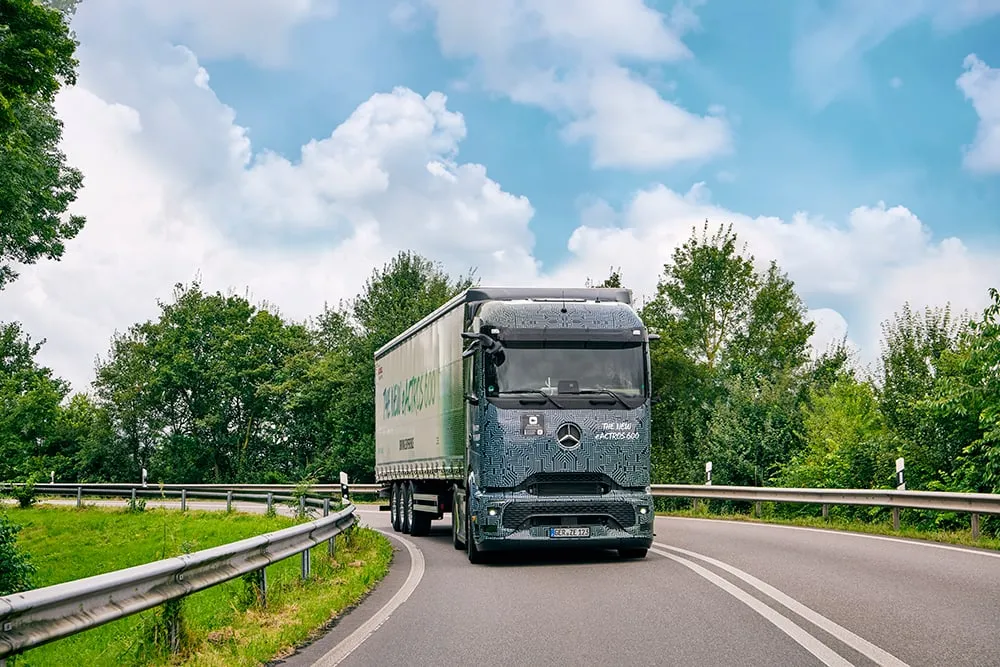
The truck has a futuristic look, offers a very smooth ride, is locally carbon-neutral in operation and can cover around 500 kilometres[1] without intermediate charging. It therefore has everything it takes to revolutionise long-haul road transport. But how does the eActros 600 perform in the field? The ‘eActros 600 Driving Experience’, organised by Mercedes-Benz Trucks in Wörth, provided the answer. The manufacturer showed international journalists and influencers what the e-truck, developed specifically for long-haul transport, can do and how its quality can deliver added value for customers.
- Near-production prototypes of the eActros 600 are being tested on typical long-haul routes.
- The eActros 600 is distinguished by its aerodynamic ProCabin, powerful acceleration, smooth handling and range-enhancing recuperation.
- Systems such as Predictive Powertrain Control, Active Brake Assist 6 and Active Sideguard Assist 2 provide greater comfort and safety.
- The new eActros 600 Experience World presents the complete ecosystem surrounding the eActros 600, with a focus on profitability and sustainability, services and charging infrastructure.
Mercedes-Benz Trucks designed three routes for the “eActros 600 Driving Experience”. Starting each time from the customer centre in Wörth, the routes pass through parts of the Südliche Weinstraße and Germersheim. They offer a good mix of motorways, secondary roads and industrial areas, providing a clear picture of how the eActros 600 performs in everyday use. A standard semi-trailer was attached to the vehicle, giving it a gross combination weight of around 40 tonnes.
Aerodynamic design and innovative drive technology
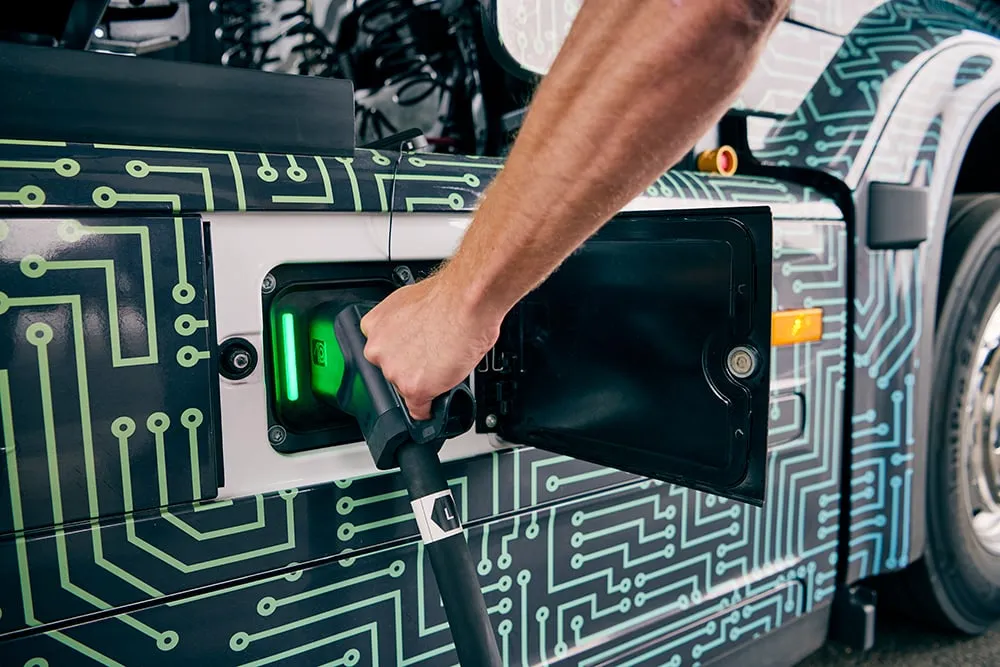
The eActros 600’s exterior inevitably catches the eye before the drive begins. Mercedes-Benz Trucks designed the entire futuristic ProCabin to be particularly aerodynamic, in order to reduce energy consumption. Then it is time to set off, and you can barely hear anything apart from the compressor, tyre noise and the wind. As soon as the brake pedal is released, the truck starts rolling. These first impressions alone give a sense of how fascinating battery-electric driving in the eActros 600 is.
That impression grows stronger as the drive continues. On motorways and secondary roads with varied topography, as well as through industrial areas and towns, the smooth, gliding motion is immediately noticeable, and the driver feels barely any gear changes or interruptions in tractive power. The electric motors deliver the same high torque across the entire rev range, while the eActros 600’s powerful, effortless acceleration is noticeable in every traffic situation, even at full load. Specifically for long-haul use, the manufacturer has developed an 800-volt e-axle with two electric motors and a 4-speed transmission. The electric motors deliver a continuous output of 400 kW and a peak output of 600 kW.
Predictive Powertrain Control
The eActros 600 is also equipped with Predictive Powertrain Control (PPC), a cruise control and transmission control system specifically adapted for electric drive. Predictive Powertrain Control automatically takes account of topography, road layout and traffic signs to ensure the most efficient driving style possible. It also now uses route information from the navigation system to better anticipate events along the way. This helps the driver avoid unnecessary braking, acceleration and gear changes, and use battery power as efficiently as possible. As the drive clearly demonstrates, energy consumption naturally always depends on the selected driving programme. ‘Range’ mode, for example, limits motor output to 70 per cent and speed to 82 km/h; ‘Economy’ mode to 85 per cent and 85 km/h; and ‘Power’ mode to 100 per cent and 90 km/h.
As demonstrated during the ‘Driving Experience’, highly individual settings for PPC can also be entered via the on-board computer. For example, the upper speed tolerance can be set from 2 to 10 km/h, and the lower speed tolerance from -1 to -10 km/h for coasting phases. It is also possible to set how much speed should be reduced when approaching a bend. Coasting settings can also be configured for route events such as stop and priority signs or roundabouts. This also applies to the so-called downhill power peak, which uses the speed gained on a descent for a subsequent uphill section.
Energy efficiency and battery capacity
The “eActros 600 Driving Experience” demonstrated how efficiently the eActros 600 uses its energy through intelligent recuperation. The electric motor converts the kinetic energy generated during braking, or when actively operating the steering-column lever during engine braking, into electrical energy. The energy generated in this way is fed back into the truck’s batteries, helping to extend its range. Depending on the situation, the driver can choose from five different braking levels. One-pedal driving can also be activated as required on the touchscreen in the digital cockpit. This means deceleration through recuperation, with reduced use of the mechanical brakes.
The Multimedia Cockpit Interactive 2 continuously displays battery charge level, remaining range, and current and average energy consumption in kWh per 100 kilometres. On the 72-kilometre route from the Wörth customer centre via the B 9 to Germersheim and Schwegenheim, from there via the B 272 to Weingarten and Hochstadt, and finally back to the customer centre via smaller country roads, an industrial area and the A 65, energy consumption during a drive in a near-production eActros 600 prototype averaged around 111 kWh per 100 kilometres. At the start, the display showed a charge level of 85 per cent and a remaining range of 470 kilometres. On arrival at the customer centre, the charge level was 71 per cent and the remaining range was 370 kilometres.
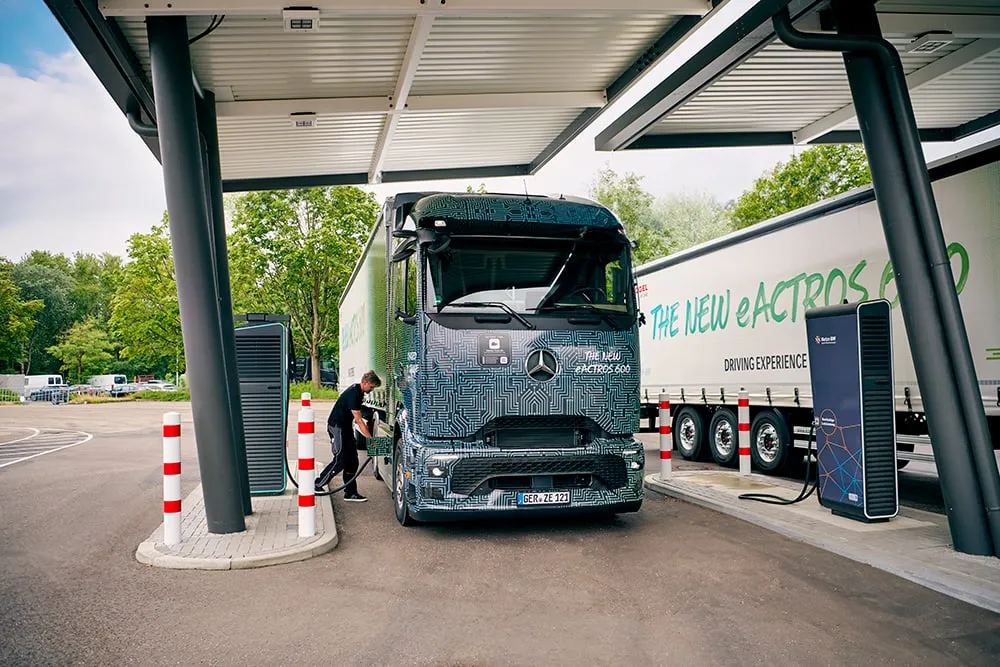
The key word is energy: The eActros 600 has three battery packs, each with a capacity of 207kWh,[2]giving a total installed capacity of 621 kWh. The batteries use lithium iron phosphate cell technology and have a long service life. In addition to CCS charging at up to 400 kW, the vehicle will later also support megawatt charging (MCS). At a suitably equipped charging station, the batteries can then be charged from 20 to 80 per cent in around 30 minutes at a charging power of approximately[3]one megawatt. In April 2024, Mercedes-Benz Trucks’ developers successfully charged the eActros 600 at 1,000 kilowatts for the first time in an internal test. Mercedes-Benz Trucks is closely involved in developing the new cross-brand MCS charging standard.
Online route analysis tool and real-world drive
Mercedes-Benz Trucks has developed a free application, the ‘eTruckReady’ web app, which allows users to check in advance on a computer how a planned route can be completed using the electric truck and where the vehicle may need to be charged. First, the vehicle type and configuration must be selected. For the eActros 600, the options are the 6×2 chassis, the 6×2 chassis with trailer or the 4×2 tractor unit. Users then select the body or trailer, with or without refrigeration and with an individually adjustable cooling temperature. In addition to the actual distance to be travelled, parameters such as the day and time, outside temperature and payload can also be configured. The tool then calculates the route, takes account of the topography and indicates whether the journey can be completed electrically using the parameters entered, including the total distance and driving time. If the battery capacity is insufficient, intermediate destinations can be added to charge the vehicle. This gives customers a realistic and useful operating profile.
More information about the ‘eTruckReady’ app is available at:
www.etruckready.mercedes-benz-trucks.com
For the 72-kilometre round trip from the Wörth customer centre via the A65 towards Landau, along smaller country roads and an industrial area, then on the B272 towards Schwegenheim, past Hochstadt and Weingarten, and finally back to the customer centre via the B9, eTruck Ready initially predicts a remaining charge level of 49 per cent, from a starting charge level of 64 per cent and a gross weight of 40 tonnes. After just over an hour of driving in moderate temperatures in a near-production eActros 600 prototype, the display confirmed the eTruck Ready forecast, showing a charge level of 49 per cent.
Actual energy consumption and the resulting range depend on many factors. In addition to weight, vehicle specification and tyre rolling resistance, temperature, weather conditions, traffic, topography and, of course, driving style all play a decisive role. In this respect, the eActros 600 Driving Experience gives every driver the opportunity to compare their own performance with the eTruck Ready forecast.
Comprehensive integrated safety concept
With the eActros 600, Mercedes-Benz Trucks is also continuing to pursue its vision of accident-free driving. In some cases, the safety assistance systems installed go well beyond legal requirements. This also applies to the European Commission’s General Safety Regulation. Since 1 July 2024, the regulation has required additional systems to be fitted as standard on all new vehicles. The eActros 600’s safety concept is based on further development of tried-and-tested[4] safety assistance systems. At the same time, Daimler Truck has developed a new electronics platform that uses sensor fusion to combine radar and camera data, giving an even wider view to the front and sides. The electronics platform offers 20 times greater data-processing capacity, while the vehicle’s six sensors can now cover a 270-degree area around it. The significantly wider field of view enables the installed assistance systems to make even better use of their capabilities.
Active Brake Assist 6 is a good example of the effectiveness of 270-degree sensor-fusion technology. Thanks to improved environmental detection, Daimler Truck’s latest emergency braking system can respond even faster to critical situations, for example when traffic is stationary or moving. The system can also detect vulnerable road users, such as pedestrians or cyclists in the lane, whether they are crossing or approaching. To prevent a potential collision, ABA 6 can automatically bring the truck to a stop for pedestrians and cyclists at speeds of up to 60 km/h. Another advantage of ABA 6 is its multi-lane monitoring, which scans up to approximately 180 metres ahead to improve hazard detection, including on typical motorway bends.
The second generation of Active Sideguard Assist (ASGA 2) demonstrates how the vehicle’s six-sensor setup and the resulting wider field of view can improve road safety when turning. ASGA 2 now monitors traffic on both the driver’s and passenger’s sides when turning. It also features an intelligent warning system for lane changes that takes the vehicle’s position in the lane into account, and can assist the driver on either side when changing lanes.
Other systems also benefit from the 270-degree sensor-fusion technology, including Active Drive Assist 3 for partially automated driving (SAE Level 2), Front Guard Assist for monitoring the area immediately in front of the vehicle, and Traffic Sign Assist for real-time traffic sign recognition. The vehicle is also equipped with an external Acoustic Vehicle Alerting System (AVAS), so that pedestrians and cyclists in particular can still hear the otherwise quiet truck around them.
Experience World, eTruck Charging Park, TruckCharge
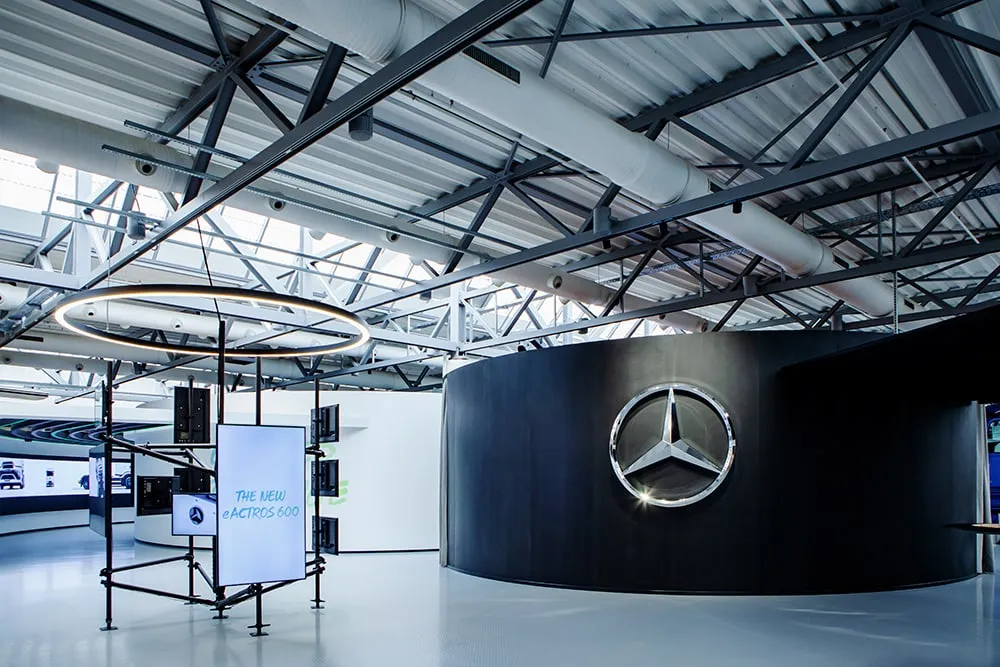
The “eActros 600 Driving Experience” also includes a visit to the eActros 600 Experience World, which opened at the customer centre in Wörth in June 2024. In this state-of-the-art pavilion, Mercedes-Benz Trucks presents its flagship for battery-electric long-haul transport through a range of media formats. Visitors can explore the various aspects of e-mobility and the eActros 600 on large touchscreens, with a focus on comfort & design, cost-effectiveness, energy costs and services such as eConsulting. A 23-metre LED wall on the outside features several films about the eActros 600. The highlight of the pavilion is the vehicle itself, presented in an open semicircle covering 120 square metres, alongside a 40-square-metre LED wall and a lighting installation.
Participants can also view charging stations from various manufacturers in different configurations at the eTruck Charging Park opposite the Customer Center. Mercedes-Benz Trucks experts advise customers here on topics such as hardware, installation, solar energy systems, battery storage systems and intelligent charging management. The eTruck Charging Park also features two Alpitronic ‘Hypercharger’ charging stations for charging the eTruck. ‘Hypercharger’ is the name of the South Tyrolean company’s product line of modular, state-of-the-art DC fast-charging stations. Alpitronic is a strategic partner for the procurement of fast-charging stations, which Mercedes-Benz Trucks recently began offering as part of a comprehensive e-mobility solution.
Daimler Truck is bringing together all its existing and future services for e-infrastructure and electric truck charging under the new TruckCharge brand, including consulting, hardware and digital services. The company aims to offer customers a cost-effective, end-to-end package, from energy generation to vehicle operation, so they can make full use of the potential of electrification. TruckCharge is aimed at truck fleet operators and industrial companies with their own or externally managed truck fleets. As fleets generally include vehicles from different manufacturers, TruckCharge is available regardless of truck brand. Daimler Truck will officially launch TruckCharge at IAA Transportation in Hanover in September 2024.
Series production to begin at the end of 2024
Mercedes-Benz Trucks is in the final stretch of series development for the eActros 600. The “eActros 600 European Testing Tour 2024” is currently travelling through more than 20 European countries to gather extensive real-world experience on a wide variety of routes, across different topographies and climate zones, particularly in terms of energy consumption and public charging. Two near-production prototypes, each with a gross combination weight of 40 tonnes, are covering more than 13,000 kilometres. More than 1,000 firm orders have already been placed for the eActros 600, and the number of letters of intent is also in the four figures. Series production is scheduled to begin at the end of 2024.
[1] The range was determined internally under specific test conditions, after preconditioning, using a 4×2 tractor unit with a gross combination weight of 40t at an outside temperature of 20 °C in long-haul transport. It may differ from the values determined in accordance with Regulation (EU) 2017/2400.
[2] The nominal capacity of a new battery, based on internally defined conditions, may vary depending on the application and ambient conditions.
[3] Based on internal simulations, as a binding and uniform standard for the Megawatt Charging System (MCS) is currently being developed.
[4] With all its assistance systems, Mercedes-Benz Trucks aims to support the driver as effectively as possible within the limits of the system. However, the driver remains fully responsible at all times for driving the vehicle safely, as also stipulated by law.
Question about this story? Ask your question
Keep following this
Get an email when a new story is published. No account needed.
- ThemeTowards low-emission equipment and transport
- SubjectGeneral







