









Keestrack K5e in Frederikshavn: Consistent sustainability
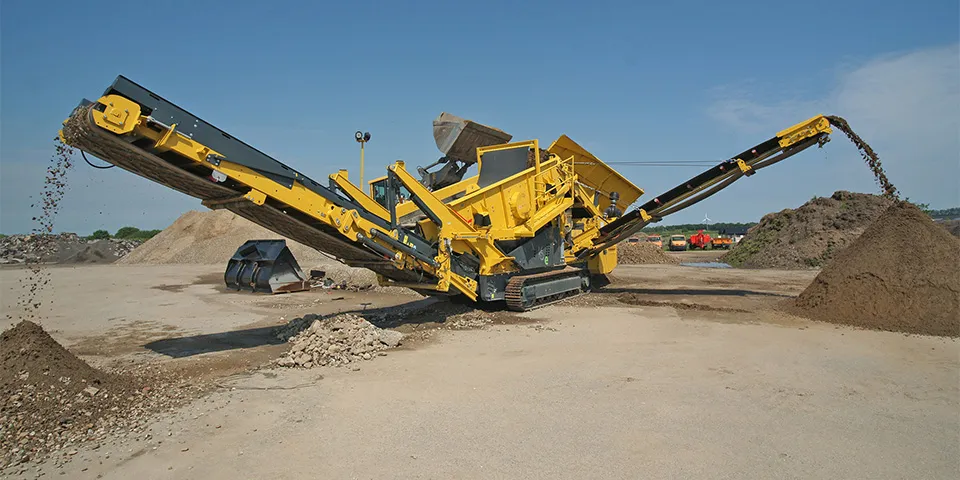
Last year, the civil engineering department of the Danish municipality of Frederikshavn replaced a mobile trommel screen for soil processing with a Keestrack K5e diesel-electric scalping screen with a fully electric plug-in option. Alongside the technical benefits, its great flexibility and equally positive environmental and operating-cost balance made the difference.
The Danish port of Frederikshavn lies in the north-eastern region of North Jutland and is the administrative centre of the municipality of the same name, which stretches for around 85 kilometres along the Baltic coast to Skagen. It is Denmark’s northernmost municipality, where the North Sea and the Baltic Sea meet. The road construction and civil engineering department Park og Vej is responsible for the municipal transport infrastructure, around 1,000 km of roads and 300 km of unpaved roads. Like all other public services, including water, energy and waste, it is organised as an autonomous municipal enterprise.
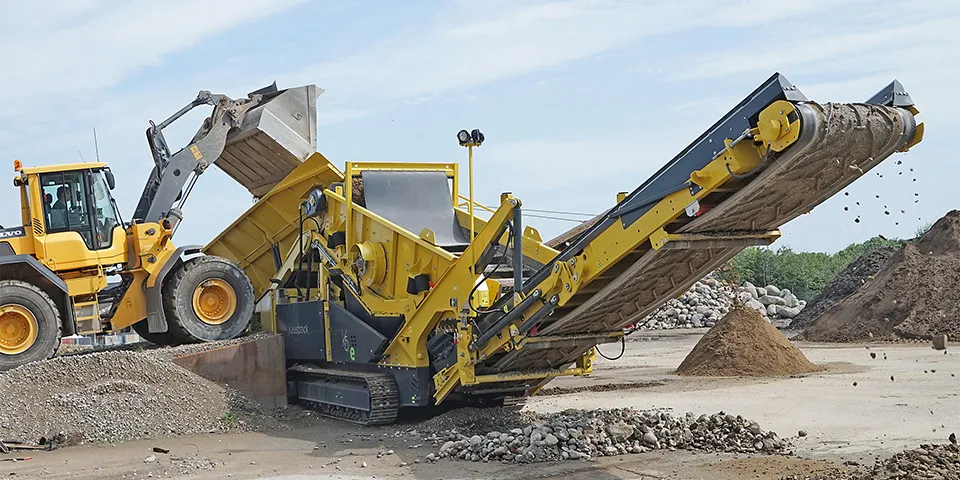
Alongside maintaining and building the road network, recycling construction waste and excavated soil is one of the tasks undertaken by the department’s approximately 130 employees. Including uncontaminated and contaminated materials from private and commercial suppliers, the annual volume processed at the central recycling site in Frederikshavn and the other storage site in Skagen amounts to 15,000 to 20,000 tonnes, according to team leader Gert Christensen, who is responsible for application technology and the machinery fleet at Park og Vej.
Coarse mineral construction rubble (> 20 mm) is temporarily stockpiled at the central site and then periodically processed by a demolition contractor. A further 10,000 tonnes of soil and excavated material are processed each year using the department’s own equipment. Until last year, a mobile 6×2 m trommel screen was in use, but it did not meet key requirements: “Our trommel screen was particularly inefficient when processing soil with large quantities of grass and roots, where we need to separate the vegetation from the soil residue as effectively as possible for composting,” explains Gert Christensen, describing the move to horizontal screening technology.
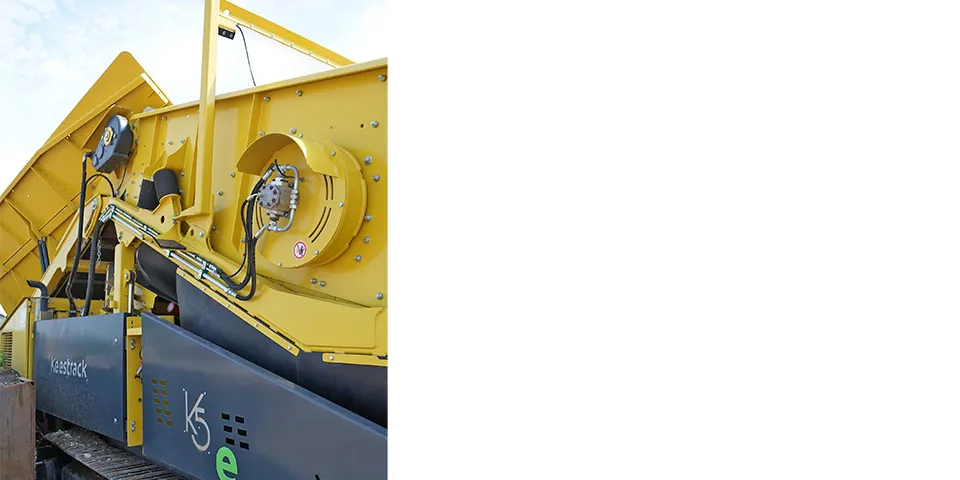
The stationary power supply is provided by a 125 A connection at the central screening site
Environmental considerations also played a part in choosing Keestrack’s mobile K5e scalping screen. “The municipality of Frederikshavn places great importance on environmental protection. When investing in new plants or equipment, their environmental impact is a decisive factor. As well as the technical requirements, we also consider energy efficiency,” says Gert Christensen. The Park og Vej department opted almost immediately for an electric drive concept, but did not want to sacrifice the flexibility of a mobile plant, so that the equipment could be used in a variety of ways at the central site, decentralised storage sites or large construction sites.
“We tested a wide range of options on the market. Keestrack’s fully hybrid diesel-electric plug-in concept seemed to us to be the most advanced. This was not simply a matter of adding an extra engine: the entire process had been electrified with great care. In fully electric operation, all system functions are available without any limitation in performance or functionality. In conventional diesel operation, we benefit from the tracked mobile screen’s independence, with significantly lower fuel consumption and emissions.”
Flexible electric solutions
Weighing around 30 tonnes, the K5/K5e series sits in the “mid-range” of Keestrack’s seven-model scalping screen portfolio. A wide choice of screening media for the 5,000 x 1,500 mm double-deck screen box (effective screening area 7.5 / 6.75 m²) and the hydraulically adjustable screening angle ensure a broad range of applications, from highly efficient scalping of stone to soil processing at capacities of up to 450 tonnes per hour, and from screening construction waste to producing saleable end products in three fractions. Like all Keestrack scalping screens, the K5 series is optimised for transport: all conveyors and other components can be hydraulically folded for transport on a low-loader (transport width 2,600 mm). Once on site, the machine can be put into operation quickly without support legs.
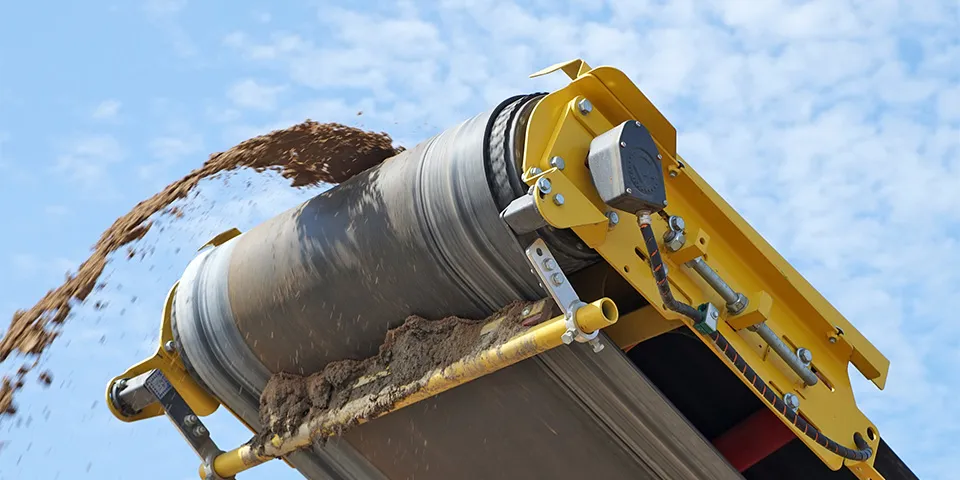
All conveyors are driven by maintenance-free electric drum motors. This shortens the length of the pipework and reduces the risk of leaks during operation.
The same applies to the fully hybrid plug-in version, the Keestrack K5e. At less than 1,000 kg heavier than the diesel-hydraulic model, it is free from transport restrictions. At the heart of the K5e is a built-in 105 kVA generator connected to the diesel engine, which directly supplies power to all electrical consumers, including drum motors, auxiliary equipment and lighting. All hydraulic components, including the apron feeder, screen drive, lifting cylinders and track drive, are powered by a central 45 kW unit comprising an electric motor and a load-sensing hydraulic system.
The diesel-electric drive concept reduces the peak loads typical of diesel-hydraulic systems and contributes significantly to low fuel consumption in diesel operation (Ø: 7-9 l/h). This efficiency can be increased further by connecting other machines downstream via the K5e’s external “plug-out” connection, for example the new fully automatic S1e stacker, a Keestrack dust suppression cannon or a powerful lighting system.
Another advantage of the K5e’s advanced electrification technology is the substantial reduction in pipework and hydraulic oil volume. Pipework is around 40 % shorter, with significantly fewer connections susceptible to wear in bending zones, particularly for conveyors. The oil volume is also considerably lower, at 235 litres compared with 370 l for the purely hydraulic K5 version, resulting in lower operating and maintenance costs and reduced environmental risks.
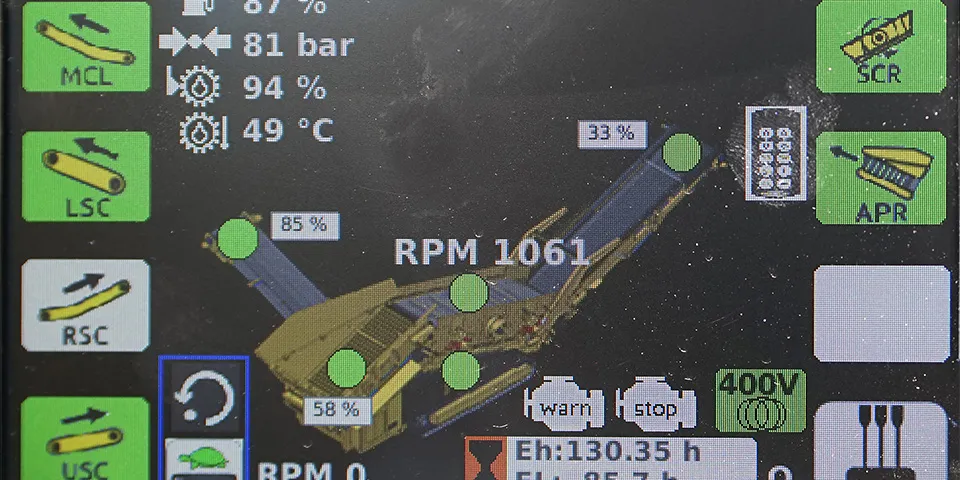
Keestrack’s control system manages the entire energy supply and displays the duration of diesel-electric operation (“Eh”) or fully electric plug-in operation (“EL”) separately.
Connecting the Keestrack K5e to the mains, a standalone generator or a sufficiently powerful upstream crusher’s plug-out connection (connection ratings: 125 A, 400 V, 50 Hz) is straightforward: once the plant is more or less in position, the built-in diesel engine can be switched off. After the 3-phase plug has been connected, the Keestrack control system manages the entire energy supply. Even without starting the diesel engine, the screen can still be moved using the track drive or the hydraulically driven conveyors can be operated.
Proven in practice
Last December, Danish Keestrack distributor TNS Imex of Løgumkloster delivered the K5e to Frederikshavn. Until the electrical supply was installed at the central screening station at the Park og Vej recycling site, the K5e ran on diesel. Since May this year, it has operated fully electrically. In normal operation, the plant is fitted with a 45 mm finger screen on the top deck and a 20 mm square-mesh screen on the bottom deck. For particularly difficult-to-screen materials, such as heavily contaminated sand from street sweepers (around 360 tonnes/year), operators switch to a 40×40 mm mesh on the lower deck.
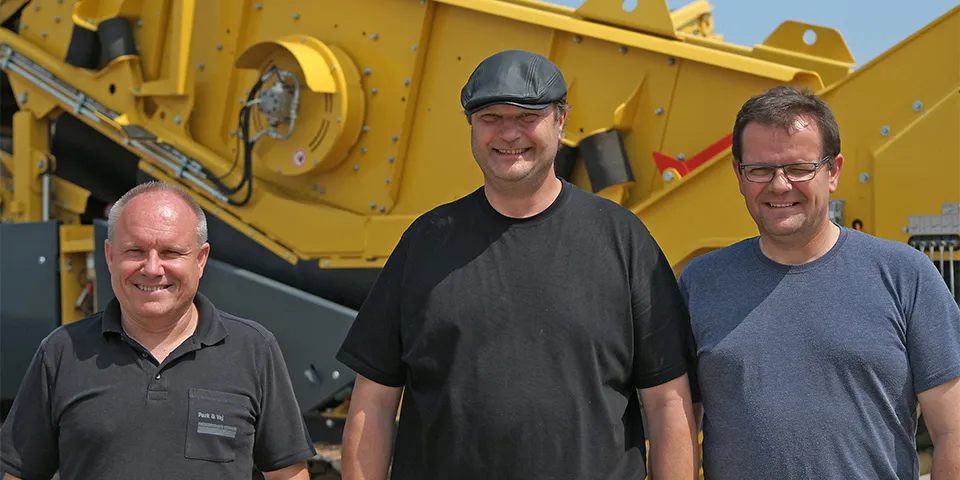
Park og Vej technical manager Gert Christensen with Keestrack distributor Thomas Sørensen of TNS Imex and machine operator Peter Bragaard (from left to right).
For the typical soil processing carried out in Frederikshavn, the K5e reaches a capacity of up to 100 tonnes/hour. This figure varies depending on the material and, in particular, on the availability of the 4.5 m³ wheel loader, which is also used to load lorries. The electric plug-in drive pays off here too: no diesel consumption while idling and no service hours for maintenance-related work. As soon as wheel-loader operator Peter Bragaard selects “stand-by” using the wireless remote control, the plant is back up to speed in no time.
Technical manager Gert Christensen has medium-term consumption assessments. He reports average fuel consumption of 6.61 l/h in diesel-electric operation and average electricity consumption of 23.15 kWh per hour in electric plug-in operation, recorded separately via the controller and, optionally, via the satellite-based Keestrack-er telematics system. Based on local fuel and electricity prices, energy costs in Frederikshavn are already 27 % lower, even without the government subsidy awarded in Denmark for environmentally friendly production processes.
Question about this story? Ask your question
Companies in this story

Keep following this
Get an email when a new story is published. No account needed.
- ThemeOn-site demolition and recycling
- SubjectGeneral
- CompanyKeestrack







