









Fully electric processing at Estonian limestone quarry: zero emissions in the far north
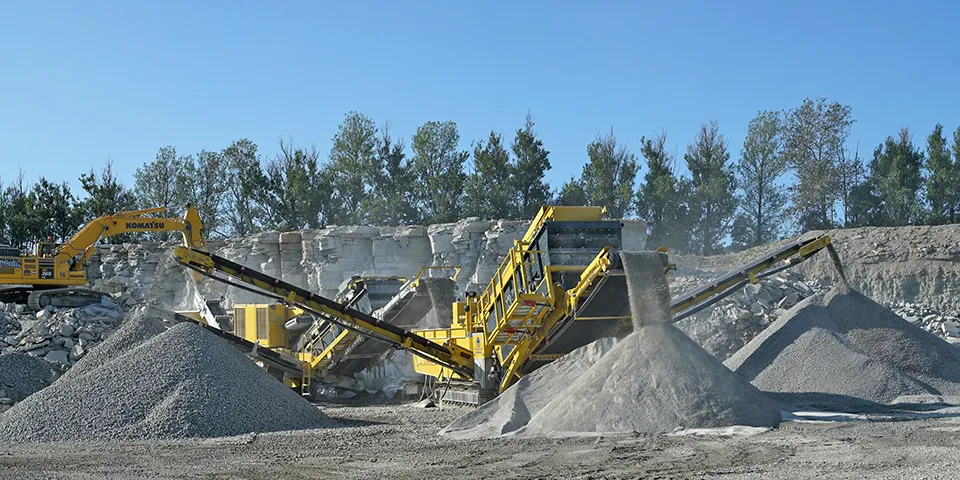
In mid-August, a mobile Keestrack processing line comprising an R6e impact crusher and a tracked, triple-deck C6e fine screening unit was officially commissioned at the Väo limestone quarry, operated by Paekivitoodete Tehas, near Tallinn. With a processing capacity of up to 400 t/h and four separate end products, the two “e” versions, designed for fully electric operation on mains power, impress with their high efficiency and low environmental impact. They also offer the same full flexibility as the diesel-electric hybrid versions.
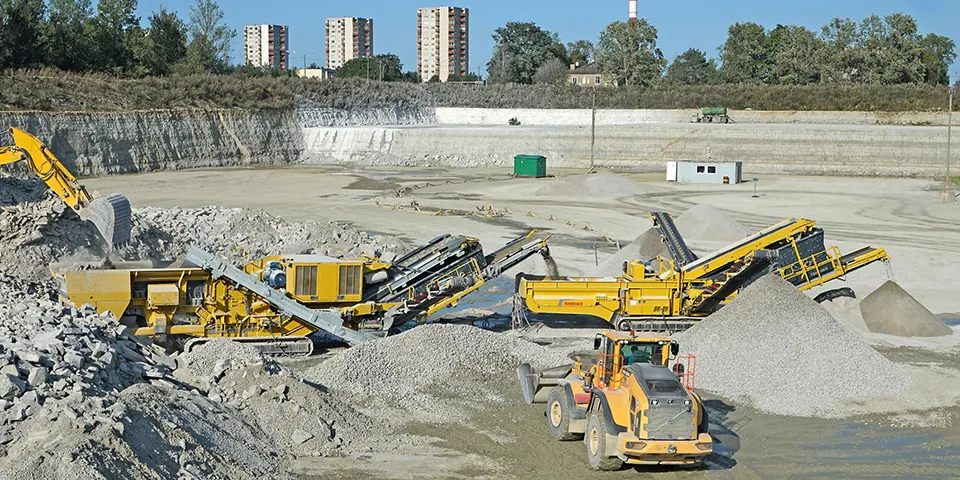
Close to a residential area, the fully electric Keestrack processing line stands out for its low emissions
Substantial domestic market
Since 1959, Paekivitoodete Tehas, Estonian for “limestone factory”, has supplied high-quality minerals and aggregates to Estonia’s roadbuilding and construction sectors. After 1989, the former state-owned company was gradually transformed into a private enterprise. Under the leadership of its long-serving managing director, now Chairman of the Board and majority shareholder, Vladimir Libman, it grew into one of Estonia’s leading building materials suppliers. Today, the Väo and Maardu quarries, both located close to the capital Tallinn, supply up to 20 per cent of Estonia’s annual demand for crushed aggregate, with a combined extraction volume of around 750,000 tonnes a year. Together with washed sand and gravel recovered from the limestone extraction waste, which has a high filler content or contains clay and marl impurities, and the company’s recycling activities, total production is around 1.2 million tonnes a year.
Limestone is found close to the surface along the Baltic coast, in narrow bands 5 to 6 metres wide. In the past, the company processed the rapidly advancing extraction using three decentralised, stationary processing units with a combined capacity of 400 t/h. Transporting the unprocessed feed material and the intermediate and finished products generated heavy traffic from rigid trucks. However, this inefficient approach became problematic as the extraction area, with its associated dust and noise emissions, moved ever closer to Lasnamäe, a residential district of Tallinn with around 120,000 inhabitants that was also expanding rapidly.
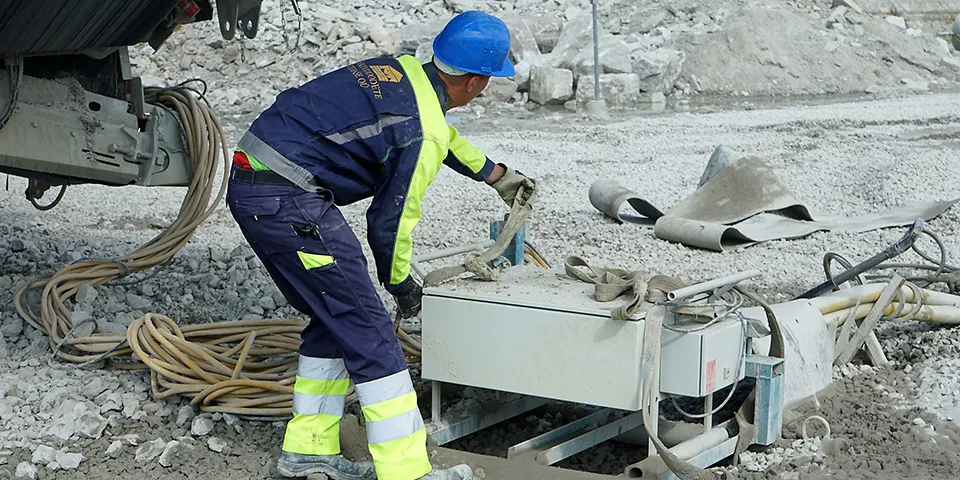
The control cabinet is positioned at the R6e to connect the complete crushing and screening line.
Investment in efficiency and environmental protection
To minimise the impact of quarrying operations, projected over seven years at current production levels, the company uses low-emission technologies wherever possible across its 176-hectare site (250 ha in total). Instead of using explosives, 95 % of the limestone is extracted with hydraulic breakers. Further investment in modern machinery and equipment with low emissions and noise levels is intended to reduce the impact even more.
The comprehensive modernisation of the processing technology, together with the optimisation of production processes, was therefore primarily aimed at protecting local residents and reducing the overall environmental impact. To replace the existing installations, the company opted for a mobile processing line that could operate directly in the extraction area, both at the main Väo site and during temporary operations at the smaller Maardu quarry, around ten kilometres away (approx. 150,000 tonnes/year).
After researching the market for several months, including all the major international suppliers, the management chose Keestrack’s technical solution: a tracked Keestrack R6e impact crusher combined with a mobile, triple-deck Keestrack C6e fine screening unit. The entire project was overseen by Ing. Johann Prüwasser, CEO of Keestrack Engineering, the Austrian design and development division of the Keestrack group: “Like the other suppliers, we faced a major challenge in achieving the required high processing capacity of 375 t/h from 0/800 to 0/63, while optimally distributing the end products 0/4, 4/16, 16/32 and 32/63. The feed material is not only high in quality but also very hard. We were able to match the crushing characteristics of the heavy-duty 1300 impact crusher exactly with the R6e, particularly in terms of the high rotor speed required. With the independent double-deck screen box and recirculation of the oversize fraction, we can now achieve a high feed rate of 250 t/h <32 mm for the coupled C6e screen and produce well over 30 % 4/16 as the main end product, as requested by the customer,” explains Johann Prüwasser, describing the results of several days of on-site adjustment.
Ultimately, however, it was primarily the advanced diesel-electric drive concept of the Keestrack “e” versions, with the option of plugging into the local power grid, that proved decisive. “We were able to provide the fully electric operation requested by the customer at the Väo quarry, while retaining all the benefits of our proven tracked technology.” Two 200-metre cables from the specially installed 400 V transformer station in the quarry now supply power to the Keestrack R6e impact crusher and the coupled C6e fine screening unit. The screen is connected directly to the crusher via a power and communication cable, enabling data exchange between the machine control systems.
Powerful electric motors drive the crusher (250 kW) and the hydraulic system’s pump units for the central installation (R6e: 90 kW, C6e: 45 kW), as well as the electric conveyor drives and auxiliary equipment, ensuring completely emission-free operation. If the processing line needs to be moved as extraction progresses, both machines are simply disconnected from the mains and follow the excavator under their own power, using their integrated diesel engines/generators. The independent diesel-electric drive also ensures cost-effective temporary operation at the Maardu quarry, further aided by the Keestrack processing line’s transport-optimised total weight of just under 95 tonnes (R6e: approx. 62 tonnes, C6e: approx. 32 tonnes).
Since the middle of this year, work teams of 3 operators (excavator/wheel loader/processing line) have been meeting the target of 3,000 tonnes a day, in one long shift or, alternatively, two shorter shifts. This represents a considerable saving compared with the original three-shift set-up, which required a total of 15 workers. Average fuel consumption for the complete system in combined diesel-electric operation is a modest 80 l/h, or 0.2 l/t at full load, resulting in total production costs of € 0.58 per tonne of end product. In fully electric operation (approx. 1 kwh/t), the total cost falls to just € 0.42 per tonne. According to Keestrack, cheaper mains electricity reduces operating costs by almost € 100,000 a year compared with diesel-electric operation. The reduction in polluting emissions on site is also substantial: fully electric operation alone cuts climate-damaging CO2 emissions by around 400 tonnes a year. This figure does not take into account the elimination of truck traffic.
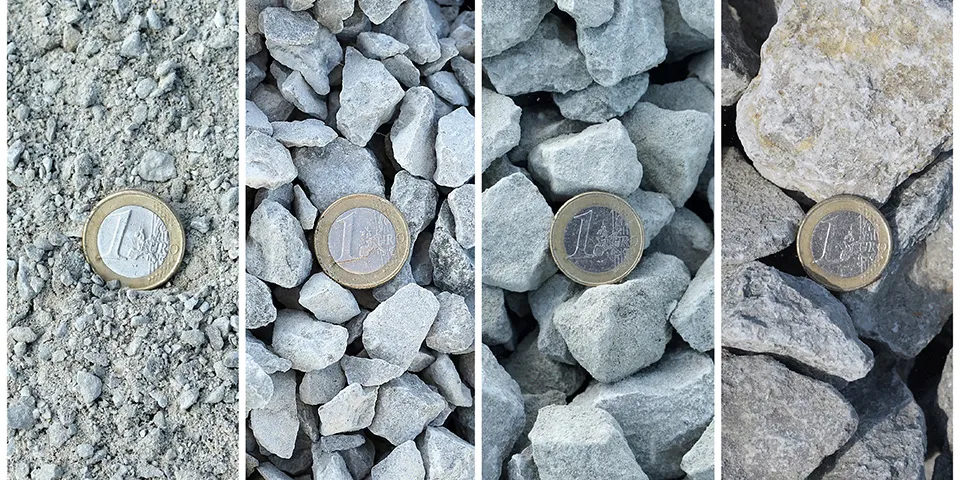
The Keestrack processing line produces four separate end products directly at the quarry, with particle sizes of 0/4, 4/16, 16/32 and 32/63. More than 30 per cent falls within the customer’s specified main fraction of 4/16.
Satisfied partners
The significance of the completed modernisation project, with a total investment of almost € 1 million, was also reflected in the attendance of numerous senior political and business representatives at its official inauguration. The project was funded to the extent of 35 % by the Estonian Environmental Investment Centre (EIC), using European Regional Development Funds. The satisfied customer is now becoming part of the international Keestrack network: from 1 September, Paekivitoodete Tehas will officially take on the role of new sales and service representative in Estonia and neighbouring Latvia.
Question about this story? Ask your question
Companies in this story

Keep following this
Get an email when a new story is published. No account needed.
- ThemeOn-site demolition and recycling
- SubjectGeneral
- CompanyKeestrack







