









Daimler Truck puts its new and further-developed safety assistance systems through intensive testing
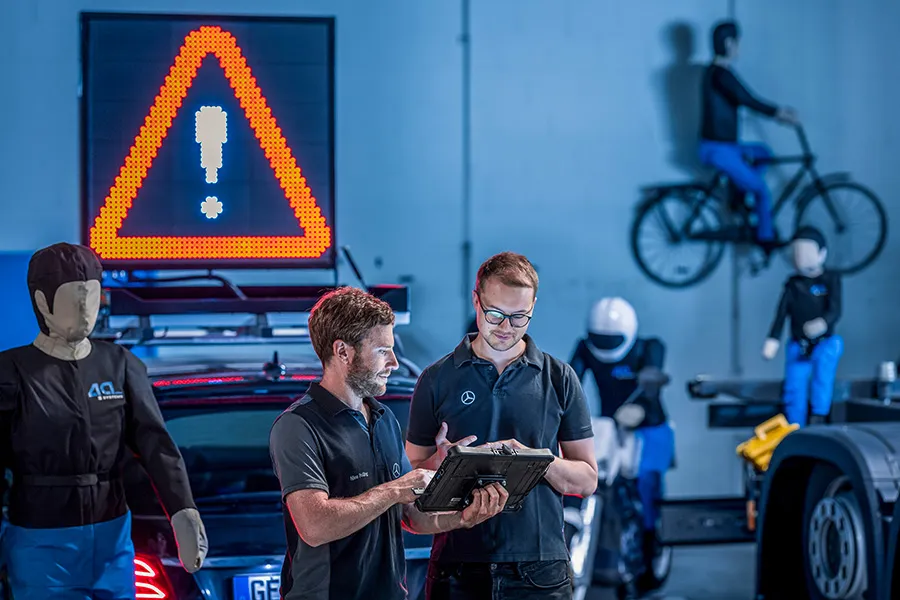
Whether it is an emergency stop at the tail end of a traffic jam, improving safety when turning right and changing lanes, reducing the risk of skidding when cornering or taking evasive action, or many other applications, safety assistance systems can help professional drivers manage many sometimes challenging situations on the road more effectively and ideally avoid accidents or at least minimise their consequences. Daimler Truck has long been a pioneer in this field. For decades, the company’s development and test engineers have been working to provide drivers with the right functions to support them as effectively as possible in their work, thereby further increasing the safety of all road users.
Daimler Truck had already fitted numerous systems across its various model ranges long before they became a legal requirement, including under the EU Commission’s current General Safety Regulation (GSR) 2019/2144. Since 6 July 2022, the regulation has required additional systems to be fitted as standard to new vehicle types, and from July 2024, in a phased introduction of advanced systems, to all new registrations.
One thing is certain: assistance systems must be thoroughly tested before they can enter series production. Daimler Truck carries out such tests throughout the year, particularly at its Development and Test Centre (DTC) in Wörth am Rhein, as well as in Finland, Spain and Japan, and at Daimler Truck North America’s test track in Madras, Oregon. Up to 60 Daimler Truck vehicles worldwide undergo continuous testing throughout the year. From 2020 to the end of 2023, around five million kilometres will be driven to validate the systems.
Niyazi Mustafa Üstertuna, Head of Software & Electronics at Daimler Truck: ‘Tests like these in Wörth are fundamental to our work. We use the results and findings to continuously optimise existing driver assistance systems and develop new safety features, from the small Atego to the Special Trucks and buses. Our new systems, which also prove themselves under extreme conditions, are being improved even further.’

Setting new standards
The recent extensive tests at the centre focused primarily on driver assistance systems that will be used in Daimler Truck’s various trucks and buses from April 2024. These include Active Brake Assist (ABA) 6, the new Frontguard Assist, Active Sideguard Assist (ASGA) 2, Active Drive Assist (ADA) 3 and Traffic Sign Assist. With these systems, Daimler Truck is once again underlining its pioneering role in this field and setting new standards for safety. In addition to the Actros, eActros and Atego from Mercedes-Benz Trucks, the test vehicles include buses from Mercedes-Benz and Setra, as well as special trucks such as the Econic and Unimog.
For example, tests assess how and when ABA 6 warns of and brakes for a cyclist or motorcyclist who suddenly crosses or appears in the lane in front of the vehicle, as well as for another vehicle at the tail end of a traffic jam. They also examine how the new Frontguard Assist gives drivers visual and audible warnings about vulnerable road users directly in front of the truck, particularly in hectic situations, such as when pulling away or at junctions. Tests also look at how Active Sideguard Assist (ASGA) 2 responds when turning right if a pedestrian or cyclist is alongside the vehicle, and how Active Drive Assist (ADA) 3 automatically steers the truck back into its lane if, for example, the driver moves left to overtake but has failed to notice a vehicle approaching from behind.
270-degree sensor fusion technology
The tested assistance systems are based on a new electronic platform and the associated sensor fusion, which combines radar and camera data to provide an even wider view to the front and sides. The electronic platform offers 20 times more data-processing capacity, while the six sensors fitted in total, four short-range radars at the front and rear, on the right and left, one long-range radar in the centre at the front, and the multifunction camera in the windscreen, now cover a 270-degree angle around the vehicle. The considerably wider field of view allows the already effective assistance systems to make even better use of their capabilities. At the same time, Daimler Truck’s safety assistance systems go well beyond GSR requirements in many areas. ABA 6, for example, can actively intervene with braking and, at speeds of up to 60 km/h, can brake not only for stationary vehicles but also for road users crossing, approaching from the opposite direction or travelling in the same lane.
High-tech equipment and detailed planning
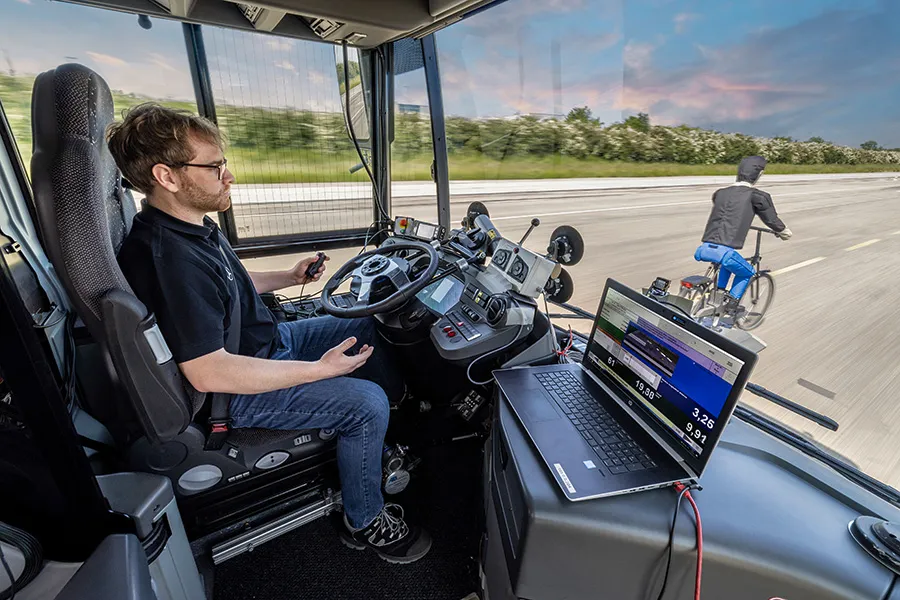
State-of-the-art equipment is available for the applications, which are reproduced countless times in real-world tests on the EVZ test track in Wörth. This includes vehicles fitted with extensive high-tech measurement equipment and steering and accelerator robots, as well as GPS-controlled dummies and targets. Before the actual use cases are tested, the sensors required for the effectiveness of the assistance systems are assessed in component tests, and the functions are tested in software-in-the-loop tests. In addition, vehicle integration tests and system tests are carried out across the various model ranges and models.
At the EVZ, a wide range of scenarios, such as the end of a traffic jam, overtaking manoeuvres and turning scenarios, can be simulated in a secure environment. These take place on different road profiles that reflect roads around the world. In this way, test vehicles can be exposed to the same conditions they might encounter in South America, South Korea, Africa and, of course, Europe.
Test drives on public roads are also always an important basis for validating the systems and functions, and for preparing safety-critical data for measurement purposes. They help push the various systems in the model ranges and models to their limits on closed test tracks and explore their dynamic driving limits. Daimler Truck’s development engineers also examined the vehicles’ functions and systems, for example during the journey to the winter tests in Finland in early 2023. These included lane-change assistance as part of Active Curve Assist and active lane guidance with Active Drive Assist in the Actros L. As the route crossed several national borders, it was also possible to measure the effect of country-specific lane markings, traffic signs and digital map data on the performance of the assistance systems fitted in
Question about this story? Ask your question
Keep following this
Get an email when a new story is published. No account needed.
- ThemeConstruction transport on road and site
- SubjectGeneral







