









Büscher builds brand-new house using 75% recycled concrete and demolition waste
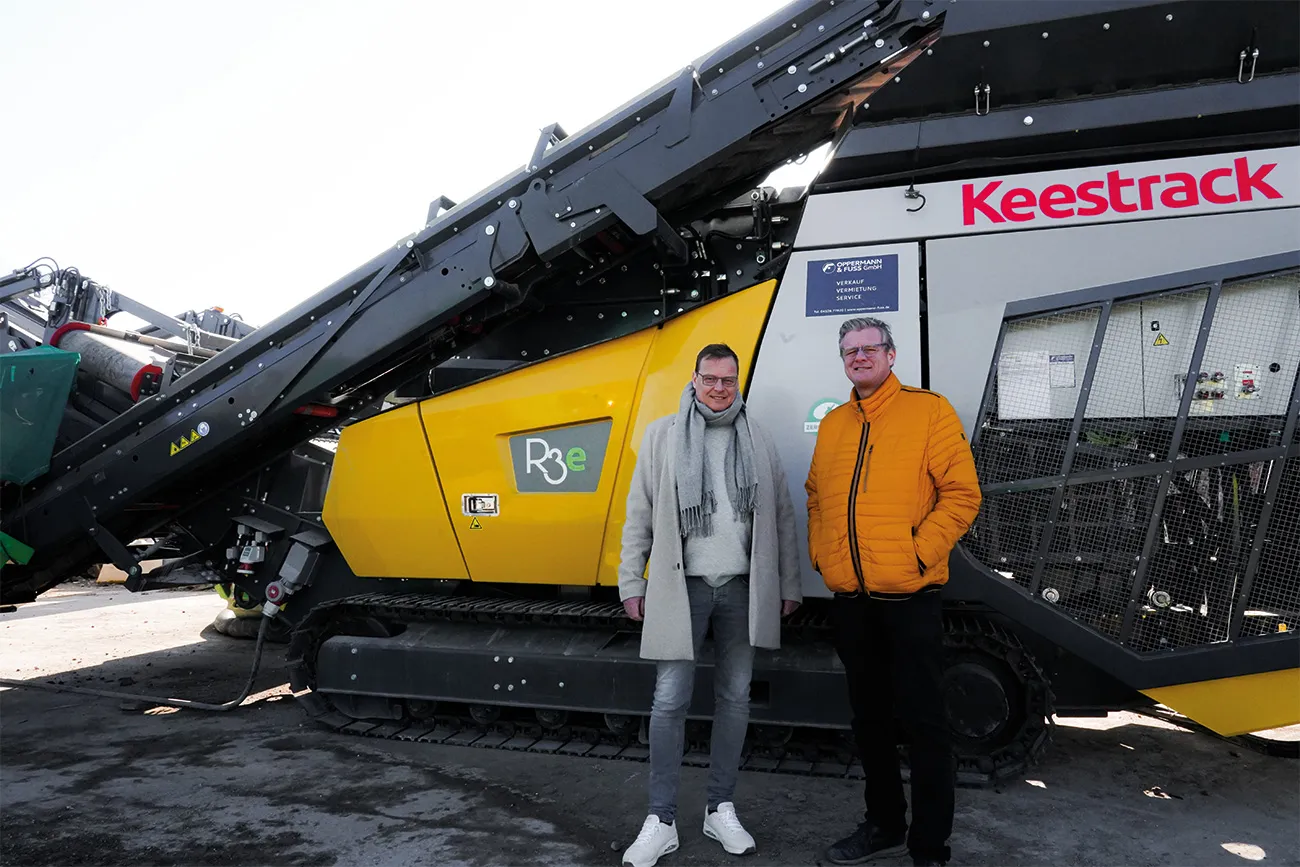
Recycling at its finest. Transforming demolition waste into sustainable building materials through fully emission-free electric crushing and screening with Keestrack.
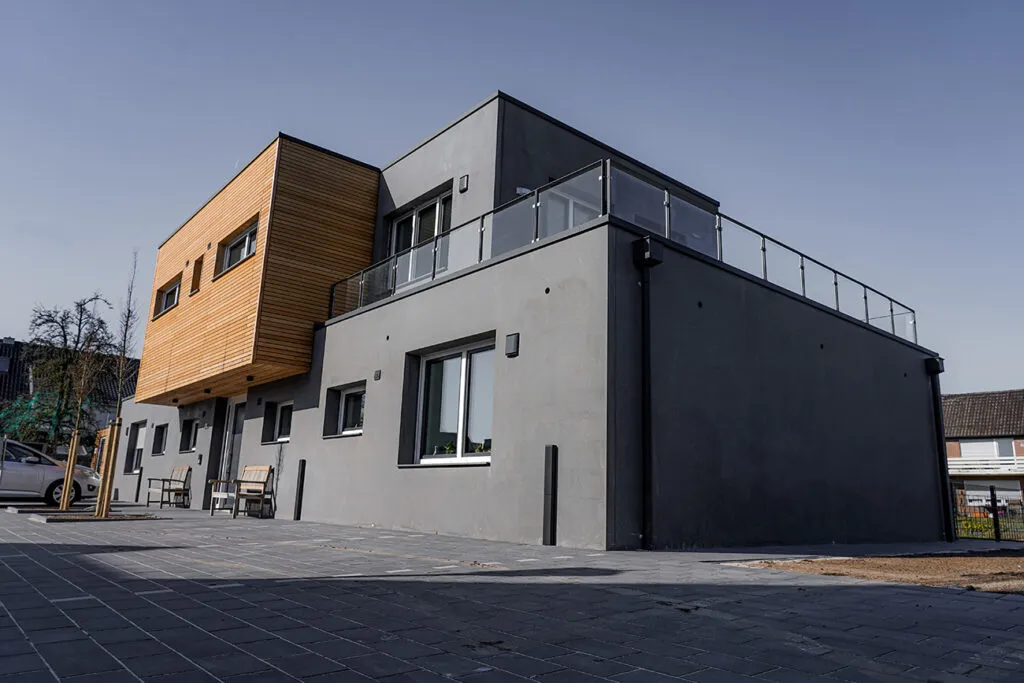
The German company Büscher was founded in 1961 as a ready-mixed concrete plant, before expanding its activities to include services such as skip hire. Today, all these years later, Büscher is the first company in the world to build a complete house using 75% recycled concrete and demolition waste. The load-bearing and non-load-bearing internal wall elements consist of 100% recycled aggregates.
The company not only proved that it was possible, but also obtained technical approval from the Deutsches Institut für Bautechnik (DIBt). The German Federal Association for Building Materials authorised the use of up to 100% recycled aggregates, including crushed Type 3 sand, in precast load-bearing and non-load-bearing internal wall elements in exposure classes XC1 and X0 (dry).
A new concrete mix
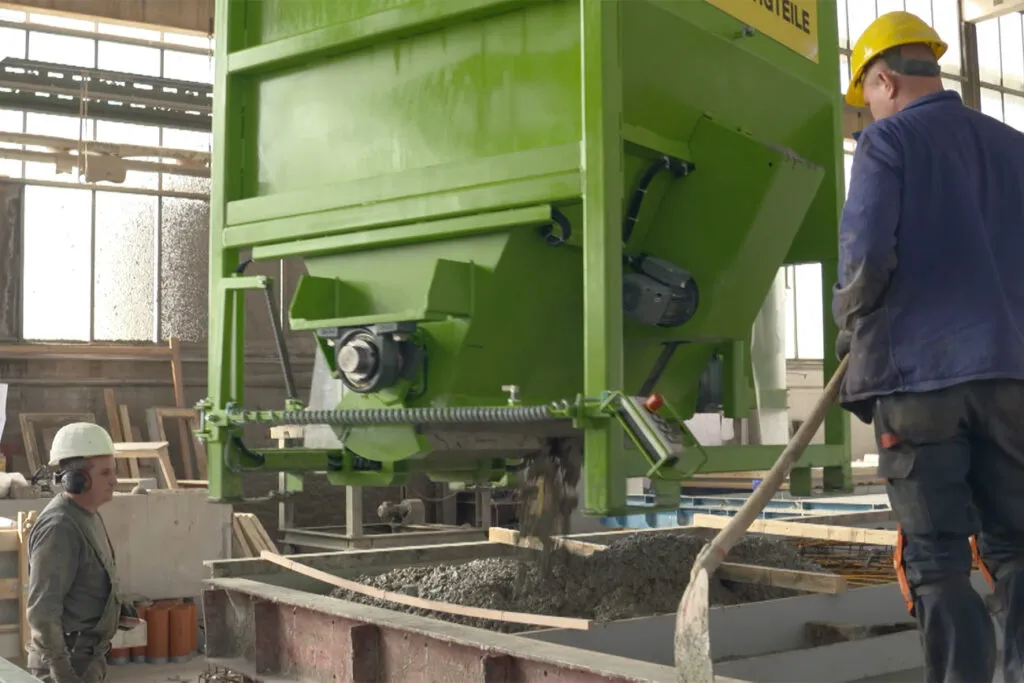
In 1961, Büscher made concrete like everyone else, using gravel, sand, cement and water. Today, the recipe has changed: sand and gravel have been entirely replaced with 100% construction and demolition waste (C&D waste) to produce precast load-bearing and non-load-bearing internal wall elements. The external walls are not made from recycled materials.
Through its skip-hire services, Büscher received a large volume of C&D waste, which it would normally recycle into aggregates for road construction. As this material was difficult to sell and available in large quantities, brothers Wolfgang & Hans-Jürgen Büscher began looking for ways to reuse it. This led them to the idea of using the material as a raw material for precast concrete and precast concrete elements.
It was a great sustainable idea, but convincing specialists in the field and the relevant authorities that it could be the way forward proved difficult. Getting 100% precast concrete certified was a major challenge. It ultimately took 8 years of research and development to obtain technical approval, as most people did not believe it was possible. “Concrete specialists, laboratories and certification experts had serious doubts about whether it was possible. Everyone said it was impossible and even illegal,” says Wolfgang Büscher.
Büscher asked researchers at laboratories and universities to establish scientifically what the material could and could not do. The company gave them the parameters for what it wanted to achieve with the material, then had them investigate whether it would pass the tests.
“All the scientific research has now been completed, and it has been demonstrated exactly what is possible with 100% recycled precast concrete and precast concrete elements. The new material works perfectly, and Büscher is now using the new mix,” says Hans-Jürgen Büscher.
Prof. Dr.-Ing. Wolfgang Breit of the Technical University of Kaiserslautern concludes: “The quality is good because Büscher has taken the right steps to ensure the acceptance of construction and demolition waste, the processing of the material and its use in precast concrete and precast concrete elements.”.
The main advantage of this certified production process is the efficient use of resources. The company uses low-cost C&D material that is available locally in large quantities to produce a sustainable, climate-neutral product with lower CO2 emissions. It also saves on transport costs because the material available on site can be reused. “No expensive raw materials are used, so the finished products are also cheaper. It’s a genuine win-win situation,” says Thomas Overbeeke, Operations Manager at Büscher.
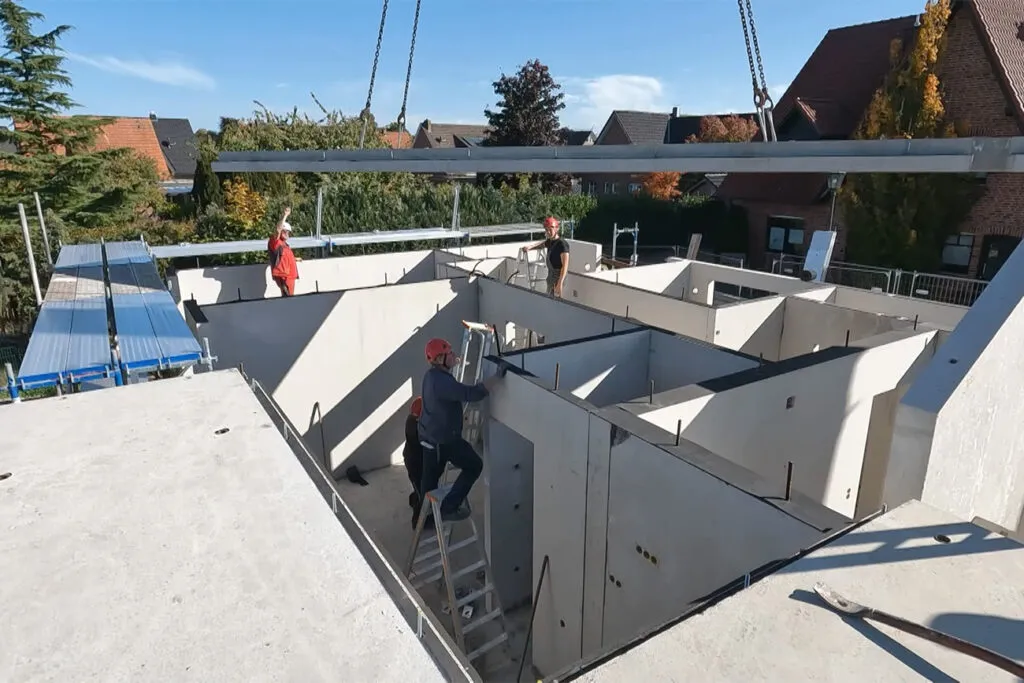
It took 8 years of scientific evidence to demonstrate that a house can be built sustainably from entirely recycled material, and at a lower cost. But it took just 4 months to build the complete 3-family home using precast elements ready for painting. The services and electrical wiring are all integrated into the smooth-surfaced precast panels, so no plastering is required. Now, for the first time, a house has been built using 100% recycled natural mineral substitutes in its load-bearing and non-load-bearing internal wall elements. And when it is time to demolish it, it will be recycled into new concrete using the Büscher method. A perfect example of the circular economy!
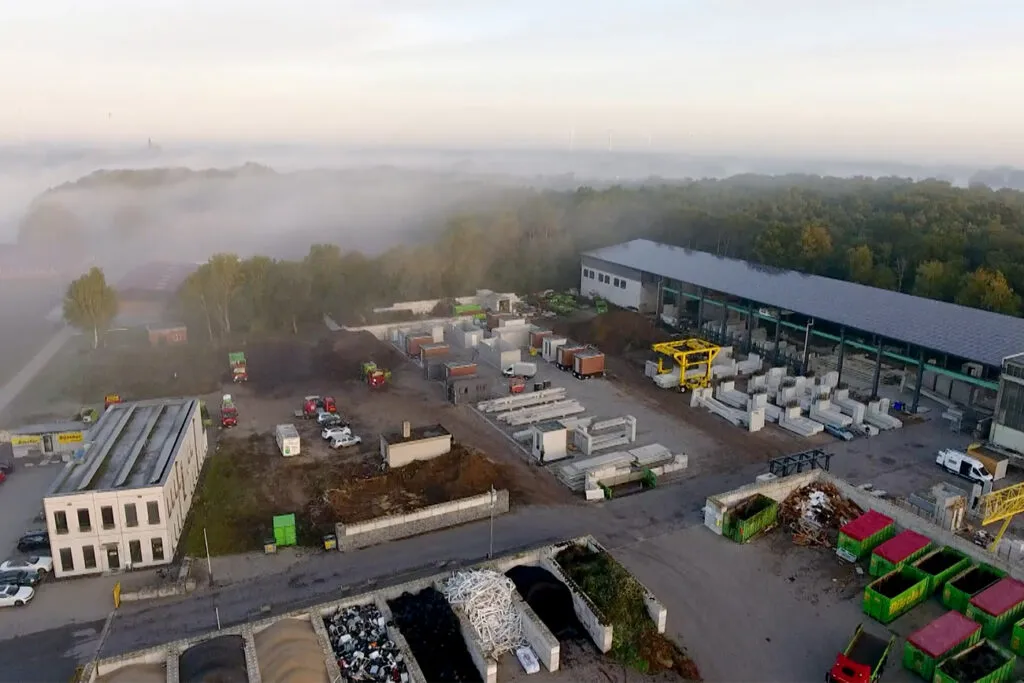
It is clear that Büscher is minimising its environmental footprint and working to close the material loop as part of the circular economy. This is also why solar panels supply the factory and recycling site with green energy. The decision to use Keestrack crushing and screening plants was also driven by this principle. Oppermann & Fuss, Keestrack's distributor in Germany, advised Büscher on which ZERO equipment would best suit its applications and capacity. Choosing the right options is also essential for this specific application.
Zero-drive
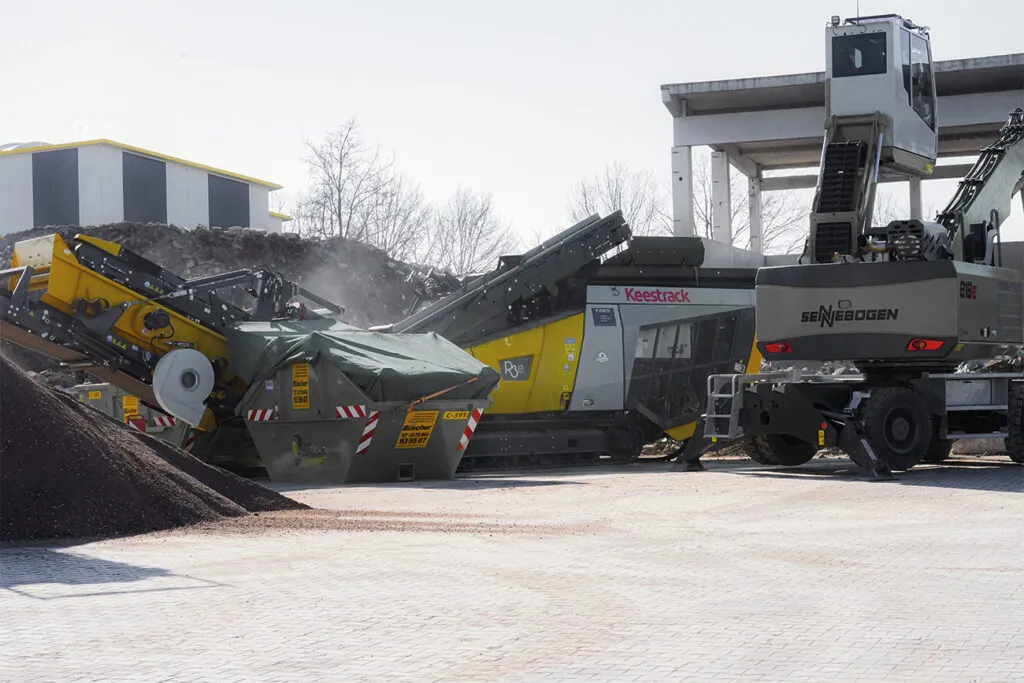
Naturally, a sustainable product must be made using sustainable production equipment. As the Büscher site is equipped with solar panels that provide up to 323 kW/h of renewable electricity, this green energy is used to power both the concrete plant and the Keestrack R3e ZERO impact crusher and K4e ZERO screening plant. Both Keestrack machines are powered entirely by renewable electricity and have no combustion engine on board.
As their electric motors drive most of the mobile crushing and screening equipment, as well as several essential hydraulic systems, both Keestrack machines operate with no CO2 emissions. Keestrack is known as an innovator and pioneer in electrically powered equipment. Most of the Keestrack product range is available with ZERO-drive.
When the R3 and K4 are connected to the power grid, as they are at Büscher's recycling site, where renewable energy from photovoltaic solar panels is used, they operate with net-zero emissions. Energy consumption will be around 152 kWh. Operating and maintenance costs will fall dramatically because there is no combustion engine on board requiring maintenance.
R3e ZERO impact crusher and K4e ZERO screening plant
The innovative technology, safety features and design of the R3 impact crusher have already won several European design awards, including the Red Dot Award. The highly compact and easily transportable impact crusher is available with diesel-hydraulic drive, electric plug-in drive (with integrated back-up diesel generator) and ZERO-drive (fully electric plug-in drive without a back-up generator), and has a maximum capacity of 250 tonnes/hour.
Büscher chose the ZERO versions to minimise environmental impact and achieve net-zero emissions using its own solar power.
The R3e ZERO is equipped with a vibrating feeder and a 1,200 mm x 920 mm pre-screen to optimise crushing results and minimise wear, a feed opening of 770 mm x 960 mm (HxW), a rotor diameter of 1,100 mm and a rotor width of 920 mm. The crusher, fitted with a closed circuit comprising a recirculating conveyor and a 3,100 mm x 1,400 mm post-screen, produces aggregates to a defined size. The integrated air classifier removes plastic, wood and paper contaminants, while the overband magnet separates metals. The R3e ZERO weighs 32 tonnes and supplies power to the connected 28-tonne K4e ZERO via its 125 A plug-out connection.
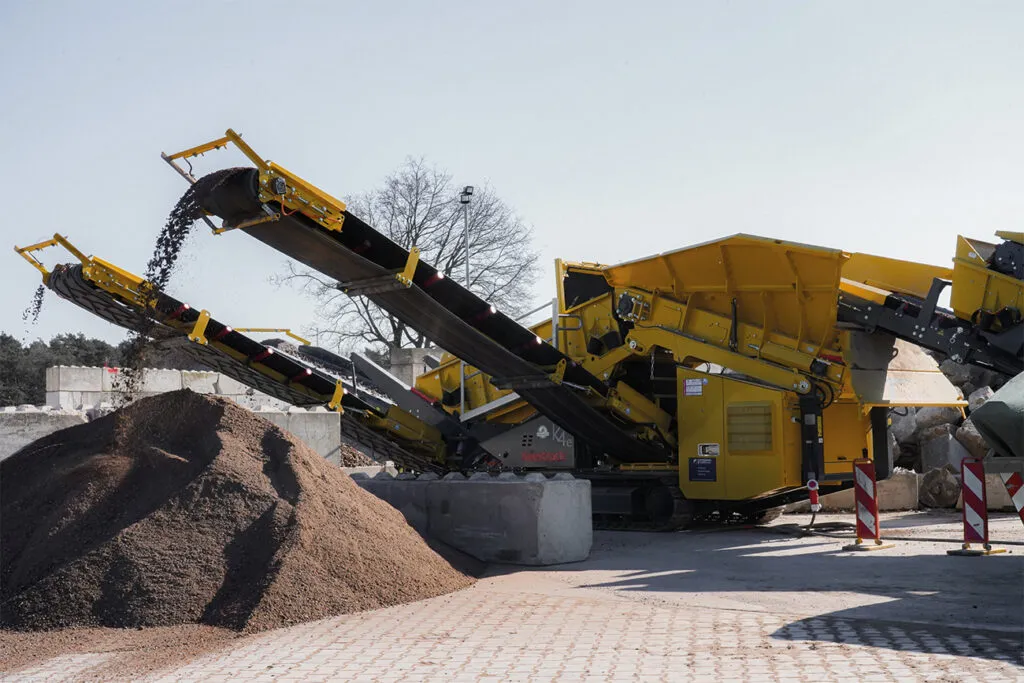
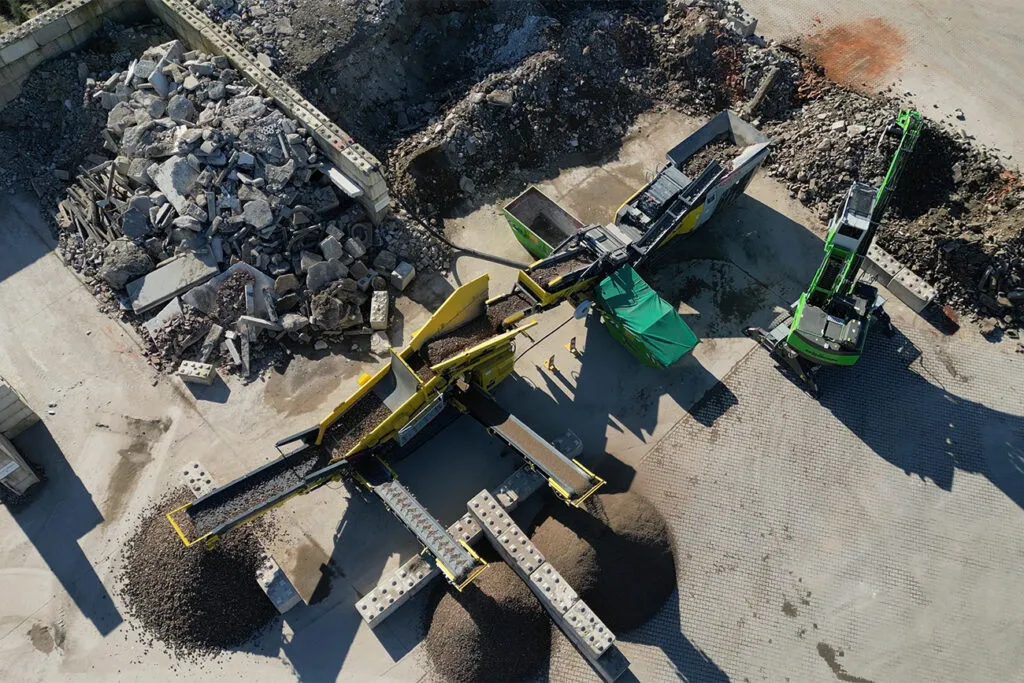
The K4e ZERO delivers high productivity, with a maximum capacity of 350 tonnes/hour. Its 4,200 mm x 1,500 mm double-deck screenbox, standard heavy-duty plate feeder and hydraulically adjustable screening angle ensure particularly high screening capacity. The many available options and screen decks make the K4 suitable for any job. At Büscher's recycling site, the conveyors for the fine and medium fractions were positioned on the same side of the screen to improve access for the wheel loader.
Every Keestrack plant is designed to provide good access for servicing, keeping maintenance and repair times to a minimum. However, as Keestrack ZERO machines have no combustion engines on board, maintenance requirements are significantly reduced.
Both Keestrack machines at Büscher are equipped with remote controls, allowing both the crusher and the screening plant to be operated from the excavator. They also have an integrated water spray system that can be used when production is too dusty. In addition, both are equipped with a Keestrack-er UMTS system. This telematics software system provides real-time data and analysis. It allows you to see where your machines are and whether they are being used correctly. All aspects of a machine can be monitored, and software updates can be carried out remotely when needed. Diagnostic tests can be run on all components, including the feed hopper, screen, crusher, engine and conveyors. Keestrack-er also offers additional maintenance planning features from Oppermann & Fuss, helping you keep your machines in optimum condition for longer.
Een zakelijke vraag aan Keestrack? Get in touch
Companies in this story

Keep following this
Get an email when a new story is published. No account needed.
- ThemeOn-site demolition and recycling
- SubjectGeneral
- CompanyKeestrack







