









Bauma puts zero-emission construction sites in the spotlight
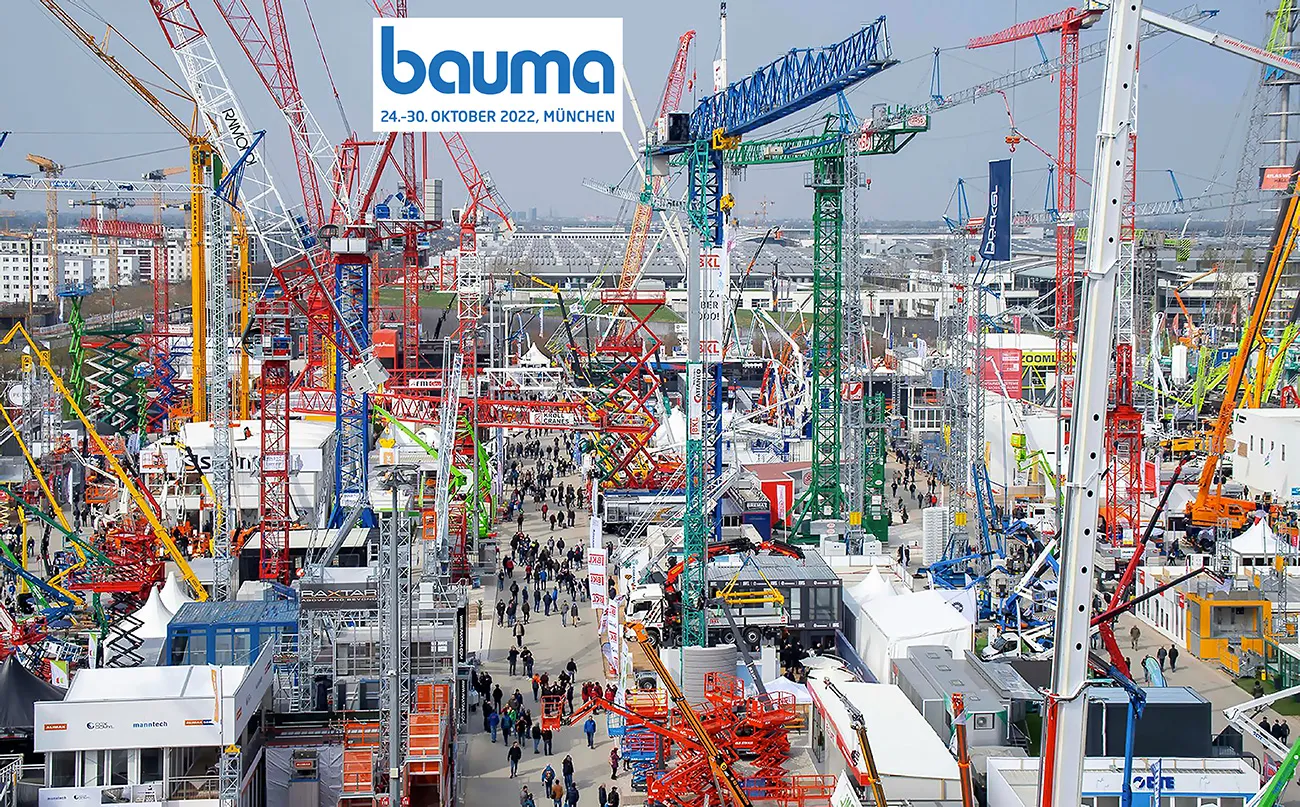
Those who stayed away were wrong to miss the world’s largest equipment trade fair
The Bauma equipment trade fair, held every three years, took place at the end of October this time, rather than in April as usual, because of Covid. After the extra-long wait, the more than 3,100 exhibitors from around the world were keen to unveil their latest innovations. And with good reason: most of them focused on electrifying machinery. What is genuinely new is that several large machines are now also available with zero-emission powertrains.
Bauma 2022 was once again sold out, as usual, with the total exhibition area across the halls and outdoor grounds covering around 85 football pitches. Visitor numbers were slightly down on 2019, as expected, with Russian and Chinese delegations largely staying away. The same was true of some very well-known brands.
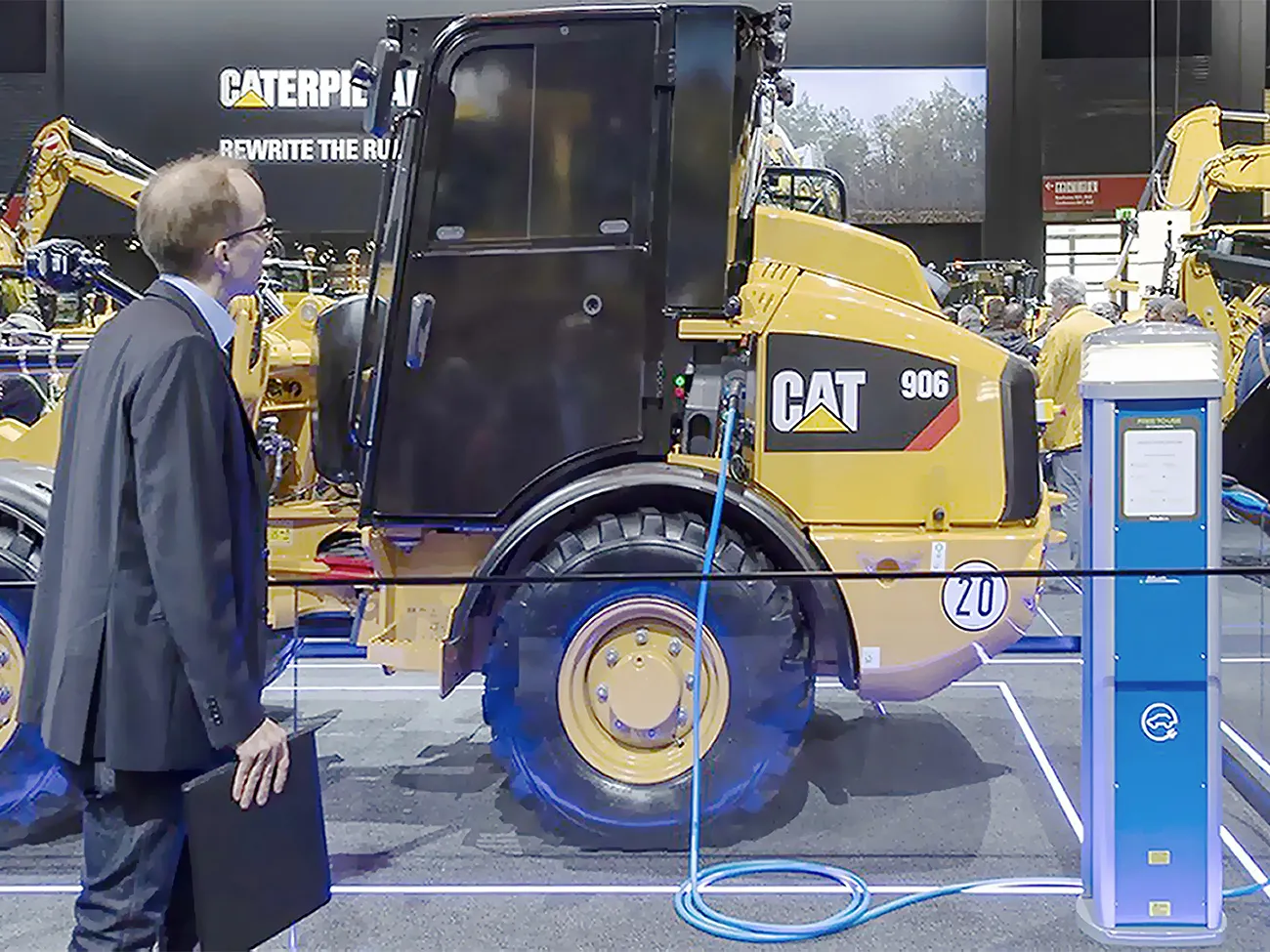
A question on many people’s lips was whether Caterpillar would be at Bauma. The answer was surprisingly twofold: no, Caterpillar was not there. But all Caterpillar machines were on display, as Zeppelin Baumaschinen, Caterpillar’s dealer in Germany, put on an extensive showcase. Volvo Construction Equipment, Caterpillar, JCB, JLG Industries, Metso Outotec and CNH Industrial, known for brands such as Case and New Holland, also skipped this year’s show, often because they have found other ways to stay in touch with their customers.
Some brands, notably, chose to go bigger than ever. Liebherr expanded from 60 to 70 exhibition spaces, while the stand of Japan’s Tadano was “bigger than ever” following its 2019 acquisition of Terex’s Demag mobile crane business. German formwork and scaffolding specialist Peri went one better, hiring an entire 4,200-square-metre exhibition hall, both for a range of live demonstrations and for lively evening events.
Electric machines are getting bigger
The demand for zero-emission construction sites has driven a huge wave of innovation, as was clear at Bauma. This innovation is focused first and foremost on electric machines. One striking feature is that it increasingly involves larger machines, built as electric models straight from the factory rather than converted. The range extends from mid-sized excavators and wheel loaders to imposing cranes, drilling rigs, material handlers and more. It is a welcome and exciting development after the wave of electric mini excavators and compact loaders in recent years.
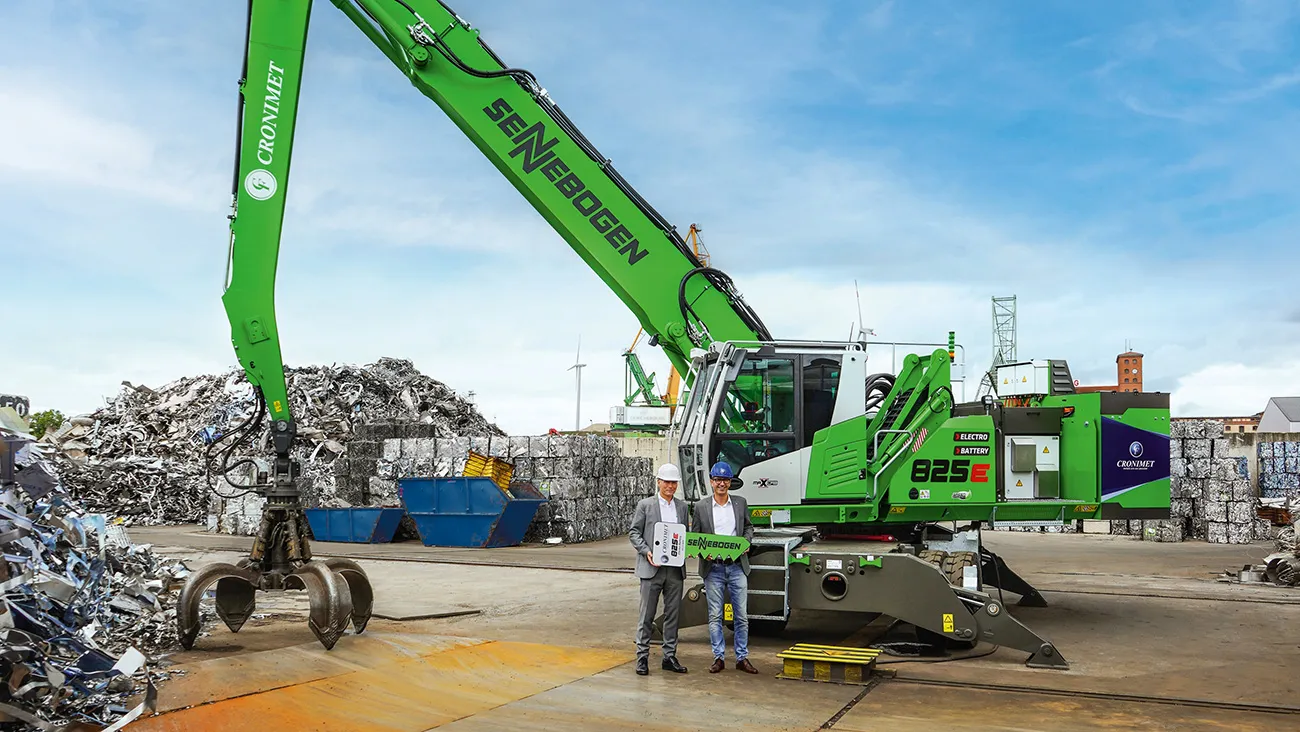
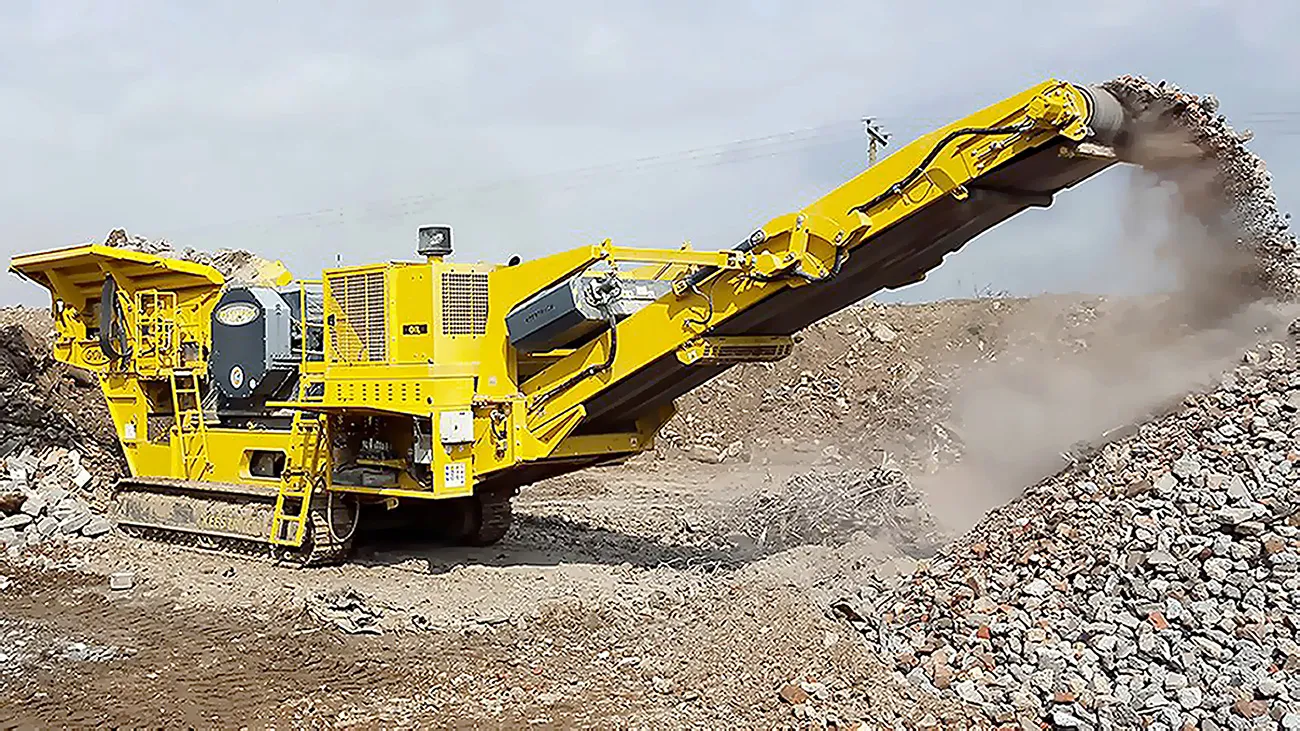
We are also seeing more (partly) electrically powered machines in the recycling sector. Sennebogen, for instance, developed the 30-tonne 825 Electro Battery material handler with project partner Cronimet, while Keestrack is also making its mark. Under the rallying cry “Join the e-volution”, the move to fully electric drive is gaining momentum, via hybrid systems.
Mecalac presents a complete ecosystem
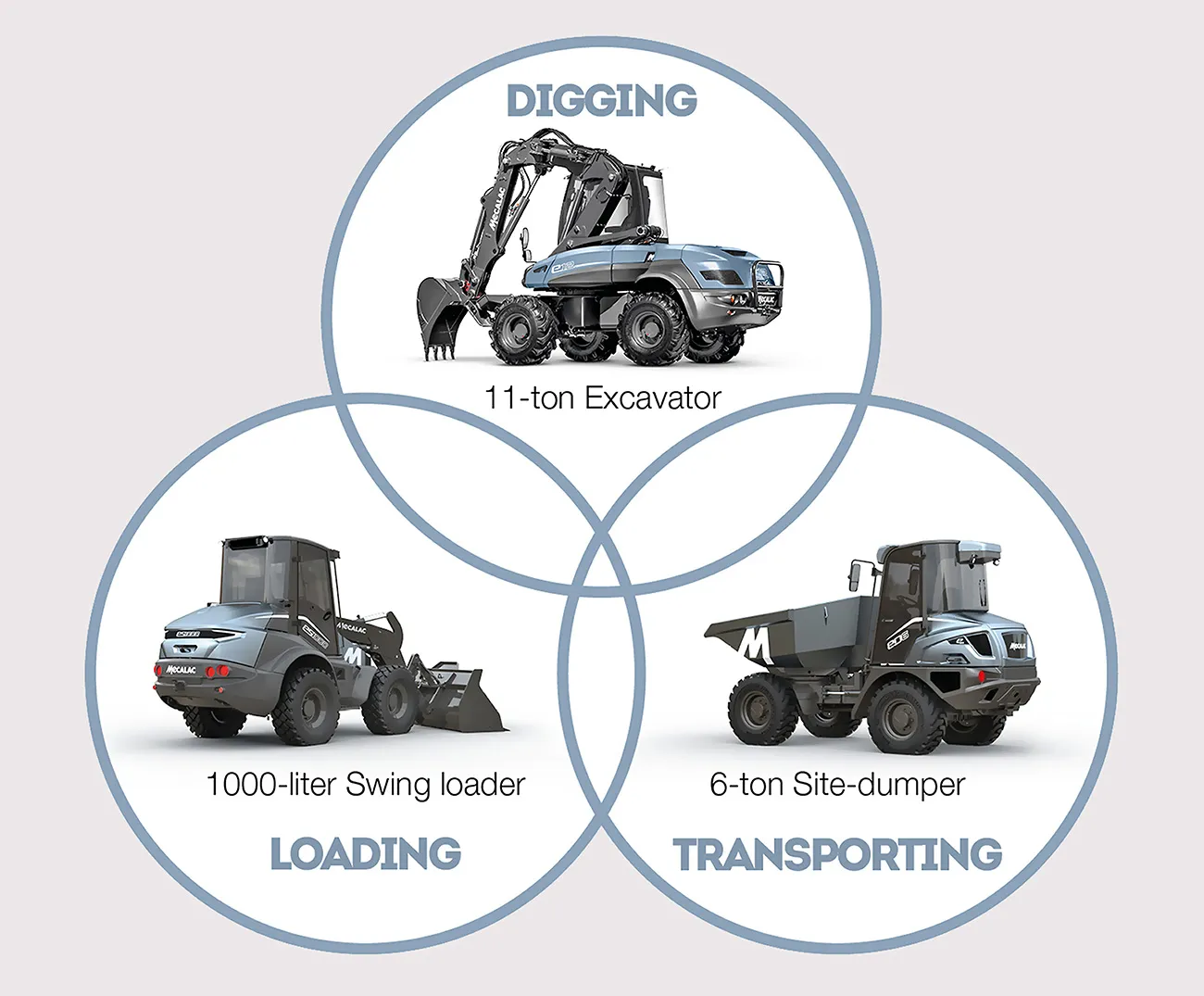
French manufacturer Mecalac presented a complete ecosystem of complementary electric machines. It comprises the 11-tonne e12 wheeled excavator, the es1000 swing loader with its 1,000-litre bucket, and the 6-tonne ed6 wheeled dumper. The ecosystem is supported by M-Power, a high-power on-site charging solution. According to Mecalac, the three mid-sized machines are “the right size for urban construction sites”.
Bobcat’s electric compact track loader debut
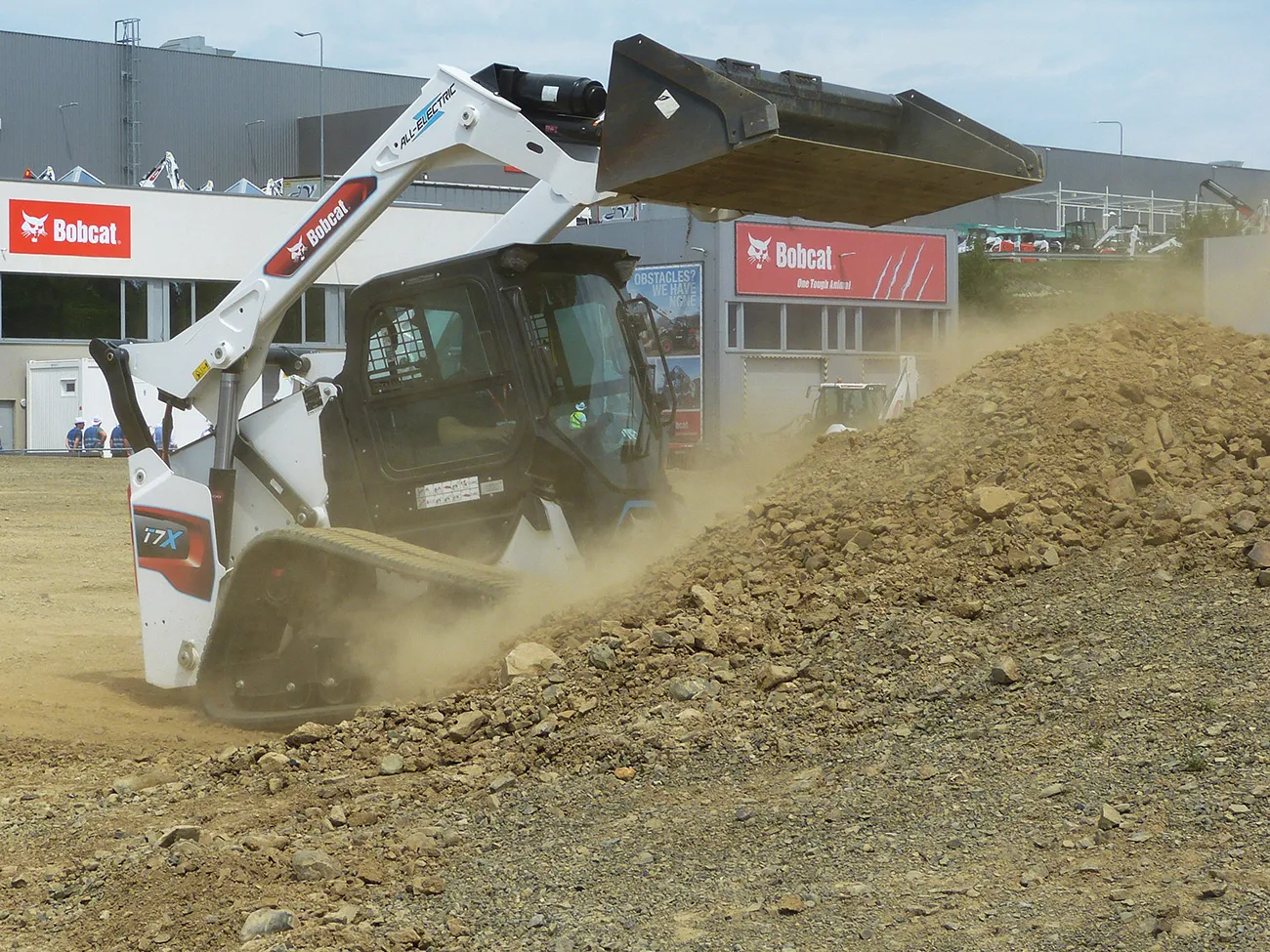
The T7X electric compact track loader was an exciting first from Bobcat. Its 62 kWh lithium-ion battery can keep it working continuously for up to five hours, thanks to its load-sensing power management system. One interesting feature is that the machine contains almost no fluids, apart from one litre of environmentally friendly coolant.
More exciting (small) innovations
Zeppelin showed four prototypes of the electric machines Caterpillar is still working on, which were also on display at its stand in 2019. It is still unclear when they will be available. The line-up comprises two excavators and two wheel loaders, each designed to work for six to eight hours on a single charge.
Among other things, Hitachi marked its 50th anniversary in Europe with the ZX55U-6 EB, a compact 5-tonne battery-powered excavator with a short tail swing, making it well suited to indoor use. It can run on battery power or be connected to mains electricity.
At Bauma, Manitou rounded off its media campaign on electric power with a preview of no fewer than seven new electric models.
Komatsu presented its first electrically powered wheel loader, as well as the immense PC4000-11 electric mining excavator, as part of its mission to meet the global CO2 emissions reduction targets set for 2030 and 2050.
Gomaco Corporation Inc. surprised us with the first electric slipform paver, the CC-1200e. It can pave concrete for eight hours continuously and is remotely controlled.
Exciting cranes and drilling rigs
Making construction sites emission-free cannot be achieved by converting mini excavators alone. Emissions from large cranes, drilling rigs, piling rigs and similar equipment also need to be brought under control. Progress is already being made on that front.
Electric 80-tonne crawler crane
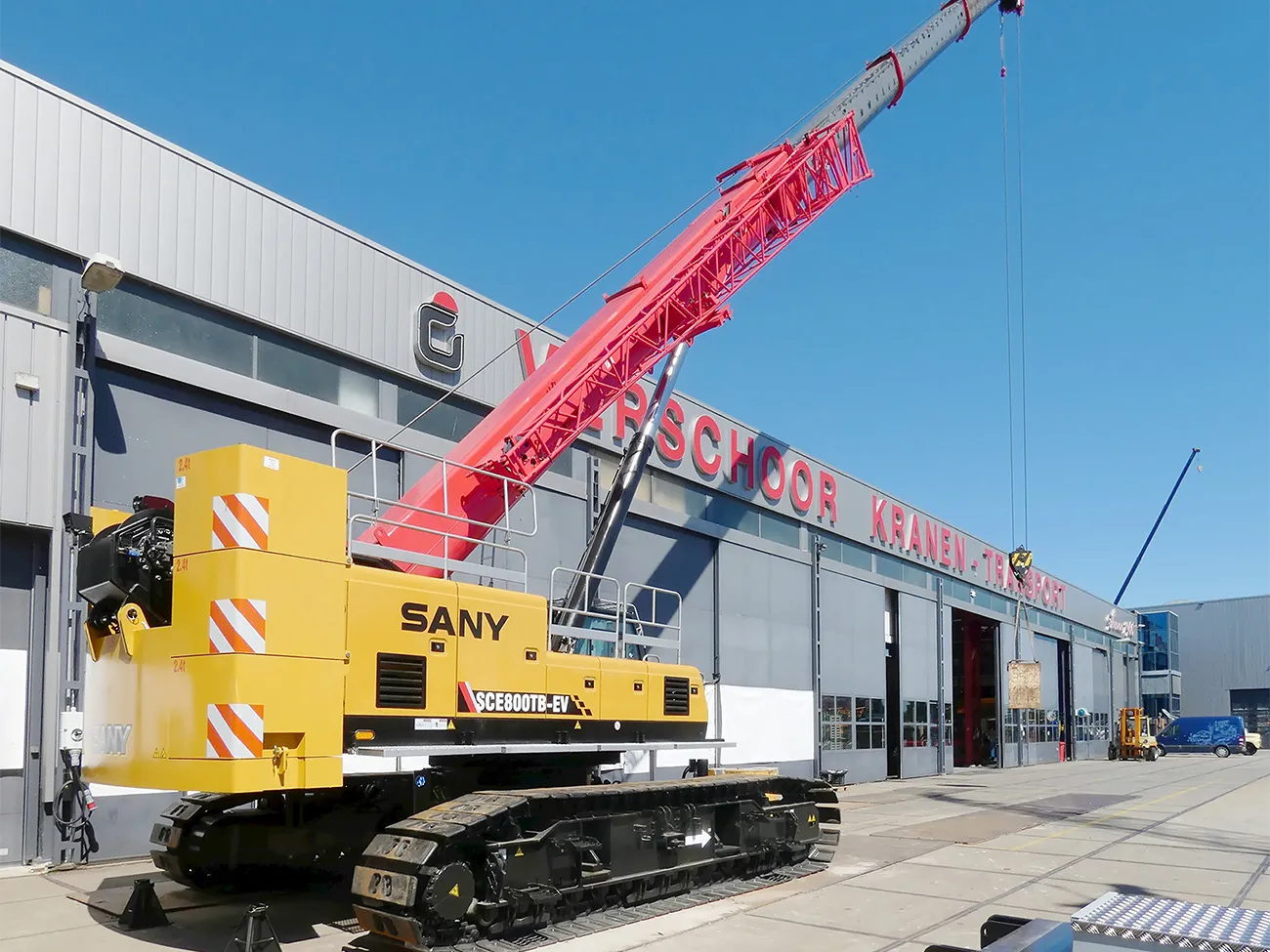
At Bauma, Japan’s Sany unveiled the SCE800TB-EV, the world’s first fully battery-powered telescopic crawler crane. This 80-tonne machine has a four-section main boom that extends to 47 metres. Its diesel engine has been replaced by a water-cooled 282 kWh LFP (lithium iron phosphate) battery and a 206 kW electric motor. This makes it not only more environmentally friendly, but also quieter and more powerful. A key advantage is its ability to work continuously for 8 hours. It can be charged using standard AC or DC power. AC charging supports multiple charging modes at 16A/32A/63A/125A. DC fast charging at up to 240 kW enables a full charge in 2 hours.
Interchangeable battery boxes
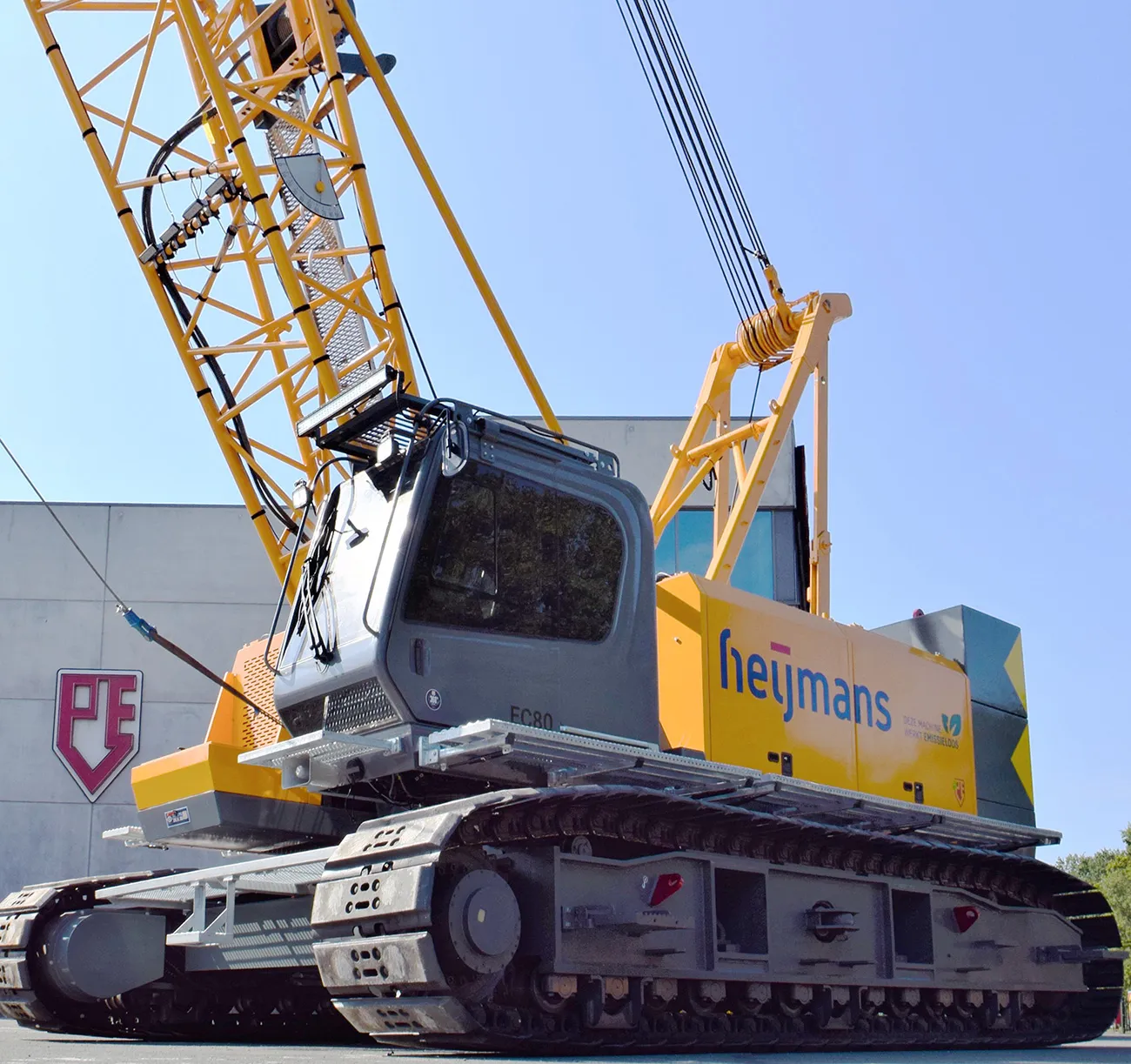
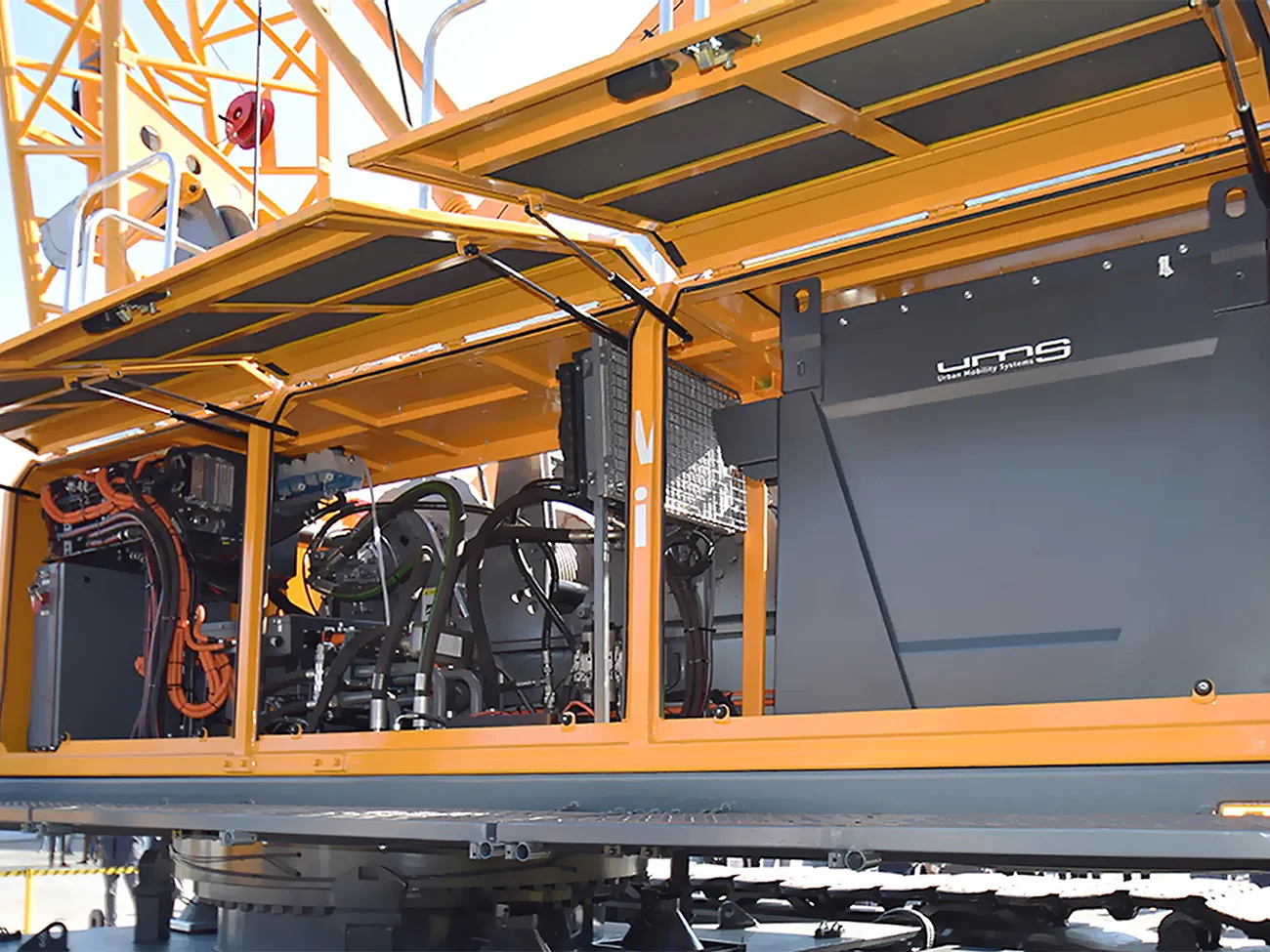
It can hardly be a coincidence that PV-E Crane also presented the EC80 as a new product at Bauma, an electric 80-tonne crawler crane with a lattice boom. It is, after all, a popular weight class. A notable feature is the powertrain developed by Urban Mobility Systems (UMS), with interchangeable 130 or 195 kWh battery boxes. These are charged at an external charging station, enabling continuous operation. The first EC80 and the comparable 160-tonne EC160 have already been sold to Dutch contractors. Two series are planned: the telescopic-boom models (ECT) will have lifting capacities of 65, 70, 80 and 120 tonnes. The lattice-boom models (EC) will have capacities of 80, 90, 100, 135 and 160 tonnes. PV-E Cranes is now also working on an impressive 250-tonne electric model.
Liebherr: “Zero emission, full power”
The climate revolution calls for construction powertrain concepts that reduce greenhouse gas emissions. Liebherr is therefore launching six new ‘unplugged’ machines. Their electric drive does not require a local power socket, and the battery power is designed to deliver the same performance as conventional machines. The line-up comprises the LRH 100.1 and LRH 200 piling rigs, LB 25 and LB 30 drilling rigs, and LR 1130.1 and LR 1160.1 crawler cranes.
A genuine Bauma first is a three-axle mobile crane with a hybrid drive. The LTC 1050-3.1 retains a conventional Stage IV diesel engine, which can run on HVO, for both road travel and crane operations. Once it reaches the worksite and is connected to the electricity grid, the newly developed power unit with its 72 kW electric motor comes into play.
Drilling rig, vibratory hammer and power pack
At Bauma, Dieseko drew attention with three substantial new products. The first is the Woltman 90DRe electric drilling rig, developed with a customer. Its unique premise is electrification based on capacity requirements, for which a patent application has been filed. It weighs around 100 tonnes and has a 36 m leader. The second new product is an electro-hydraulic vibratory hammer. This proved challenging to develop, so the company was proud to present the PVE 24VMe vibratory hammer, with a 24 kgm eccentric moment and variable moment. The third is the electro-hydraulic eHPU power pack. The PVE 600e uses independent oil flow systems (600 l/min at 320 bar), powered by four electric motors.
Hyundai unveils fuel cell excavator
While almost all brands are focusing on electrification, Hyundai Construction Equipment is taking a different approach. The 14-tonne HW155H concept wheeled excavator is powered by a hydrogen fuel cell. According to the South Korean manufacturer, this is better suited to larger construction machines than lithium-ion batteries. Hyundai has gained practical experience with hydrogen-powered commercial vehicles over many years and is convinced that hydrogen will play a leading role in renewable energy in the long term. The machine emits only water. Hydrogen is stored in high-pressure tanks to the right of the cab. The HW155H can operate continuously for 8 hours. Its tank can be refilled in around 20 minutes.
Question about this story? Ask your question
Companies in this story

Keep following this
Get an email when a new story is published. No account needed.
- ThemeTowards low-emission equipment and transport
- SubjectGeneral
- CompanyKeestrack







