









bauma 2019: the big ‘everything is changing’ show
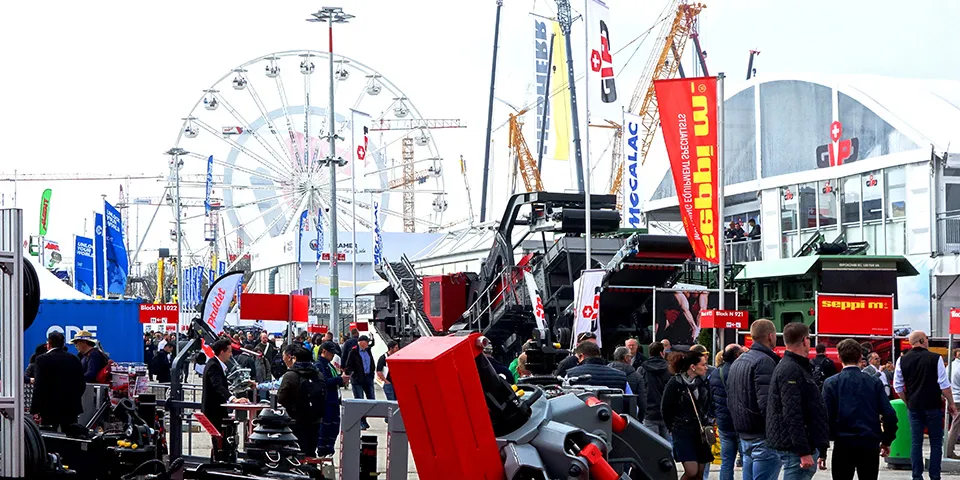
Caterpillar was already talking this spring about ‘rewriting the rules of the game on the construction site’. At the trade fair in Munich in early April…
This spring, Caterpillar was already talking about ‘rewriting the rules of the game on the construction site’. At bauma, the construction equipment trade fair held in Munich in early April, this was very much a topic of conversation, in many different forms. It also featured prominently at press events hosted by leading brands. There were, of course, plenty of prototypes, and we got to see fully operational electric machines. And naturally, all the brands are starting to deliver their Stage V machines. The environment cannot wait. But that was no longer the real news. This edition focused on connectivity, or machines communicating with one another, as well as the autonomy of tomorrow’s machines.
Machines are no longer simple, stand-alone devices. Operators are no longer solely in charge of their machines. If the signs are anything to go by, that era will be over within a few years. Autonomy is on the horizon: machines will increasingly operate themselves, doing the work faster and often better than they do today. Remote operation for work in difficult or even dangerous conditions will become standard.
At Komatsu, the international trade press was shown a charming video of an operator asleep. While his eyes were still closed, his excavator woke up on site. Right on time, and with a clear instruction: get to work. At home, the operator, who woke a little later, could see on his mobile phone how much progress had been made. He then poured himself another cup of coffee. Dear reader, this is how one of the world’s largest construction equipment manufacturers, Japan’s Komatsu, sees the future of construction machinery. A real eye-opener.
With its Smart Construction programme, Komatsu is already well on the way to making that future a reality. The programme covers monitoring, the use of drones, tracking systems, data sharing, artificial intelligence and the long-established Intelligent Machine Control (ICM), which is already used on some machines, including excavators.
Komatsu describes Smart Construction as machines becoming increasingly intelligent in the way they work together, with other machines and, of course, with people.
Autonomy is the goal. Let the machine do the work, controlled from the office or, better still, via our mobile phones. (Image: T. Bonvalot)
On the road to the land of plenty
Komatsu has long been a pioneer. The Japanese company was one of the first in the world to build a working hybrid excavator. Thousands of machines from the third generation are now working at full capacity around the world. That is why we should take Komatsu’s prediction seriously.
With 5G mobile networks on the way, communication will be child’s play. Before long, everything will be connected to everything else, and data will be exchanged at lightning speed. It will be as if we turn the globe into one immense (robotic) brain, with the 5G network acting as its neural system.
Communication between operator and machine, between machines, and also between machines and the office, design department, maintenance team, dealer… That is what it all comes down to. What is going to happen with autonomous cars is already beginning to happen on construction sites. People are becoming spectators in a play of their own devising. We enter our instructions via a computer, whether a mobile phone or tablet, and the machines get to work for us. If that becomes reality, we will literally be heading for the land of plenty.
The trade press and other invited guests turn out in force for the unveiling of two electric Volvo machines.
The first steps have been taken
Both Kobelco and Doosan showed at their stands that the first steps towards making Komatsu’s prediction a reality have long since been taken. The cute teddy bear on the operator’s seat was a telling sign. The excavator was operated remotely using the so-called K-Dive remote control system. In the tent next to the machine, visitors of all ages could take the operator’s seat, facing away from the excavator and looking at three monitors. This time, it was not a simulation, like the one we saw, for example, in the loft at Soma College in Harderwijk, but a real machine being operated to stack blocks, and then knock them over again, of course. It has to be fun, after all. Kobelco has partnered with Leica and Engcon, and used bauma to demonstrate 3D machine control compatible with tiltrotators. After all, attachments need to keep pace as we move towards autonomous machines.
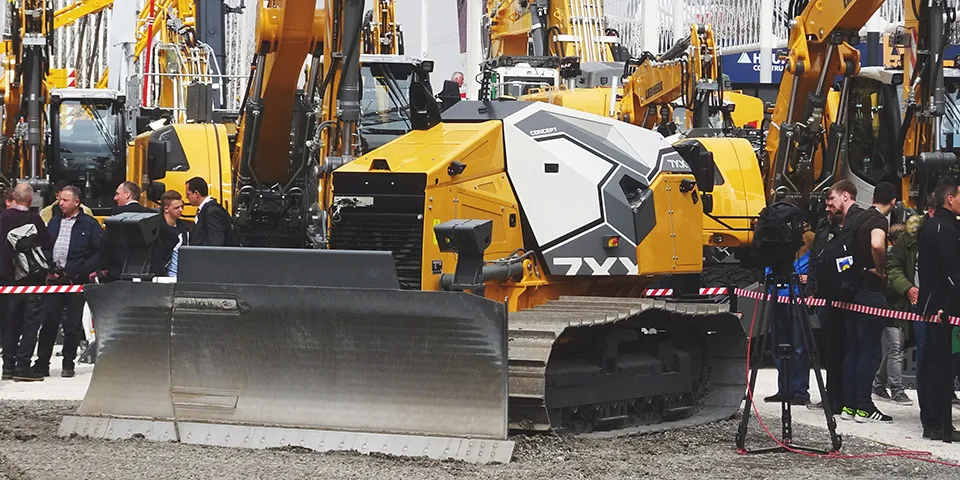
Liebherr’s Dozer 7XX is a concept machine demonstrating INTUSI, the INTeractive User Interface.
Operating from a considerable distance
Doosan also demonstrated remote operation of a machine, using its TeleOperation system. This really was from a considerable distance, as the machine was in South Korea. The machine responded as expected, with a slight delay, despite the use of a modern 5G connection that is ten times faster than today’s 4G. A few years ago, it was Caterpillar that pulled off a similar stunt with a bulldozer. The operator was at the Conexpo construction equipment trade fair in Las Vegas, while the machine was driving several thousand kilometres away at Caterpillar’s then headquarters in Peoria, near Chicago.
Bulldozer without a cab
It looks contrived, and it is: Liebherr’s Dozer 7XX is still a genuine concept machine. It was on Liebherr’s immense stand to showcase INTUSI, the INTeractive User Interface. This intuitive control concept is set to transform communication between people and machines, and between machines themselves. In this respect, Liebherr is on the same track as Komatsu. Safe, autonomous operation is getting ever closer.
For Volvo CE, communication is an important guiding principle for the future use of machinery. For now, the main goals are safety and less downtime.
Time to look at machinery
From the cabless bulldozer and Bobcat’s debut, the 1-tonne electric E10e mini excavator, to Hitachi’s almost 260-tonne EX2600-7 mining excavator, there was something for everyone to enjoy in the outdoor area. We still love looking at machinery, after all. And there was certainly plenty to see. bauma 2019 was bigger than ever. More than 3,700 exhibitors representing over 60 countries occupied the vast 614,000 m² site at Messe München. Around 600,000 visitors came to admire all the attractions over the course of seven days.
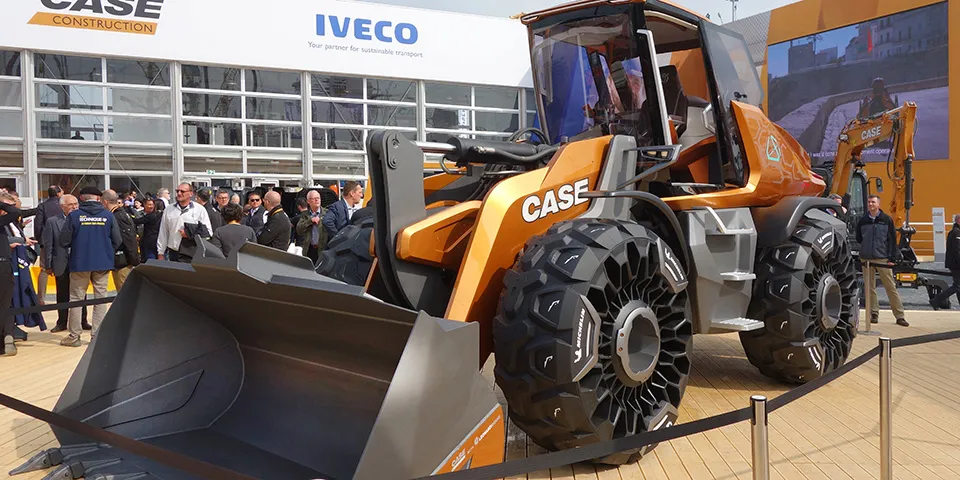
Not exactly a beauty, this biogas-powered Case wheel loader prototype offers a glimpse of the future.
Going electric
A major trend over the past year has been the tentative shift from diesel to electric power. Several brands displayed prototypes or fully operational models of mini excavators at bauma. These included the Bobcat E10e, Eurocomach 12X, Hitachi ZE19 and ZE85, Giant G2220E X-tra, Wacker Neuson EZ17e and EZ26e, Schäffer 24e, Kobelco 17SR Concept and Takeuchi TB220e. And we are sure to have missed a few. Some brands are even venturing into the heavier segment. Examples include the previously unveiled Mecalac e12 and bauma’s surprise, the 7.7-tonne Hicon 7W from Turkish manufacturer Hidromek, nicknamed the Electric Urban Excavator. One thing is clear: bans on diesel will increasingly affect work in cities. Fully electric construction equipment, along with refuse trucks, vans, buses, truck mixers, mobile cranes… will become the rule rather than the exception in built-up areas. The Hicon 7W can work for eight hours on its 71.4 kWh lithium-ion battery and takes just over 3 hours to charge from a 380-volt supply, or 1.5 hours with a fast charger. Otherwise, it is a conventional excavator, with the specifications normally expected in its class.
The 7.7-tonne Hicon 7W from Turkish manufacturer Hidromek talks to the crowd. It is nicknamed the ‘Electric Urban Excavator’.
Autonomous and electric
Volvo Construction Equipment is working hard on both autonomous construction equipment and electric power. bauma featured examples of both. From the middle of next year, Volvo plans to bring only electric compact excavators (EC15, EC27) and wheel loaders (L20, L28) to market. Under the ‘Building tomorrow’ banner, the ECR25 and L25 were already on display at bauma. They are fitted with the familiar lithium-ion batteries and should be able to operate for around eight hours. Autonomy is represented by Volvo’s research into the ‘emission-free construction site’, with a strong focus on the autonomous HX02 hauler and LX01 wheel loader, both of which were on display as prototypes at bauma.
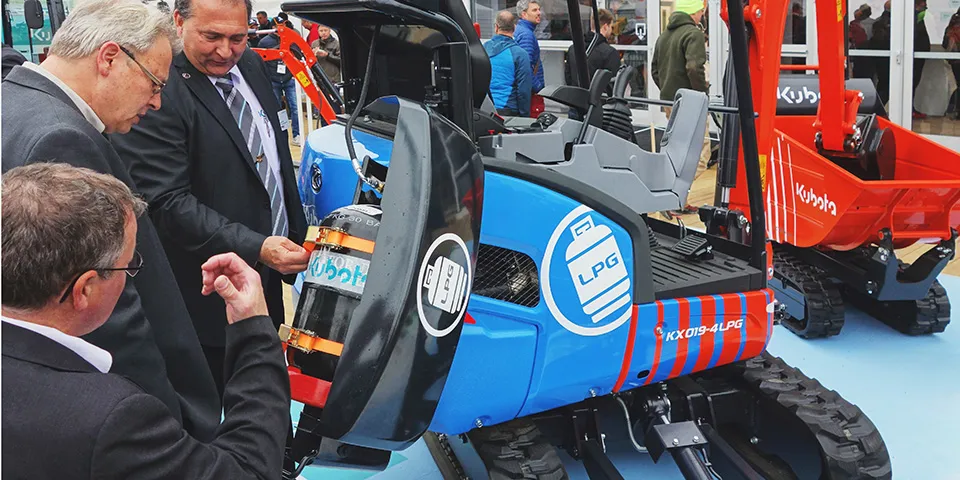
This Kubota mini excavator also runs on gas, as the gas cylinder shows.
Volvo CE is also strongly focused on connectivity. It is called ActiveCare, and the goal is simple: optimal uptime. ActiveCare was officially launched at bauma as an intelligent telematics service. In plain terms, it helps machine users and fleet managers navigate the overwhelming amount of machine data they now have to deal with. This is done through weekly and machine health reports.
Kobelco calls its remote operation system K-Dive. It allows the operator to be somewhere else entirely, even thousands of kilometres away.
Not exactly a beauty
It is well-intentioned, but certainly not the best-looking machine at bauma. Project Tetra is a futuristic wheel loader powered by biogas. Biomethane is a climate-neutral fuel, produced mainly from waste products such as manure, organic waste and sewage sludge. Case can therefore rightly claim a first, as biogas powertrains have so far only been seen in vehicles such as refuse trucks. The North American manufacturer says the engine, modified by sister company FPT, can deliver up to 170 kW (230 hp). That should be as much power as a comparable diesel engine, such as the one found in the Case 821G wheel loader. The results are impressive: 90 % less NOx emissions, 99 % fewer particulates, 80 % lower total emissions and 50 % less driving noise. It is a shame the machine itself looks a little too contrived. In that respect, it would fit right into a Superman film.
Kubota’s KX019-4LPG mini excavator prototype also runs on gas. There is no need to refuel at a filling station, as you simply replace a standard gas cylinder, just as you might at a campsite. Kubota also displayed an electric mini dumper at its stand, the KC70H-4E.
‘Connect with Hitachi’.
Valuable things need to be stored safely, like Bobcat’s new electric mini excavator.
Question about this story? Ask your question
Companies in this story

Keep following this
Get an email when a new story is published. No account needed.
- SubjectGeneral
- Companyengcon
- CompanyWacker Neuson







