









#2 Podcast: In conversation with Dries Van Haut, Chair of SIGMA
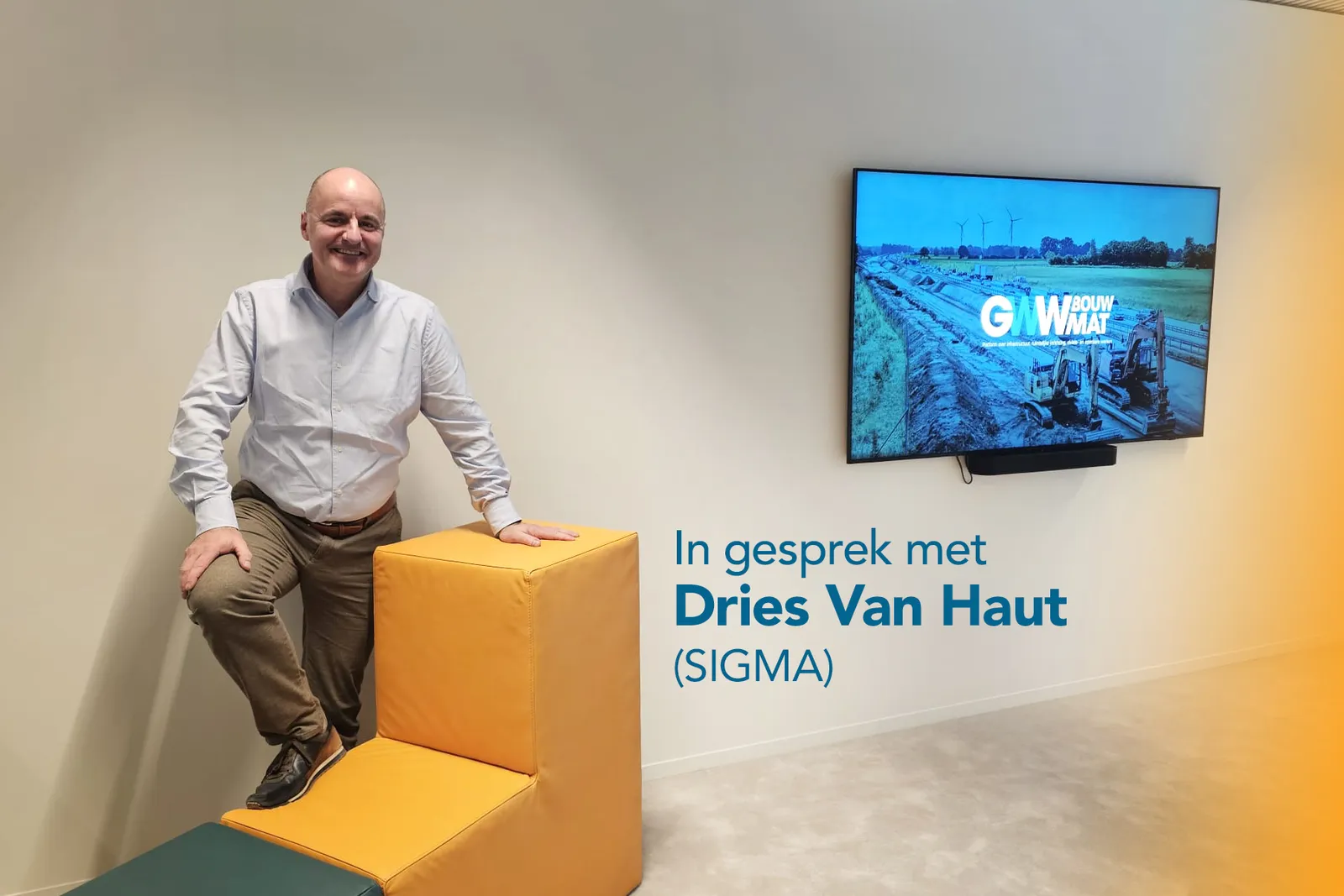
How is our sector evolving, and how are we preparing today for tomorrow? In this podcast, we talk to key figures from the sector who not only make sense of current developments, but also dare to look ahead. People at the heart of the industry who help shape technology, regulation, safety and professionalisation. Our guest today is none other than Dries Van Haut, Chair of SIGMA, the Belgian trade association for importers, distributors and manufacturers of construction and earthmoving machinery, civil engineering machinery, materials handling equipment and industrial vehicles.
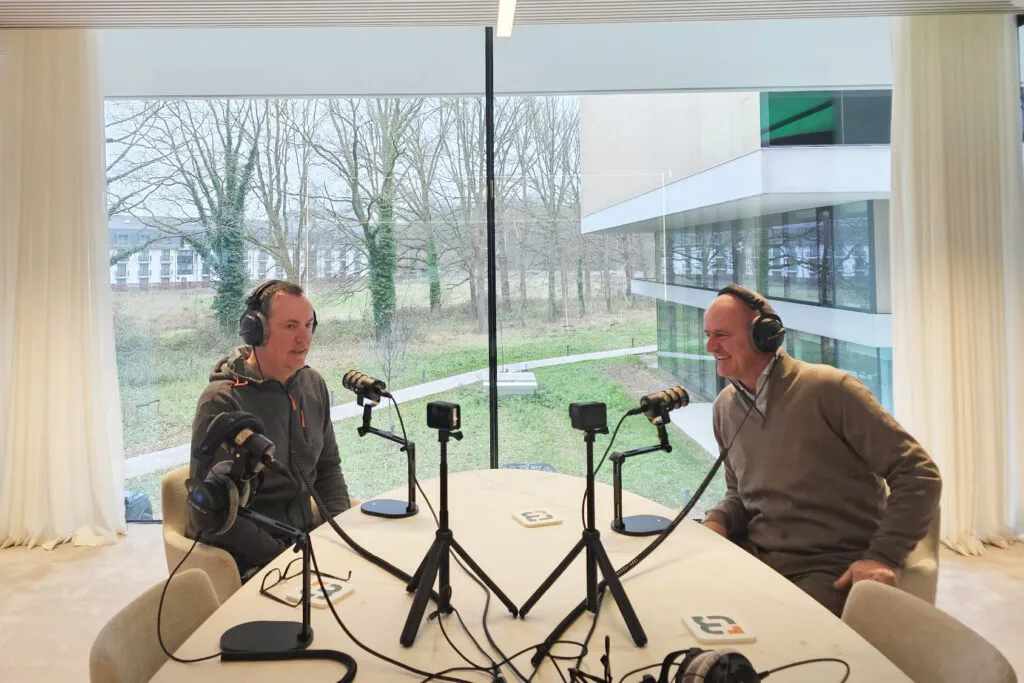
Together with Dries, we take an in-depth look at the sector. Where does it stand today, amid economic uncertainty, tighter regulation and a growing labour shortage? Which technological and sustainability trends are emerging towards 2026 and beyond? And what role can and should a federation such as SIGMA play?
Full transcript
Alle hoofdstukken (45)
- Podcast introduction
- Guest’s response
- Introducing SIGMA
- How SIGMA operates
- Personal motivation as Chair
- Commitment and collaboration
- Economic report and market figures
- Explaining the falling figures
- Temporary or structural?
- A nuanced view
- Geopolitical uncertainty
- Impact on businesses
- The war for talent
- Shortage of technical staff
- Technology and transition as a response to labour shortages
- The state of automation and telematics
- Challenges around operating range
- High cost of electric machines
- SIGMA’s role in subsidies
- Sharing knowledge and external communications
- Predictive maintenance
- Using data and telematics
- More data driving faster adoption
- The rise of AI
- AI as a necessity
- Reflections on technological change
- Shift towards after-sales
- Changing market dynamics
- Growth of SIGMACERT
- Explaining SIGMACERT
- Objective inspections and growth
- Starting the quick-fire round
- Electric or hydrogen
- Machinery Regulation
- Uptime as a KPI
- Belgium as a pioneer or follower
- Looking ahead to 2026
- A cautious recovery
- Key trends towards 2026
- SIGMA's role in the future
- Working with other federations
- A message for policymakers
- Administrative simplification
- Closing quote
- Closing the podcast
Introduction, SIGMA and the economic context
Speaker: Dries Van Haut (Chair of SIGMA)
Host: Kris Vandekerckhove
Podcast introduction
Kris Vandekerckhove Welcome to the Bouwmat Podcast, the platform for professionals in the construction and materials sectors. Kris Vandekerckhove: How is our sector evolving, and how are we preparing today for tomorrow? In this podcast, we talk to key figures from the sector who not only make sense of current developments, but also dare to look ahead.
Kris Vandekerckhove People at the heart of the industry who help shape technology, regulation, safety and professionalisation. Our guest today is none other than Dries Van Haut, Chair of SIGMA, the Belgian trade association for importers, distributors and manufacturers of construction and earthmoving machinery, civil engineering machinery, materials handling equipment and industrial vehicles.
Kris Vandekerckhove SIGMA plays a crucial role in the sector: representing it to the government and policymakers, safeguarding safety and quality through initiatives including SIGMACERT, and acting as a knowledge centre for regulation, certification and technological innovation.
Kris Vandekerckhove Today, together with Dries, we take an in-depth look at the sector. Where does it stand today, amid economic uncertainty, tighter regulation and a growing labour shortage? Which technological and sustainability trends are emerging towards 2026 and beyond? And what role can and should a federation such as SIGMA play?
Kris Vandekerckhove A long introduction, but nevertheless, Dries, welcome.
Guest’s response
Dries Van Haut I have to say, it’s a great honour to be the first guest on the podcast. Thank you for that.
Introducing SIGMA
Kris Vandekerckhove The honour is all ours, Dries. Is there anything you’d like to add for anyone unfamiliar with SIGMA, which seems very unlikely, but still?
Read the full transcriptCollapse transcriptnog 42 hoofdstukken
How SIGMA operates
Dries Van Haut You’ve already covered it very comprehensively. We are indeed a federation of forklift truck and construction machinery importers, and in that respect a traditional trade association. We do the things most trade associations do.
Dries Van Haut That means providing information on technical, legal and social matters. We also represent our members’ interests. For example, we are currently involved in social negotiations with the social partners on the collective labour agreement.
Dries Van Haut And, of course, it’s also a place where we get to know our colleagues and network.
Personal motivation as Chair
Kris Vandekerckhove You’ve been Chair of SIGMA for years and were recently re-elected. What personally motivated you to take on this role?
Commitment and collaboration
Dries Van Haut It’s probably just in my nature. I’ve always been someone who readily takes on commitments and responsibilities in several associations.
Dries Van Haut When you see that small and large companies often face the same issues and problems, it’s a bit absurd to tackle them all separately. It makes much more sense to work together.
Economic report and market figures
Kris Vandekerckhove In short, you’re a people person. You say it, and I won’t argue. SIGMA publishes an economic report twice a year, and we’re seeing some striking declines. Is there any sign of improvement?
Explaining the falling figures
Dries Van Haut First of all, there are several reasons for those declines. We’re coming out of a period in which one record after another was broken. In 2021, 2022 and 2023, the sky was the limit.
Dries Van Haut So it’s only natural that, at some point, things turn and the figures fall. The general economic situation means people aren’t investing on a large scale at the moment.
Dries Van Haut We’re also seeing new players enter the market, which means the pie is being shared among more people and the figures are falling as a result. Not all these new players are members of our association.
Dries Van Haut A fourth factor is the geopolitical situation, which is causing a great deal of uncertainty and caution.
Temporary or structural?
Kris Vandekerckhove Do you see this as a temporary correction or a structural shift?
A nuanced view
Dries Van Haut Some factors are temporary, such as the fact that we’re coming out of a record period and the current economic situation. But the arrival of new players is more of a structural change.
Geopolitical uncertainty
Kris Vandekerckhove You often talk about geopolitical turbulence. How concretely are you feeling its effects?
Impact on businesses
Dries Van Haut Businesses are more cautious. People aren’t sure what’s coming their way or how the economic situation will develop.
Dries Van Haut Things such as import tariffs and international tensions have a direct impact on our products. Our customers’ customers are also more cautious.
Dries Van Haut There is unease and caution throughout the value chain, so people are marking time.
The war for talent
Kris Vandekerckhove On top of that, there’s the war for talent. Is the shortage still that acute, and where exactly?
Shortage of technical staff
Dries Van Haut It’s getting worse, and we don’t think it’s going to improve. The problem is particularly serious when it comes to technical staff.
Dries Van Haut Both mechanics and office staff handling technical files are hard to find. Customers have fewer technical staff of their own, so they rely on us more.
Dries Van Haut That only makes the problem worse. On top of that, younger people have a different attitude to work-life balance and work fewer hours than the older generation.
Technology, electrification, AI and after-sales
Technology and transition as a response to labour shortages
Kris Vandekerckhove Indeed, we’re seeing that here too. That leads us neatly to the next part of this podcast: technology and transition, which might help to address some of the war for talent.
Kris Vandekerckhove We’re right in the middle of what is almost a revolution, a period of technological transition. Where do you see the biggest breakthrough? Will it be electrification, automation or telematics?
The state of automation and telematics
Dries Van Haut Automation and telematics are already quite advanced in our industry. It’s hard to think of a larger machine that doesn’t have telematics.
Dries Van Haut But the biggest shift is definitely coming in construction machinery. Not forklifts, but construction machinery. For that sector, the focus today is primarily on electrification.
Dries Van Haut We’re still right at the beginning of that story. It’s a topic that comes up in every investment discussion.
Challenges around operating range
Dries Van Haut The biggest challenge is getting machines that can run for a full working day.
Dries Van Haut That’s already possible with certain types of machines that need to move less, such as cranes. With other machines that are constantly moving, such as excavators, they’re still struggling to achieve a full working day on one battery charge or with a smooth battery swap.
High cost of electric machines
Kris Vandekerckhove Apart from operating range, these machines are still quite expensive.
SIGMA’s role in subsidies
Dries Van Haut Businesses need to move in this direction. The question is how SIGMA can help lower the barriers.
Dries Van Haut One thing we’ve achieved in the past is getting an electric construction machine or red site vehicle weighing at least five tonnes included on VLAIO’s exhaustive technology list.
Dries Van Haut This means customers can receive 20 or 25 per cent eco-support. It helps, but it remains limited, because an electric machine often costs 50 to 100 per cent more than a conventional diesel machine.
Sharing knowledge and external communications
Kris Vandekerckhove So you help members with the information they need to access subsidies?
Dries Van Haut Absolutely. For example, we also took part in information days organised by M-Build and Bera, where SIGMA helped inform the sector about what is and isn’t possible yet. We do this both internally and externally.
Predictive maintenance
Kris Vandekerckhove Another term we hear a lot is predictive maintenance. It seems to be the next step in many sectors. How far along are we with it in Belgium?
Using data and telematics
Dries Van Haut Better information from telematics makes preventive maintenance possible. Remote diagnostics are perfectly feasible.
Dries Van Haut It’s mainly the larger players who are already well advanced in this area. I’m not as familiar with it myself, but from what I hear from colleagues, there are already plenty of programmes available.
Dries Van Haut I remember an example involving Enbeeld and fuel consumption, but that data is also used for preventive maintenance. It’s nothing new, really.
More data driving faster adoption
Dries Van Haut With more data available, it becomes easier to apply it correctly and more proactively. A slight digression, sorry about that.
The rise of AI
Kris Vandekerckhove No problem. What about the adoption of AI? That’s obviously the next big step.
AI as a necessity
Dries Van Haut If you’re not using AI yet, you’re already behind. Things are moving incredibly fast.
Dries Van Haut One thing many people do, and we do too, is use AI to analyse technical problems.
Dries Van Haut A customer comes in with a problem with a machine, and AI searches the company’s own data to find out how the problem was solved last time. That way, you don’t have to reinvent the wheel every time.
Reflections on technological change
Kris Vandekerckhove These are exciting times, Dries?
Dries Van Haut Absolutely.
Shift towards after-sales
Kris Vandekerckhove We’re seeing a striking shift. Sales of new machines are falling, while after-sales is growing. What does that tell us about the market?
Changing market dynamics
Dries Van Haut In our economic reports, we write that the balance is shifting. That doesn’t necessarily mean sales of new machines are falling, but after-sales is becoming more important.
Dries Van Haut Customers have fewer technical staff and rely on us more. That’s a factor.
Dries Van Haut It’s also typical of a period when people invest less and keep their machines for longer.
Dries Van Haut As a result, machines are used for two years longer than planned, which brings additional costs. Aftersales is becoming more important, but I do not see any spectacular change in the short term.
Growth of SIGMACERT
Kris Vandekerckhove SIGMACERT is growing year on year. What explains the increasing demand for uniformity and safety? Is this being driven by the government or by you?
Explaining SIGMACERT
Dries Van Haut SIGMACERT is mainly focused on forklift trucks, because there was no structured inspection system in place in the market. We have tried to address that with a structured approach.
Dries Van Haut This is less of an issue with construction machinery, because it is often used as lifting equipment and is already subject to the standard quarterly inspection.
Dries Van Haut With forklift trucks, the advantage is that the person carrying out the maintenance also performs the inspection at the same time. This avoids two or three separate visits.
Objective inspections and growth
Dries Van Haut This is ensured by inspection systems and spot checks, so that everything is carried out objectively.
Dries Van Haut Growth within SIGMACERT is steady and normal. Older machines need to be inspected again, and new ones are added. This gives us annual growth, without any spectacular breakthrough.
Quick-fire round, vision for the future and closing
Starting the quick-fire round
Kris Vandekerckhove All right, Dries, as the penultimate part of this podcast, we are moving on to the quick-fire round. Here we go.
Dries Van Haut Bring it on.
Kris Vandekerckhove There are five very short questions, and we are expecting short answers too.
Dries Van Haut Go right ahead.
Electric or hydrogen
Other speaker: Electric or hydrogen?
Dries Van Haut It depends on the type of machine, and above all on its power output. Electric power will certainly take off for lower power outputs, and it is already doing so.
Dries Van Haut For the really high power outputs, I am convinced that hydrogen will be necessary, simply because there is no prospect of solving that with batteries. A number of companies are already working on hydrogen-powered machines, too.
Machinery Regulation
Kris Vandekerckhove Machinery Regulation, blessing or burden?
Dries Van Haut Definitely a blessing. The European Machinery Regulation creates a level playing field, with everyone starting on an equal footing.
Dries Van Haut It ensures fair competition, and we at SIGMA also help ensure that only machines complying with CE regulations are placed on the market.
Uptime as a KPI
Kris Vandekerckhove Uptime seems to be increasingly becoming the key KPI.
Dries Van Haut Can I give a very short answer? Yes.
Kris Vandekerckhove All right.
Belgium as a pioneer or follower
Dries Van Haut Is Belgium a pioneer or a follower? I think that, in most cases, we are followers. Look at electrification: the Netherlands is clearly a pioneer there.
Dries Van Haut Though we should say that Belgium is ahead of neighbouring countries such as Germany and France in a number of areas. Electrification is one example.
Dries Van Haut We also have the CO2 Performance Ladder, linked to discounts in tenders. It was planned for early 2025, has already been postponed several times, but it is being discussed extensively.
Dries Van Haut That topic is much less prominent in Germany and France.
Looking ahead to 2026
Kris Vandekerckhove Last question in the quick-fire round. Will 2026 be a bumper year or a transitional year?
Dries Van Haut I am afraid it will be a transitional year. We have had a few bumper years, so that is not surprising.
A cautious recovery
Kris Vandekerckhove If it is a transitional year, can we talk about a cautious recovery in 2026?
Dries Van Haut At SIGMA, we have always thought that the figures would start to rise around September–October.
Dries Van Haut We also look at the National Bank's business confidence indicator, and have recently seen a slight flattening there.
Dries Van Haut Let's hope that is temporary and that there will be a recovery after the winter, in January or February. We are not expecting a spectacular increase, but we do expect a recovery.
Key trends towards 2026
Kris Vandekerckhove What do you think are the three biggest trends that will shape the sector towards 2026 and beyond?
Dries Van Haut First and foremost, electrification, which will continue to gain ground. I also think there will be technical and technological advances to help it take off.
Dries Van Haut AI is another important factor. Our IT supplier once said that six months is an eternity in AI.
Dries Van Haut As a third point, I would mention the geopolitical situation. If the war in Ukraine were to be resolved, the whole picture would look completely different.
SIGMA's role in the future
Kris Vandekerckhove What role do you see for SIGMA in the future?
Dries Van Haut We are always trying to adapt so that we remain interesting and relevant. Traditionally, when things are not going so well, people have a greater need for a federation.
Dries Van Haut During the covid period, we suddenly saw much greater demand for accurate information and advocacy.
Dries Van Haut Today, information is easier to find through Google or AI, so we are placing greater emphasis on advocacy, networking and the personal touch.
Working with other federations
Kris Vandekerckhove The personal touch should never be missing.
Dries Van Haut It may also be worth mentioning that we are working more closely with two other federations.
Dries Van Haut On the one hand, Fedagrim, the federation of importers and distributors of agricultural machinery, with which we have a clear overlap.
Dries Van Haut On the other hand, Bera, from the rental sector. The three federations jointly organise a New Year's event.
A message for policymakers
Kris Vandekerckhove One final question. If you could give policymakers one message, what would it be?
Dries Van Haut Make sure that for every new law or regulation, at least two outdated ones are repealed.
Dries Van Haut Businesses are being swamped with paperwork, making everything unnecessarily expensive.
Dries Van Haut Today, we have to put far more staff into back-office and administrative work. There is still a long way to go.
Administrative simplification
Kris Vandekerckhove So, administrative simplification.
Dries Van Haut Absolutely.
Closing quote
Kris Vandekerckhove You like to finish with a quote.
Dries Van Haut I will use my favourite quote from Winston Churchill. Success is the ability to go from one failure to another without losing enthusiasm.
Closing the podcast
Kris Vandekerckhove We think so too here at Louwers Mediagroep. Fantastic. Dries, it has been a great conversation, and as the first podcast for GWW, the next guests will have big shoes to fill. Thank you.
Dries Van Haut Thank you. I was pleased to be the first to appear here on behalf of SIGMA.
Kris Vandekerckhove Thank you, Dries.
Dries Van Haut Thank you.
Companies in this story
Keep following this
Get an email when a new story is published. No account needed.
- SubjectGeneral
- CompanyVan Haut







