Safe, manoeuvrable and very easy-to-use push-off system
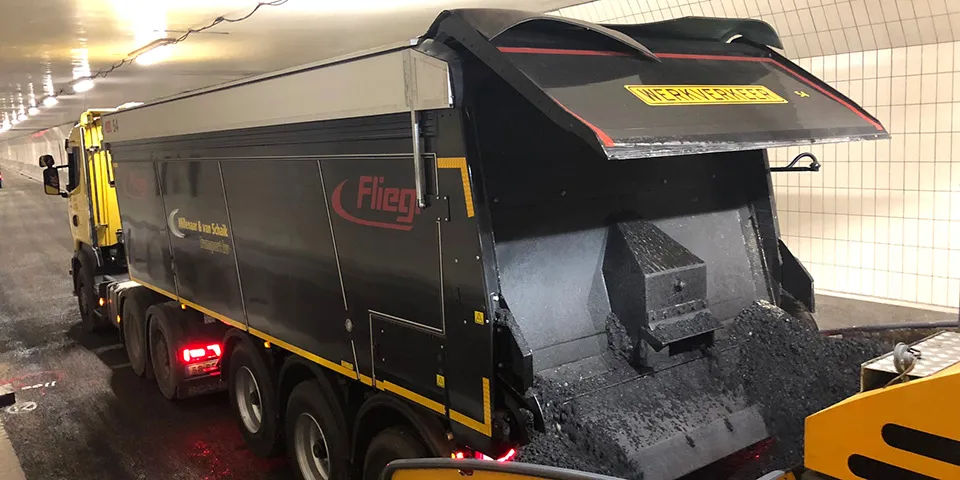
The Fliegl push-off system has been built since 2008 to transport road construction materials such as sand, gravel, soil, (fat) clay and (crushed) rubble… The system was first unveiled 21 years ago and, in its early years, was built mainly as a soil tipper and extensively tested in extreme off-road operations. In 2012, the first Fliegl push-off systems were adapted for asphalt, resulting in a further-developed product with a strong focus on practical use.
In recent years, FLiegl has conducted research, in collaboration with, among others, the technical universities of Vienna and Darmstadt, into the effect of the Fliegl push-off system on asphalt segregation. The research results show that conventional tipping causes both thermal and mechanical segregation. This means that the discharged material does not enter the paver homogeneously, resulting in very poor areas in the newly laid road surface.
Homogeneous material
The following conclusion was drawn from this research: the segregation of bitumen and temperature variation during transport are greatly reduced by using the Fliegl push-off system. The system feeds all the layers of asphalt in the body, large and small bitumen particles, hot and cooler material, into the paver at the same time. This makes the discharged material much more homogeneous, resulting in a much longer asphalt service life. This saves the client a great deal of maintenance during the warranty period, while also enabling highly sustainable operations in collaboration with the haulier.
Safety above all
“Safe, manoeuvrable and very easy to maintain”, is how Fliegl drivers sum up the advantages of the push-off system. Safety comes first. There is no risk of tipping over during unloading, and unloading can be carried out safely in tunnels and buildings, or beneath traffic lights, flyovers and trees. Because the body is always clean after unloading, even with, for example, ZOA, OPA, SURF asphalt and very sticky clay, downtime is reduced. As unloading takes place horizontally, all road construction materials can also be transported.
Question about this story? Ask your question
Keep following this
Get an email when a new story is published. No account needed.
- ThemeEarthmoving and road construction in practice
- SubjectEarthmoving